

17.06.2025
QKS Review
QKS Review: Navigating the Smart Building Landscape: A Comparative Lens on Space Monitoring Tools
Author:
Divya Prakash


Executive Summary:
As the smart building and facility management market faces rising pressure from the demand for operational efficiency, sustainability, and data-driven decision-making, organizations are moving beyond traditional space management tools.
This review blog by QKS Group evaluates whether key players in space monitoring Planon, Spacewell, and Spica Technologies are truly innovating to meet these evolving demands or simply making incremental updates to their existing solutions.
What Modern Space Monitoring Solutions Should Deliver:
Today’s platforms must go beyond basic space utilization tracking. Critical next-gen capabilities include:
- Real-time occupancy monitoring for dynamic space management.
- Seamless integration with IoT and AI-driven energy optimization to enhance sustainability and reduce operational costs.
- User-centric interfaces and flexible configurations to ensure ease of use and scalability across organizations.
Key Findings:
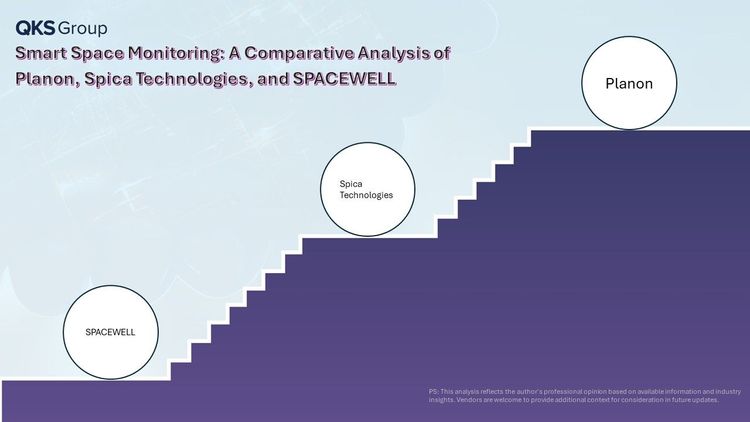
- Leading vendors like Planon stand out with comprehensive, integrated solutions that offer real-time insights, advanced IoT capabilities, and a strong focus on space optimization, making it ideal for long-term scalability.
- Capable vendors such as Spica Technologies show strength in real-time space utilization and energy efficiency, supported by advanced analytics and AI integration, particularly appealing to sustainability-driven organizations.
- Lagging vendors like Spacewell face challenges with user adoption, implementation complexity, and limited flexibility, which may hinder its relevance compared to more refined, intuitive alternatives.
Introduction to Space Monitoring
How we define - Space monitoring in the context of smart buildings refers to the use of technology to track and analyze how physical spaces, such as offices and meeting rooms, are utilized. This includes monitoring occupancy, energy consumption, and space efficiency, which are critical for organizations aiming to optimize operations, reduce costs, and enhance employee experience. The importance of space monitoring has grown, especially with the rise of hybrid work models and sustainability goals, as organizations seek data-driven insights to make informed decisions about space allocation.
In the evolving landscape of smart building technologies, effective space utilization analytics have become paramount for organizations aiming to optimize their real estate investments and enhance workplace efficiency. Among the prominent players in this domain are Planon, Spacewell, and Spica Technologies. A comparative analysis reveals that Planon distinguishes itself with superior integration and user-centric solutions, while Spacewell and Spica Technologies exhibit notable limitations.
Planon: Leading with Integrated IoT Solutions
Planon's Integrated Workplace Management System (IWMS) seamlessly incorporates IoT capabilities to deliver real-time insights into space utilization. A compelling example of its effectiveness can be seen in its implementation at Waterschap Zuiderzeeland, a Dutch water utility organization, where Planon's IoT platform significantly improved meeting room occupancy and streamlined the booking process. By deploying Passive Infrared (PIR) sensors in meeting rooms, the system could detect real-time occupancy and automatically release unused spaces, thereby maximizing space efficiency. This real-world application highlights Planon's commitment to driving tangible outcomes through advanced technology.
The platform offers a comprehensive IWMS that spans space management, real estate management, maintenance management, and more. Key features include workplace engagement applications, access management, meeting and hospitality services, interactive kiosks and room booking panels, sensor integration, service contract management, financial chargebacks, move and change management, and CAD (Computer-Aided Design) & BIM (Building Information Modeling) integration. Together, these capabilities provide a robust, end-to-end solution for complete building management.
Spica Technologies: Real-Time Insights and Smart Energy Synergy
Spica Technologies follows closely with a strong emphasis on real-time space utilization and a robust approach to energy efficiency. At the core is its GemEx Engine®, which enables live tracking of occupancy and space usage, empowering workplace and facility teams with dynamic insights for daily operations. This is further enhanced through smart cleaning workflows and automated alerts, supporting responsive facility management.
Spica also distinguishes itself with advanced people-counting and indoor positioning capabilities. Through partnerships with PointGrab and Pointr, Spica brings together precision analytics and indoor navigation. PointGrab’s edge-processing devices provide accurate occupant counts even in open-plan areas, while Pointr’s IPS sensors enable seamless wayfinding and geo-location services critical for modern agile workplaces.
What further elevates Spica’s position is its iBOS energy® platform, which applies AI to optimize HVAC systems based on the unique thermal behavior of buildings. This not only drives measurable reductions in energy waste and CO2 emissions but also contributes directly to lowering operational costs adding an environmental edge to space optimization.
Spacewell: Conceptual Ambition, Operational Constraints
Spacewell offers an ambitious platform combining workplace analytics, facility management, and IoT under the Spacewell Workplace brand, achieved through the integration of Axxerion IWMS and Cobundu IoT. While the concept of a unified SaaS ecosystem is strategically sound, the execution reveals some important limitations.
User feedback often points to a steep learning curve and configuration complexity, which can deter adoption, particularly for teams without specialized technical support. The platform’s extensive range of features may feel overwhelming rather than empowering if not properly implemented.
Flexibility is another concern. Spacewell does not offer a free trial or free version, and its subscription-based pricing model with a mandatory minimum commitment can be a barrier for smaller organizations or those seeking to explore solutions more incrementally.
Additionally, while Spacewell is active in the commercial and institutional real estate sectors, its relevance in the corporate real estate domain appears limited. Enterprises seeking tailored solutions for corporate portfolios may find the platform’s scope less aligned with their expectations. Although Spacewell’s Space Monitor tool provides sensor-based occupancy insights, the overall experience may fall short in terms of seamless usability and organizational fit especially when compared to competitors offering more intuitive and modular solutions.
Conclusion: A Clear Hierarchy in Smart Space Monitoring
Planon emerges as the top performer, offering a fully integrated IWMS with deep capabilities for real-time space optimization, strategic planning, and long-term scalability. Spica Technologies follows closely, demonstrating strength in real-time insights, energy-aware operations, and integration flexibility making it a highly compelling alternative, especially for agile and sustainability-focused workplaces.
Spacewell, despite its feature-rich approach, faces real challenges in usability, pricing flexibility, and corporate market alignment. While its ambition is evident, organizations must weigh its operational complexity and limited adaptability against more refined and focused alternatives.
Disclaimer:
This blog is based on independent research and publicly available information. The insights presented reflect the views of QKS Group and are for informational purposes only. While we strive for accuracy, we do not guarantee completeness or absolute correctness. Vendors are welcome to provide clarifications or updates. If any vendor listed in this analysis wishes to provide additional context or clarification, we welcome a briefing call and will consider incorporating relevant updates. This analysis is not intended to disparage any vendor but to provide an informed, balanced perspective. We encourage open and constructive dialogue to foster transparency and a deeper understanding of the industry.
Author: Divya Prakash, Analyst - Internet of Things (IoT) at QKS Group
Vendors: