

29.07.2025
QKS Review
QKS Review: Modular, Monolithic, or Hybrid: Decoding CWM Platforms Through Functional Design
Author:
Ashray Gadekar


Executive Summary:
As the Collaborative Work Management (CWM) market faces rising pressure from hybrid workforce demands, integration complexity, and real-time coordination needs, organizations are moving beyond traditional project tracking and task management tools.
This review blog by QKS Group assesses whether CWM platform vendors are truly innovating to meet these demands or merely making incremental updates.
What Modern CWM Platforms Should Deliver:
Today’s platforms must offer more than core features. Critical next-gen capabilities include:
- Architecture that aligns with integration depth, governance needs, and user experience
- Scalable collaboration across distributed teams with real-time adaptability
- Support for structured workflows with flexible extensions into specialized domains
Key Findings:
- Atlassian’s modular architecture offers deep workflow customization and broad integration support, ideal for organizations with mature IT and diverse use cases.
- Adobe Workfront’s monolithic design provides robust governance and execution consistency, aligning well with compliance-heavy and content-driven enterprises.
- Asana’s hybrid approach balances usability and extensibility, making it suitable for mid-sized organizations prioritizing quick deployment and structured coordination.
Each model presents a distinct trade-off between control, flexibility, and scalability underscoring the need to align platform selection with organizational structure, digital maturity, and operational goals.
Collaborative Work Management (CWM) platforms have become essential operational infrastructure for current distributed, multi-functional work environments. As organizations shift toward hybrid execution models, cross-functional programs, and real-time alignment, CWM tools offer structured yet flexible environments to coordinate planning, tracking, approvals, and delivery. From digital agencies managing creative cycles to enterprise PMOs overseeing portfolios, CWM platforms are now foundational across business units.
CWM solutions address real-world pain points such as siloed communication, unclear accountability, and lack of execution visibility. In practice, this means enabling marketing, engineering, and operations teams to collaborate on shared timelines, automate recurring workflows, monitor dependencies, and manage feedback loops within a single digital environment. As remote and hybrid work models persist, the importance of centralized coordination and contextual task intelligence only intensifies.
While the functionality of CWM tools has matured significantly, one of the most consequential architectural distinctions remains underexplored: whether a platform is modular or monolithic in its design.
Understanding Modular, Monolithic and Hybrid offerings in CWM Platforms
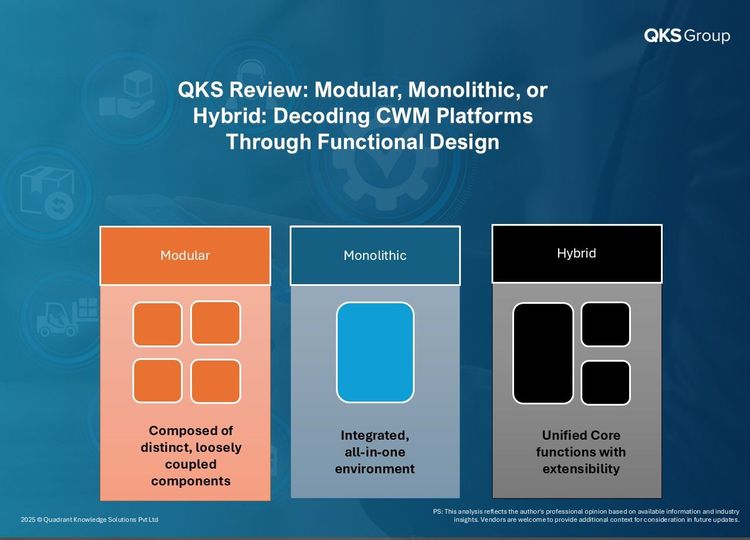
Collaborative Work Management (CWM) vendors generally follow one of two architectural approaches: modular or monolithic, each reflecting different philosophies about flexibility, control, and scale. The choice between them significantly affects how organizations can evolve their collaboration environments over time, especially as team structures diversify and integration needs grow more complex.
Modular platforms are composed of distinct components, each tailored to perform a specific function such as task tracking, document collaboration, time logging, or reporting. These components are loosely coupled and typically communicate through well-defined APIs or integration layers. This architecture offers organizations high adaptability, allowing them to select only the tools they require and scale up over time by plugging in new components or services. It supports best-of-breed strategies where specialized tools can be stitched together to match nuanced workflows. As such, modular systems are highly suited to organizations with varied team structures or those undergoing frequent change.
However, the trade-off is operational complexity. Modular platforms can create a fragmented user experience if integrations are not carefully managed. Different modules might have inconsistent UIs, separate authentication methods, or redundant data silos. Moreover, customizing and managing such systems often requires greater IT involvement and configuration expertise. This can lead to longer onboarding cycles and governance challenges, particularly in decentralized organizations.
Monolithic platforms, in contrast, offer a tightly integrated, all-in-one environment where core collaborative functions are embedded within a single interface and share a common data model. These platforms prioritize consistency and pre-integrated workflows, often including centralized dashboards, unified notification systems, and native process templates. Their design reduces cognitive load for users, simplifies data governance, and supports robust audit trails making them particularly attractive for industries with stringent regulatory or operational compliance requirements.
Yet monolithic platforms also come with limitations. Their one-size-fits-all approach may not accommodate niche use cases or specialized workflows. Customization, while available, tends to be limited to predefined configurations, and integrating external tools can be restrictive. Additionally, such platforms often require more time for implementation and a steeper learning curve when rolling out across large or diverse teams.
Ultimately, the architectural choice reflects a strategic trade-off: modular platforms offer flexibility and specialization, while monolithic platforms deliver uniformity and control. The right choice depends on an organization's operational maturity, governance model, and appetite for customization.
Hybrid Platforms represent a convergence of modular and monolithic architectural models. These platforms are characterized by a unified interface and shared data structure for core functionalities, while also offering extensibility through application programming interfaces (APIs), connectors, and integration layers. This design enables organizations to standardize collaboration workflows internally while maintaining compatibility with external tools and services.
In practice, hybrid architectures address the need for operational consistency and cross-functional alignment, without fully limiting integration options. Core features such as task management, resource planning, and reporting are managed within the native environment, whereas specialized functions such as advanced analytics or domain-specific tools can be connected as needed.
However, hybrid platforms may also introduce limitations. While more adaptable than monolithic systems, they may not support the full range of third-party integrations or deep configuration options available in modular environments. Similarly, governance and compliance frameworks are often dependent on the vendor’s implementation maturity and integration boundaries.
Asana: A Hybrid Platform Prioritizing Clarity and Simplicity
Asana represents a hybrid approach offering an integrated experience while maintaining openness through APIs and third-party connectors. It provides a unified UI, project hierarchy, and features like Portfolios, Goals, and Work Graph AI, allowing teams to align on strategy while executing operational work. Its Work Graph model, which captures relationships between tasks, people, and goals, supports context-aware intelligence and automation.
From a platform design perspective, Asana leans toward monolithic behavior in the UI layer but is modular in integration extensibility. The platform allows quick onboarding and supports structured team-wide coordination without requiring deep technical overhead.
Asana suits organizations seeking centralized execution without complexity. However, governance and compliance features remain lighter than dedicated enterprise systems. Teams scaling across multiple geographies may encounter limitations in customization and reporting depth. It’s ideal for teams looking for a balance between usability and moderate extensibility.
AtlassianTeamwork Collection: Modular Depth for Technical and Functional Teams
Atlassian delivers a modular solution called Teamwork Collection comprising Jira, Confluence, Loom and AI Agents for teamwork, which can be combined with additional collections like the Strategy Collection and others. These apps share a common underpinning and interoperate on the Atlassian Platform, as well as enjoying support by an ecosystem of partners and integrated apps via the Atlassian Marketplace. This design allows different business units to adopt purpose-built tools while maintaining cross-platform alignment through identity management, shared schemas and the Teamwork Graph.
The Atlassian architecture supports extensive AI and workflow capability, delivered through Rovo, Atlassian's AI-powered enterprise search and automation solution and paired with workflow customization, scriptable automations, and integrations for advanced DevOps, collaboration, service management and strategy use cases. Rovo allows users to summarize issue trends and status across projects, answer questions about Atlassian and third-party content, and assist with common collaboration tasks reducing information friction in distributed teams and surfacing bottlenecks proactively.
Atlassian’s modular design offers granular control and more consistent integration and interface than in the past, but successful adoption is enhanced with configuration expertise. Atlassian can support teamwork across the enterprise, including tech and non-tech teams. The offering is best suited for organizations with strong IT support, advanced workflow needs, and a modular mindset toward software architecture.
Adobe Workfront: A Monolithic Suite for Enterprise Execution
Adobe Workfront follows a monolithic design model, emphasizing deeply integrated work orchestration for marketing, creative, and operations teams. It offers capabilities like intake queues, custom workflows, native proofing, and resource planning designed to operate within a centralized interface and data model. Integration with Adobe Experience Manager and Creative Cloud reinforces its role in content-heavy operations, particularly in campaign execution scenarios.
The platform's recent updates including natural-language request forms and a refreshed Planning Workspace (April 2025) further enhance usability while preserving its compliance-focused structure. With support for audit trails, approval cycles, and access control, it aligns well with organizations operating in regulated sectors.
Adobe Workfront provides strong enterprise governance and operational consistency. However, its extensibility is more limited than modular systems, and onboarding requires alignment with IT and change management teams. It is best suited for enterprises prioritizing standardized workflows and operational compliance across departments.
Conclusion:
The selection of a Collaborative Work Management platform is not solely a matter of interface preferences or feature checklists; it is fundamentally tied to the platform’s architectural model. Whether modular, monolithic, or hybrid, each design reflects distinct operational assumptions and carries specific implications for scalability, governance, integration, and user adoption.
Organizations with highly specialized teams, distributed operations, or a need for customizable workflows and toolchain flexibility will benefit most from modular platforms. These environments are best suited for enterprises with strong internal IT capabilities, mature governance frameworks, and the capacity to maintain integrations across multiple systems.
Enterprises operating in regulated industries, or those that prioritize centralized control, process standardization, and compliance readiness, may find greater alignment with monolithic platforms. These platforms streamline governance and data management by consolidating all collaboration processes within a single system.
For organizations seeking a balance between consistency and adaptability, particularly mid-sized to large enterprises undergoing digital transformation, hybrid platforms offer a pragmatic alternative. These solutions provide an integrated user experience with the flexibility to connect external tools as needed.
Ultimately, the architecture of a Collaborative Work Management (CWM) platform should reflect the organization’s operating model, digital maturity, integration needs, and regulatory posture. A well-aligned platform architecture can enable more efficient coordination, clearer accountability, and better scalability factors that are increasingly critical in today’s dynamic work environments.
Disclaimer:
This blog is based on independent research and publicly available information. The insights presented reflect the views of QKS Group and are for informational purposes only. While we strive for accuracy, we do not guarantee completeness or absolute correctness. Vendors are welcome to provide clarifications or updates. If any vendor listed in this analysis wishes to provide additional context or clarification, we welcome a briefing call and will consider incorporating relevant updates. This analysis is not intended to disparage any vendor but to provide an informed, balanced perspective. We encourage open and constructive dialogue to foster transparency and a deeper understanding of the industry.
Author: Ashray Gadekar, Analyst at QKS Group
Vendors: