

19.06.2025
QKS Review
QKS Review: Managing Beauty Product Data – The Missing Link Between Compliance and Conversion
Author:
Dharun R


Executive Summary:
As the beauty retail market faces rising pressure from stringent regulatory compliance, global expansion, and the need for seamless customer experiences, organizations are moving beyond traditional PIM tools that simply centralize data.
This review blog by QKS Group assesses whether Product Information Management (PIM) vendors are truly innovating to bridge the gap between compliance and conversion or merely offering basic content repositories.
What Modern PIM Platforms Should Deliver:
Today’s platforms must offer more than data normalization. Critical next‑gen capabilities include:
- Regulatory compliance workflows with attributes specific to beauty
- Intelligent enrichment and auto‑classification to improve product discovery
- Content conversion optimization across digital and retail channels
Key Findings:
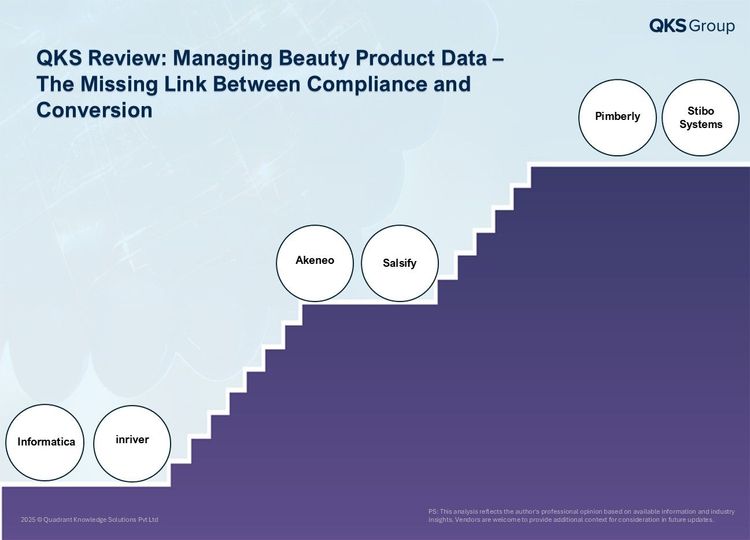
Leading vendors (Stibo Systems, Pimberly) offer domain-rich PIM engines tailored for beauty brands, combining compliance workflows with conversion-focused automation.
Capable vendors (Akeneo, Salsify) support modern UX and categorization enhancements, but lack deep beauty‑specific compliance features.
Lagging vendors (inRiver, Informatica) remain focused on generic data modeling without optimized pathways for compliance‑driven conversion in beauty retail.
In beauty retail, product data is more than just a backend function; it’s the front line of consumer trust and digital experience.
Today’s beauty shoppers expect transparency: ingredients, certifications, sustainability claims, allergens, and more. At the same time, brands and retailers must comply with a perplexity of global regulations such as the EU Cosmetics Regulation, U.S. FDA guidelines, Clean at Sephora standards, and more.
Yet most PIM systems still treat compliance and digital shelf readiness as separate workflows. The result? There are gaps in data, delays in publishing, inconsistencies in channels, and a decrease in conversions.
The real question is, can your PIM keep up with both compliance complexity and digital shelf demands without becoming a bottleneck?
Pimberly and Stibo Systems: Leading the Charge on Beauty PIM
Pimberly stands out as a modern PIM provider, especially in fast-moving categories like beauty. Its strength lies in unifying compliance, digital content, and syndication within a single architecture, turning regulatory obligations into digital assets.
Dynamic workflows support region-specific labeling (EU vs. US vs. APAC) and ingredient disclosures. Its channel-specific enrichment engine enables personalized product storytelling across Amazon, Sephora, and D2C storefronts, critical in a high-touch category like beauty. With no-code flexibility and cloud-native speed, Pimberly gives mid-market beauty brands agility without sacrificing governance.
In a sector where new SKUs launch weekly and sustainability claims shift monthly, agility and accuracy must coexist. Pimberly delivers both and does so without the bloat of legacy PIMs.
Stibo Systems, meanwhile, it brings unmatched enterprise-grade data governance. For global beauty giants navigating strict regulatory regimes and multilingual packaging, Stibo’s lineage tracking, data modelling, and governance controls are mission critical.
It excels at managing multi-domain hierarchies (ingredients, allergens, sustainability attributes) and cross-referencing them to product families. Its integration with ERP, labelling, and regulatory systems ensures consistency from source to shelf.
Stibo is the benchmark for enterprise-scale beauty data management but may feel overbuilt for nimble indie brands unless pre-configured accelerators are used.
Salsify and Akeneo: Bridging Operational Gaps, But Not Fully Aligned
Salsify remains a leading choice for global brands aiming to streamline product content syndication and digital shelf readiness. Its AI-powered Product Experience Management (PXM) platform excels at centralizing product content and accelerating multichannel deployment, a key advantage for beauty brands managing rapid SKU proliferation across retailers and geographies.
However, Salsify places schema control firmly on its own platform, limiting retailers’ ability to make direct changes and potentially introducing delays in high-velocity beauty categories. While the platform offers accelerators like the PXM Grocery Accelerator, it lacks a beauty-specific compliance engine meaning brands must manually manage ingredient disclosures, allergen tags, and evolving regional standards like EU 1223/2009. The absence of automated support for Digital Product Passports (DPPs) further compounds the risk for beauty brands, where regulatory slip-ups can result in delistings, reputational damage, or fines.
Akeneo continues to attract mid-market brands with its user-friendly UX and open-source flexibility. It’s well-suited for centralized enrichment and cross-functional collaboration, but still lacks native support for advanced compliance requirements.
Ingredient traceability, region-specific warnings, and certification mappings are still manual-heavy or require external bolt-ons. For beauty retailers operating in multiple regulatory zones, this becomes a scalability concern.
Akeneo is an excellent enrichment tool but its utility in regulated beauty categories may be limited without significant customization.
Informatica and inriver: Enterprise-Ready, But Not Beauty-Tuned
inriver has struggled to evolve beyond its linear enrichment and syndication roots. In a beauty market defined by rapid assortment rotation and rising ESG scrutiny, static workflows and manual governance simply don’t scale.
Lack of native compliance engines or ingredient-based rule creation severely limits its relevance in categories where consumer trust hinges on transparency. inriver’s UX and modularity improvements have been incremental but not transformational. inriver remains functional for basic PIM needs but beauty brands aiming for global compliance and differentiated shelf presence will find themselves outgrowing it quickly.
Informatica is a notable vendor in enterprise MDM, offering rigorous governance, data lineage, and integration capabilities across multiple domains. However, it is not a dedicated PIM solution especially not one tuned for the beauty category’s unique pace and regulatory requirements.
While some global companies may repurpose Informatica’s MDM for product data governance, it lacks native support for beauty-specific compliance workflows such as INCI disclosures, region-specific labeling, or sustainability tagging. Its setup and configuration demands often make it too heavy for category managers or digital teams who need agility, speed, and intuitive UX.
The Beauty PIM Mandate: From Clean Labels to Conversion Wins
Beauty brands are no longer just selling products, they’re selling transparency, ethics, and experience. PIM must evolve to serve that reality.
- Pimberly enables mid-market brands to move fast, stay compliant, and win on the digital shelf.
- Stibo Systems ensures global consistency and regulatory integrity at scale.
- Salsify delivers channel agility but requires compliance supplementation.
- Akeneo stands out in enrichment but underperforms in regulated complexity.
- inriver and Informatica struggle to meet the category’s evolving pace and precision.
Ask yourself: Is your PIM helping you scale transparency or scrambling to patch it after the fact?
Final Thought: The Shelf is Digital - Your Compliance Should Be Too
In beauty retail, the digital shelf is the first (and often only) storefront. Missed data is missed revenue. Incomplete compliance is a risk waiting to surface. The winners in this space will treat product data not as a backend asset but as a real-time engine of trust, agility, and conversion.
Disclaimer:
This blog is based on independent research and publicly available information. The insights presented reflect the views of QKS Group and are for informational purposes only. While we strive for accuracy, we do not guarantee completeness or absolute correctness. Vendors are welcome to provide clarifications or updates. If any vendor listed in this analysis wishes to provide additional context or clarification, we welcome a briefing call and will consider incorporating relevant updates. This analysis is not intended to disparage any vendor but to provide an informed, balanced perspective. We encourage open and constructive dialogue to foster transparency and a deeper understanding of the industry.
Author: Dharun R, Analyst - Retail Operation Management at QKS Group
Co- Author: Kumar Anand, Associate Director & Principal Industry Analyst at QKS Group
Vendors: