

16.07.2025
QKS Review
QKS Review: Is Your Integration Copilot Built to Think or Just Built to Assist?
Author:
Ipsita Chakrabarty


Executive Summary:
As the Enterprise Integration Platform as a Service (EiPaaS) market faces rising pressure from business-led automation, GenAI expectations, and IT-dependency fatigue, organizations are moving beyond traditional integration tools.
This review blog by QKS Group assesses whether EiPaaS vendors are truly innovating to meet these demands, or merely making incremental updates.
What Modern EiPaaS Platforms Should Deliver:
Today’s platforms must offer more than flow builders and prebuilt connectors. Critical next-gen capabilities include:
- Generative AI copilots that can interpret natural language and create automation logic with context
- Self-service enablement for business teams to reduce dependency on IT for integration and maintenance
- Adaptive assistance that evolves over time and improves based on user interaction and intent
Key Findings:
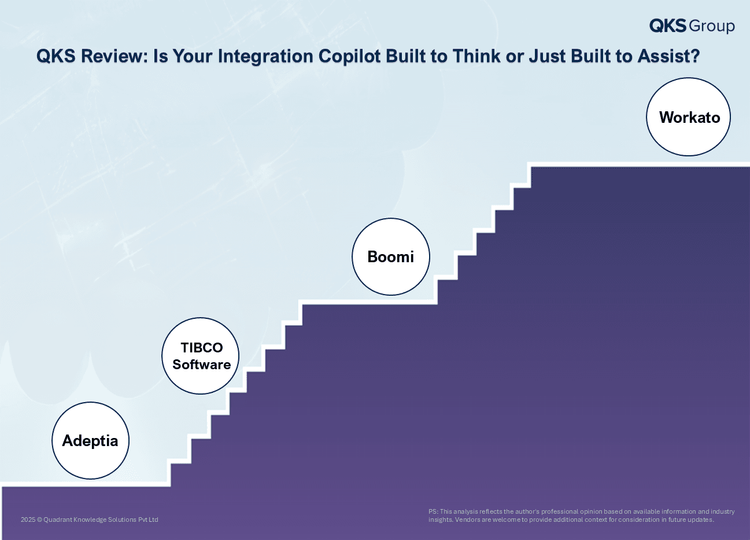
Leading vendors (Workato) stand out with deeply embedded, user-centric copilots that enable business users to build automations independently and intelligently.
Capable vendors (Boomi) show promising AI capabilities in parts of the platform but lack a unified, end-to-end copilot experience.
Lagging vendors (TIBCO Software, Adeptia) remain technical or rules-based, offering limited generative intelligence and failing to meet the expectations of non-technical users seeking intuitive automation.
In this blog, we evaluate how four integration platform providers Workato, Boomi, TIBCO Software, and Adeptia are embedding GenAI copilots into their EiPaaS offerings. Our assessment is grounded in a simple, user-centric question: Who is genuinely enabling business teams to move faster, smarter, and more independently?
The Copilot Confusion
The term "copilot" has become a convenient shorthand for any AI-enabled feature in the enterprise software market. But not all copilots are created equal and many, in fact, don't qualify as copilots at all. A true GenAI copilot should not only support tasks but also intelligently assist with decision-making, automate multi-step workflows, and learn over time to provide increasingly relevant recommendations.
Unfortunately, the market is currently flooded with shallow implementations. Some platforms offer chatbots branded as copilots, others provide static form fillers that barely respond to user intent. This has led to confusion and inflated expectations among business users who are hoping for AI that can truly partner with them in building and maintaining integrations.
For end users, this distinction matters. A genuine copilot means they can launch automations faster, with fewer dependencies on IT, and adapt processes more quickly to business changes. A superficial implementation, on the other hand, creates more frustration than freedom.
Workato: A True Copilot, Not Just a Talking Head
Workato stands out for how deeply it has integrated AI into its core builder experience. The platform allows users to describe a process in simple English, such as "When a contract is signed, update Salesforce and notify the legal team," and automatically generates the underlying logic. It doesn't stop at generation. The Copilot explains each decision, suggests best practices, and adapts based on user behavior over time.
Workato also supports formula generation, data mapping, and recipe documentation through AI. Its tight integration with collaboration tools like Slack and Microsoft Teams ensures that automation workflows are accessible where users already operate. For business teams, this means they can build meaningful automations without waiting on developers.
Analyst Opinion: Workato sets the standard for what a GenAI copilot should be. It combines ease-of-use with depth, giving non-technical users the autonomy to build while still offering the sophistication that enterprise IT demands.
Boomi: Strong Foundation, Still in Transition
Boomi has made visible progress in enhancing its platform with AI, most notably with Boomi GPT and Boomi AI Agents. These tools assist with flow creation, data mapping, and offer logic recommendations. However, their implementation feels fragmented. Depending on where a user is in the platform, AI features may be more or less helpful, and many actions still require manual intervention or IT support.
Boomi benefits from strong metadata governance and a vast connector ecosystem, making it well-positioned for long-term evolution. Still, its GenAI story feels more like a work in progress than a finished product. For end users, this means that while they might find some tasks simplified, the full promise of self-service automation isn't consistently delivered.
Analyst Opinion: Boomi’s intent is clear, and its architectural foundation is solid. But until its AI capabilities are integrated into a cohesive, end-to-end experience, business users will face a steeper learning curve and continued reliance on IT.
TIBCO Software: Powerful Infrastructure, Lacking User-Facing Intelligence
TIBCO is a veteran in data integration and complex event processing, and its strength lies in its technical depth. However, its EiPaaS platform lacks a user-centric GenAI interface. It does not currently offer natural language processing for creating automations or contextual AI that helps guide users through building workflows.
This means that while TIBCO is powerful under the hood, it remains a platform best suited for IT professionals. Business users without technical expertise will find the interface difficult to navigate and the AI features largely inaccessible.
Analyst Opinion: TIBCO's backend strength is unquestionable, but its front-end approach is outdated. Until it introduces a more conversational, assistive AI layer, it will struggle to serve the growing demand for business-led integration.
Adeptia: Specialist in B2B Onboarding, But Limited for Broader Use
Adeptia focuses primarily on automating partner data onboarding and excels at schema mapping and rule-based process automation. While it uses AI to simplify these narrow use cases, it lacks a generative copilot that can support broader, internal business workflows. Users must still manually build out most logic flows, and there's no adaptive assistance during or after deployment.
This approach makes Adeptia strong in B2B integration environments but not suitable for teams looking to automate across functions like HR, marketing, or finance.
Analyst Opinion: Adeptia solves a specific problem well but hasn't evolved into a platform that supports business users across the broader enterprise. Its AI remains rules-based rather than generative, limiting its scope.
Closing Thoughts: Copilots Must Do More Than Talk
The difference between a helpful AI copilot and a glorified chatbot is massive, especially for business users tasked with building and managing integrations. Workato currently leads by offering a complete and intuitive copilot experience that empowers both business and technical teams. Boomi is on a promising trajectory, investing in the right capabilities but not yet delivering a unified experience. TIBCO and Adeptia, while strong in their respective niches, fall short in enabling business users to independently create, refine, and scale automation.
As GenAI matures, the winners in EiPaaS will not be those with the loudest AI branding, but those who deliver copilots that can truly think, act, and adapt alongside users. Integration is no longer just about connectivity; it’s about intelligence, and intelligence starts with how well your platform helps you build.
Disclaimer:
This blog is based on independent research and publicly available information. The insights presented reflect the views of QKS Group and are for informational purposes only. While we strive for accuracy, we do not guarantee completeness or absolute correctness. Vendors are welcome to provide clarifications or updates. If any vendor listed in this analysis wishes to provide additional context or clarification, we welcome a briefing call and will consider incorporating relevant updates. This analysis is not intended to disparage any vendor but to provide an informed, balanced perspective. We encourage open and constructive dialogue to foster transparency and a deeper understanding of the industry.
Author: Ipsita Chakrabarty, Analyst - Application Deployment at QKS Group
Vendors: