

28.08.2025
QKS Review
QKS Review: Integration Matters: Comparing NAC Vendors on Zero Trust Enablement
Author:
Mohnish Rathore


Executive Summary:
As the network security market faces rising pressure from sophisticated cyber threats and the shift to Zero Trust architecture, organizations are moving beyond traditional network access control (NAC) tools.
This review blog by QKS Group assesses whether NAC vendors are truly innovating to meet these demands - or merely making incremental updates.
What Modern Network Access Control Should Deliver:
Today's platforms must offer more than core features. Critical next-gen capabilities include:
- Rich integration ecosystem with firewalls, SIEMs, MDM/EMM systems, and cloud orchestration platforms to serve as a central security clearinghouse.
- Context-aware Zero Trust policy enforcement based on user role, device type, location, time-of-day, and real-time threat intelligence.
- Real-time automated response and granular access controls that continuously verify and adapt to changing security postures.
Key Findings:
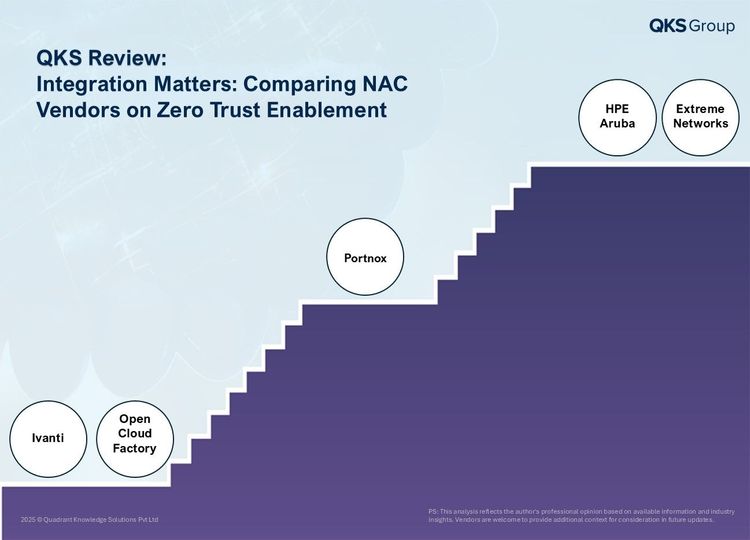
- Leading vendors (HPE Aruba, Extreme Networks) stand out with comprehensive, enterprise-grade solutions offering extensive third-party integrations and advanced context-driven policy engines.
- Capable vendors (Portnox) show promise in vendor-agnostic deployment and core access control but lack the breadth of integration partnerships needed for comprehensive Zero Trust strategies.
- Lagging vendors (Open Cloud Factory, Ivanti) remain focused on traditional NAC features, with comparatively smaller integration ecosystems, which could make it harder for them to fully align with the evolving Zero Trust landscape.
HPE Aruba
HPE’s Aruba ClearPass is a proven NAC/Zero Trust platform with a very broad integration ecosystem. It connects to firewalls, SIEMs, MDM/EMM systems, network devices, and more, serving as a central clearinghouse for security alerts. In fact, ClearPass supports an “extensive list of third-party integrations (firewalls, SIEMs, MDM/EMM, network access devices, etc.)”. This lets it pull in data (like threats or device health) and push out access policies across the infrastructure. On the policy side, ClearPass uses a context-based policy engine that ties together user role, device type, authentication method, location, time-of-day, and other attributes to make granular access decisions. Users often praise its real-time enforcement and flexibility. In short, Aruba ClearPass brings a rich partner ecosystem and dynamic, identity-based policies to a Zero Trust strategy.
Extreme Networks
ExtremeControl (by Extreme Networks) takes a similar approach. Built on Extreme networks management foundation, it integrates deeply with third-party security tools, including firewalls, SIEM platforms, mobile device management (MDM), enterprise mobility management (EMM), and even cloud orchestration systems. This broad ecosystem allows ExtremeControl to both share user and device context with external platforms and ingest threat intelligence back into the NAC for smarter decision-making. Its policy engine is context-driven, factoring in device compliance and user status to enforce granular controls. This means that even if a device is unfamiliar or potentially risky, the system can automatically apply stricter access rules or additional checks. With this combination of extensive integrations and posture-aware policies, ExtremeControl provides strong support for Zero Trust strategies across mixed wired and wireless environments.
Portnox
Portnox focuses on simplicity and flexibility. Its NAC is fully vendor-agnostic, working with any switch or network hardware, and can be delivered either from the cloud or as software. It supports both IEEE 802.1X for traditional network access control (NAC) deployments and non-802.1X devices using SNMP, which means organizations can adopt it without replacing their existing switches or Wi-Fi infrastructure. The platform integrates with identity and endpoint security tools such as IAM, SIEM, MDM, and EDR, while allowing administrators to define granular access policies based on factors like user role, device type, or location. In practice, Portnox provides a straightforward Zero Trust NAC that covers the essentials. However, compared to leaders like HPE and Extreme, its integration ecosystem is narrower, focusing on core access control rather than building out a large library of third-party partnerships. This makes it a versatile and easy-to-deploy option, but not as feature-rich as the top-tier solutions.
Open Cloud Factory
Open Cloud Factory’s NAC (OpenNAC) is a smaller player, primarily focused on IT/OT visibility. Its strengths lie in asset discovery and compliance, particularly within industrial networks. The platform integrates with Fortinet firewalls to enrich asset information for IT/OT segmentation, but beyond this, its integration ecosystem is limited. Compared to larger competitors, OpenNAC lacks the breadth of multi-vendor connectivity needed to exchange context across diverse security systems or enforce policies through a wide range of tools. While it delivers the fundamentals of NAC, its narrow integration scope and device support make it less suitable for organizations pursuing a comprehensive Zero Trust strategy.
Ivanti
Ivanti Policy Secure (formerly Pulse Secure) is a traditional NAC solution with solid endpoint control and support for role- and posture-based policies. It offers useful features such as guest onboarding and reporting, making it a practical choice for organizations that want straightforward NAC functionality. However, compared to larger competitors, its integration ecosystem is smaller, and its IoT device database is more limited. This can mean fewer built-in connectors and profiles, with some environments requiring additional manual setup. While Policy Secure covers the fundamentals of access control and policy enforcement, its narrower integration scope makes it less adaptable for organizations looking to build out a broad Zero Trust ecosystem across diverse devices and platforms.
Conclusion
A strong integration ecosystem and effective Zero Trust enablement are central to modern network access control (NAC) strategies. HPE Aruba ClearPass and ExtremeControl stand out as leaders, offering extensive third-party integrations across firewalls, SIEM, MDM, and more, combined with advanced context-aware policy engines. Portnox provides a practical middle ground, with the advantage of being vendor-agnostic and straightforward to deploy, though its integration scope is more focused on core access control. Ivanti Policy Secure and Open Cloud Factory, while covering the fundamentals of NAC, have narrower ecosystems by comparison, Ivanti with a leaner set of integrations and device profiles, and Open Cloud Factory with a stronger focus on IT/OT visibility rather than broad Zero Trust enablement. Ultimately, the right choice depends on the organization’s priorities: those seeking a highly integrated, enterprise-grade platform may find HPE or Extreme most compelling, while Portnox offers flexibility for simpler or hardware-agnostic environments. For complex, diverse networks aiming for comprehensive Zero Trust, the ecosystem depth of the leading platforms can make a meaningful difference.
Disclaimer:
This blog is based on independent research and publicly available information. The insights presented reflect the views of QKS Group and are for informational purposes only. While we strive for accuracy, we do not guarantee completeness or absolute correctness. Vendors are welcome to provide clarifications or updates. If any vendor listed in this analysis wishes to provide additional context or clarification, we welcome a briefing call and will consider incorporating relevant updates. This analysis is not intended to disparage any vendor but to provide an informed, balanced perspective. We encourage open and constructive dialogue to foster transparency and a deeper understanding of the industry.
Author: Mohnish Rathore, Analyst - Customer Identity and Access Management (IAM) at QKS Group
Vendors: