

26.08.2025
QKS Review
QKS Review: Insider Risk Management in the Age of AI - Who’s Ahead, Who’s Catching Up
Author:
Venkatesh Kopparthi


Executive Summary:
As the Information Security market faces rising pressure from escalating insider threat costs, sophisticated attack vectors, and demand for predictive threat detection, organizations are moving beyond traditional rule-based monitoring toward AI/ML-driven insider risk management platforms.
This review blog by QKS Group assesses whether Insider Risk Management vendors are truly innovating with artificial intelligence and machine learning or merely making incremental updates.
What Modern AI/ML-Driven IRM Platforms Should Deliver
Today's platforms must offer more than basic machine learning anomaly detection. Critical next-gen AI capabilities include:
- Advanced behavioral analytics powered by supervised and unsupervised ML models
- Predictive risk assessment using reinforcement learning and sentiment analysis AI
- Contextual intelligence integration combining threat intelligence, HR data, and business workflow AI
- Adaptive response automation with AI-driven policy adjustments and real-time threat mitigation
- Explainable AI capabilities providing transparent reasoning for risk assessments and compliance support
Key Findings
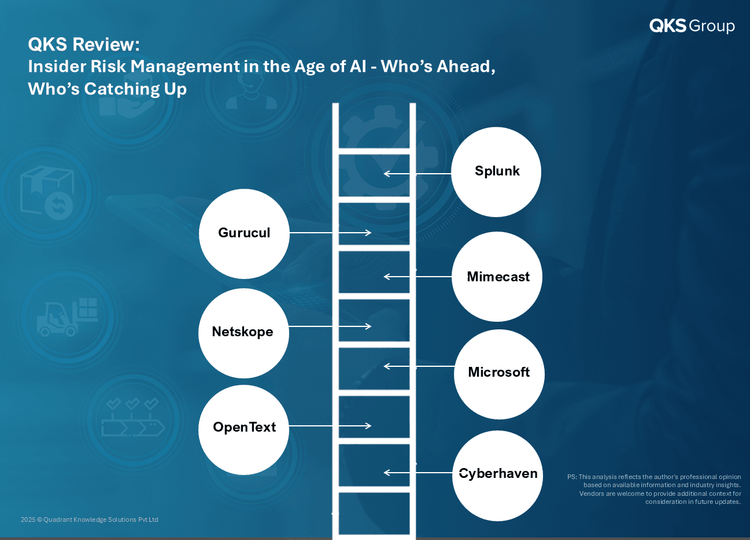
- Leading AI/ML innovators (Splunk, Gurucul, Mimecast) demonstrate sophisticated machine learning implementations with extensive model libraries, reinforcement learning capabilities, and comprehensive contextual AI integration across security, identity, and human factors.
- Capable AI/ML adopters (Netskope, Microsoft Purview, OpenText) show strong AI performance in specific domains like cloud security or Microsoft ecosystems but lack the breadth and sophistication of leading platforms’ ML implementations.
- Narrow-scope AI/ML (Cyberhaven) specializes in data lineage-driven IRM, leveraging its Linea AI to analyze data flows and context for risk detection and remediation. However, its AI/ML implementation demonstrates a narrower scope in terms of model diversity and contextual intelligence integration beyond data lineage, potentially affecting the breadth of insider threat detection and adaptive response automation.
Introduction
The insider threat landscape has evolved dramatically, with organizations experiencing escalating costs from insider incidents while traditional rule-based detection systems fail to keep pace with sophisticated insider attacks. As artificial intelligence and machine learning have emerged as critical differentiators in insider risk management platforms, significant gaps have developed between market leaders and those struggling to implement meaningful AI capabilities. This analysis examines how seven leading vendors leverage AI/ML innovations to detect, predict, and mitigate insider threats.
Modern insider risk management demands more than simple anomaly detection. Today's threats require sophisticated AI systems that can correlate disparate signals, predict risky behaviors, and adapt to evolving threat patterns. The global AI market for cybersecurity is expanding rapidly, with insider risk management representing one of the fastest-growing segments.
Effective AI/ML implementation in IRM requires several critical capabilities: continuous learning algorithms that adapt to new attack vectors, contextual intelligence that understands business workflows, predictive analytics that identify risks before they materialize, and explainable AI that provides clear reasoning for risk assessments. Organizations that successfully deploy AI-driven IRM solutions report significantly faster threat detection and substantial reductions in false positives compared to traditional systems.
Leading AI/ML Innovators
Splunk's User Behavior Analytics (UBA) platform represents their dedicated insider risk management solution, employing sophisticated machine learning algorithms to analyze user and entity behaviors across enterprise environments. The UBA platform utilizes advanced anomaly detection algorithms that establish behavioral baselines for users, devices, and applications, then applies statistical machine learning models to identify deviations indicating potential insider threats. Splunk UBA's AI capabilities include peer group analysis that uses clustering algorithms to identify unusual behaviors compared to similar users, temporal analysis that detects behavioral changes over time, and contextual scoring that weighs anomalies based on asset sensitivity and user privileges. The platform's integration with external threat intelligence sources enhances AI-driven risk assessment by correlating internal behavioral anomalies with external threat context through automated ML correlation engines.
However, Splunk UBA's AI/ML sophistication requires substantial expertise and infrastructure investment to achieve optimal performance. The platform's machine learning models demand extensive baseline establishment periods during which behavioral patterns are learned, which can create detection gaps during initial deployment phases. Organizations often struggle with the complexity of tuning UBA's numerous ML parameters and risk-scoring algorithms, requiring specialized data science skills that many security teams lack. The platform's AI effectiveness depends heavily on data quality and completeness across monitored systems, with inconsistent or incomplete data feeds significantly degrading ML model accuracy and increasing false positive rates.
Gurucul's REVEAL platform serves as a comprehensive data and security analytics foundation that powers their insider risk management capabilities through sophisticated AI/ML innovation. REVEAL analyzes data from security, identity, and HR systems to provide contextual intelligence for identifying insider risk anomalies, incorporating user and entity behavioral data (UEBA), identity access patterns, HR data, and behavioral models that can factor in organizational sentiment signals, as well as traditional security telemetry to detect external threats disguised as compromised insiders. The platform's AI innovation includes an extensive library of machine learning models that employ ensemble learning techniques, reinforcement learning algorithms that adapt based on investigation feedback, and advanced sentiment analysis capabilities that aim to predict insider risk based on employee psychological and organizational factors that traditional security tools cannot detect.
The complexity of managing REVEAL's extensive AI/ML ecosystem presents substantial operational challenges for some organizations. The platform's extensive library of machine learning models requires continuous monitoring, retraining, and optimization by skilled data scientists and ML engineers, creating significant staffing and expertise requirements. REVEAL's sophisticated AI capabilities require high-quality, consistent data integration across security, identity, and HR systems, making implementation particularly complex for organizations with fragmented IT environments or inconsistent data governance. The platform's advanced HR sentiment analysis and employee behavioral modeling raise privacy and legal considerations that require careful navigation, especially in jurisdictions with strict data protection regulations or organizations with sensitive employee relations concerns.
Mimecast's Human Risk Command Center (HRCC) leverages AI/ML innovation to focus on human-centric insider risk assessment through sophisticated behavioral psychology models and adaptive learning algorithms. The platform's SAFE scoring methodology combines email, awareness, and collaboration behavior analytics, powered by ensemble machine learning techniques that assess insider risk likelihood based on human factors often overlooked by traditional security systems. Following strategic acquisitions of Elevate Security and Code42, Mimecast has integrated advanced AI capabilities for data exfiltration prediction, file behavior analysis, and cross-platform behavioral correlation that extends beyond email to comprehensive endpoint and cloud activity monitoring.
Mimecast's AI implementations, while strong in human-centric risk, may face limitations in scope and integration complexity that can constrain comprehensive insider risk management effectiveness across a broader enterprise context. The platform's machine learning capabilities are optimized for email and collaboration security scenarios. Extending AI-driven insights to broader enterprise systems and diverse, non-email threat vectors often requires extensive customization and professional services engagement, as it necessitates integrating and correlating data from a wider array of sources. The behavioral coaching AI and human-centric risk assessment models depend heavily on organizational culture alignment and user engagement levels, potentially showing reduced effectiveness in diverse workforce environments or organizations with varying security awareness maturity levels across different departments or geographic locations.
Capable AI/ML Adopters
Netskope's User Confidence Index represents their cloud-native approach to AI-powered insider risk management, employing extensive proprietary machine learning detectors that analyze cloud application behaviors, data movement patterns, and access anomalies in real time. The platform's AI architecture is specifically designed for cloud environments, utilizing pattern recognition algorithms that understand SaaS application workflows, file-sharing behaviors, and data exfiltration attempts through sophisticated behavioral modeling. Netskope's machine learning capabilities excel at detecting unauthorized cloud application usage, anomalous data transfers, and credential misuse within cloud ecosystems through continuous behavioral analysis and adaptive risk-scoring algorithms.
Despite strong cloud-centric AI capabilities, Netskope's machine learning implementation may show limitations when addressing hybrid and on-premises insider risk scenarios, as its AI models are primarily optimized for cloud behavioral patterns. This focus could potentially result in missed insider threats that primarily involve traditional enterprise systems, legacy applications, or air-gapped environments that fall outside the typical cloud monitoring scope. Furthermore, Netskope's ML algorithms, like many sophisticated AI systems, can sometimes operate with inherent complexity that might require specialized understanding or further investigation to fully ascertain decision-making processes. This complexity can potentially complicate aspects such as forensic investigations, compliance reporting, and custom model tuning for organizations with specific insider risk management needs, even as Netskope emphasizes its commitment to responsible AI practices and transparency through policies and documentation.
Microsoft Purview Insider Risk Management leverages machine learning-powered risk templates and AI-enhanced analysis through integration with Microsoft Security Copilot, focusing on behavioral anomaly detection within the Microsoft ecosystem. The platform employs adaptive ML algorithms that learn organizational patterns from Microsoft data flows, automatically calibrating risk thresholds based on user roles, data sensitivity classifications, and established business processes. Purview's AI capabilities include natural language processing for communication pattern analysis, machine learning-driven policy recommendation engines, and computer vision techniques for sensitive document identification and classification across Microsoft applications and services.
While Microsoft's AI implementation demonstrates strong capabilities primarily within its ecosystem, its effectiveness may be predominantly optimized for organizations leveraging Microsoft products. Although it offers some capabilities for integrating third-party signals, the machine learning models' primary training on Microsoft application data patterns and behavioral signals could potentially create blind spots for insider threats relying solely on diverse, non-Microsoft systems, cloud platforms, or on-premises applications. Additionally, optimizing Purview's machine learning algorithms to learn specific organizational patterns and avoid alert fatigue in complex environments may still require careful configuration and organizational behavior mapping, particularly for environments with diverse software portfolios or non-standard Microsoft implementations, even with features designed to assist with this process.
OpenText Core Behavioral Signals utilizes unsupervised machine learning approaches to establish behavioral baselines and identify insider risk anomalies without requiring predefined threat signatures or manual rule configuration. The platform's AI implementation focuses on statistical anomaly detection algorithms that continuously adapt to organizational changes, seasonal variations, and evolving user behavior patterns through automated baseline adjustment capabilities. OpenText's machine learning approach emphasizes continuous learning models that identify statistically significant behavioral deviations across multiple dimensions, including access patterns, application usage, file interactions, and temporal activity analysis.
OpenText's AI implementation, while effective for unsupervised anomaly detection, may demonstrate a lesser degree of sophistication and contextual intelligence integration compared to leading insider risk management platforms that leverage a broader range of AI techniques and data sources. While unsupervised learning can reduce initial configuration complexity and detect novel threats, it can sometimes produce less precise risk assessments and potentially higher false positive rates compared to supervised machine learning models that benefit from labeled data and human feedback loops. The platform's AI capabilities focus primarily on behavioral analysis without the extensive integration of external contextual intelligence sources such as HR sentiment data, external threat intelligence feeds, or deep organizational workflow understanding that characterize more advanced AI-driven insider risk management solutions.
Narrow-Scope AI/ML Adopters
Cyberhaven’s insider risk management platform is built on a unique data lineage foundation, strengthened by its proprietary Large Lineage Model (LLiM) and Linea AI. These capabilities extend beyond traditional lineage to include behavioral correlation across devices, cloud, messaging, and applications, user risk scoring, and even predictive assessments such as dynamic severity evaluation and autonomous investigations. In practice, Cyberhaven delivers strong technical sophistication in tracking how data moves, classifying sensitivity, and linking activity to user behaviors.
However, Cyberhaven’s AI/ML adoption remains more concentrated in scope compared to leading behavioral-first platforms. While competitors have invested heavily in expansive behavioral sentiment modeling, ecosystem-scale integrations, and adaptive learning across diverse enterprise contexts, Cyberhaven’s strengths are still most pronounced in data-centric and lineage-driven risk intelligence. This positioning makes Cyberhaven an advanced innovator within its chosen domain but places it in the category of narrow-scope AI/ML adopters when measured against vendors pursuing broader, multi-dimensional behavioral analytics and large-scale enterprise adoption.
Conclusion
The artificial intelligence and machine learning revolution in insider risk management has created distinct competitive tiers between vendors leading innovation and those struggling with meaningful AI implementation. Leading AI/ML innovators, including Splunk, Gurucul, and Mimecast, demonstrate sophisticated machine learning ecosystems providing comprehensive behavioral analysis, predictive threat detection capabilities, and contextual intelligence integration that sets industry standards for AI-driven insider risk management.
Capable AI/ML adopters like Netskope, Microsoft Purview, and OpenText offer solid machine learning implementations within specific domains but may demonstrate a narrower scope in terms of model diversity and contextual intelligence integration compared to the leading platforms' ML implementations. These platforms excel in particular areas but lack the breadth, sophistication, and adaptive learning capabilities of leading AI innovation platforms.
Organizations evaluating insider risk management platforms must carefully assess AI/ML maturity across multiple critical dimensions, including behavioral analytics sophistication, predictive capability depth, contextual intelligence integration scope, algorithmic transparency and explainability, and adaptive learning effectiveness. The competitive landscape increasingly favors platforms that seamlessly integrate advanced artificial intelligence with human expertise, creating intelligent systems that evolve with emerging threat patterns while providing actionable, transparent insights that enable effective security decision-making.
Disclaimer:
This blog is based on independent research and publicly available information. The insights presented reflect the views of QKS Group and are for informational purposes only. While we strive for accuracy, we do not guarantee completeness or absolute correctness. Vendors are welcome to provide clarifications or updates. If any vendor listed in this analysis wishes to provide additional context or clarification, we welcome a briefing call and will consider incorporating relevant updates. This analysis is not intended to disparage any vendor but to provide an informed, balanced perspective. We encourage open and constructive dialogue to foster transparency and a deeper understanding of the industry.
Author: Venkatesh Kopparthi, Principal Analyst at QKS Group
Vendors: