

23.06.2025
QKS Review
QKS Review: Inside Healthcare's Data Revolution: Why the Industry Is Making a Crossover to Data Quality and Observability, and Which Vendors Are Leading the Transition
Author:
Arun U


Executive Summary:
Executive Summary
The healthcare industry is undergoing a critical transformation as it grapples with increasingly complex, fragmented, and high-stakes data environments. With patient information scattered across electronic health records, devices, and systems, the cost of poor data quality now extends beyond inefficiencies to life-threatening outcomes. In response, healthcare organizations are embracing data quality and observability platforms to ensure the accuracy, traceability, and reliability of clinical data across systems. This blog explores how data observability has become a mission-critical capability, enabling real-time insights and regulatory compliance, particularly amid post-pandemic demands. It also examines how leading vendors like Collibra and Ataccama are driving this revolution with healthcare-centric solutions, while others such as Experian, Monte Carlo, and DQLabs seek to refine their offerings to meet the sector’s stringent needs. As the vendor landscape evolves, the success of these platforms will depend on their ability to support compliance, scale with growing data volumes, integrate across systems, and demonstrate deep healthcare domain expertise.
Market Landscape
The health care industry is at a critical juncture. With patient information dispersed between electronic health records (EHRs), medical devices, insurance platforms, and research databases, health care organizations are dealing with unparalled data complexity. The consequences couldn't be greater, substandard data quality in health care doesn't just affect business performance; it can quite literally be life-or-death.
This reality has fueled a data revolution among health organizations, with massive investments in data quality and observability platforms. As firms race to harness the promise of their data for better patient outcomes, population health management, and operating efficiency, the vendor ecosystem is rapidly evolving to meet these critical needs.
The Healthcare Data Quality Crisis
Healthcare data problems are extraordinarily sophisticated. While inconsistencies in data can impact quarterly results or advertising efforts in other businesses, healthcare data accuracy problems have the potential to influence directly the safety of patients and the delivery of care. Look at these statistics:
•Medication errors caused by low-quality data are responsible for an estimated 250,000 deaths each year in the United States
•Healthcare organizations spend around 30% of their IT budget on suboptimal data quality problems
• Inaccurate or incomplete patient records lead to redundant testing, delayed diagnosis, and medication errors
The complexity comes of various reasons: the lack of coordination in communication among legacy systems, differences in data formats among different medical devices, human error while entering data, and complexity of aggregating data from multiple healthcare providers as patients move along the continuum of care.
Why Data Observability Has Become Mission-Critical
Data observability, the capacity for understanding, monitoring, and debugging data health end-to-end across the data pipeline has become an essential competency for healthcare organizations. In contrast to conventional data monitoring, which centers on system availability and performance metrics, data observability offers profound insights into data quality, lineage, and reliability.
For clinicians, that means being able to detect when patient data is compromised, understanding how a change to one system could affect downstream analysis, and ensuring that clinical decision support systems are making decisions based on accurate, comprehensive information. The COVID-19 pandemic accelerated this need, as healthcare systems relied on real-time information to make crucial resource allocation and treatment determinations.
Top Vendors Shaping the Healthcare Data Environment
The Data Quality Titans
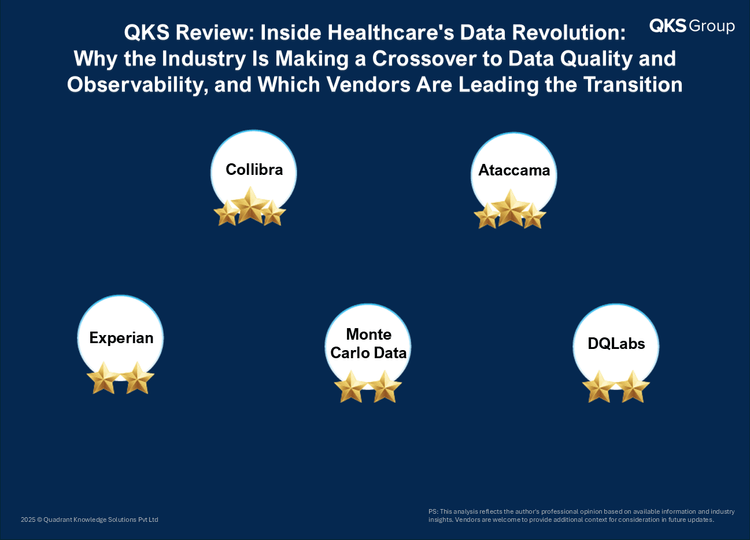
Collibra is leading the charge when it comes to handling healthcare data quality and governance. Of particular note, the reason for their platform is to use intelligence in navigating the complicated regulatory space healthcare organizations deal with on a daily basis. What makes Collibra light-years ahead is familiarity with detailed compliance demands in the healthcare space-including HIPAA or FDA rules regarding clinical trials.
Their data catalog capabilities are particularly impressive in healthcare contexts, where understanding data lineage isn't just about operational efficiency, it's about proving compliance during audits and ensuring that patient data is handled appropriately throughout its lifecycle. Healthcare organizations using Collibra report significant improvements in their ability to respond to regulatory inquiries and maintain data privacy standards while still enabling analytics and research initiatives.
The platform's collaborative aspects have been of untold value to healthcare's cross-functional groups, enabling clinical researchers, data scientists, compliance specialists, and IT professionals to productively collaborate on common data assets. Their recent developments in automated discovery of data have been especially beneficial for healthcare institutions grappling with massive volumes of unstructured clinical notes and imaging data.
Ataccama has gained a solid position in the healthcare sector with their comprehensive approach towards data quality management. So, appealing to healthcare organizations is Ataccama due to the sophisticated data profiling and cleansing features, which are essential when dealing with patient information that likely comes from several, varied sources.
Their value comes from providing the solutions needed to overcome the intricate data integration requirements that healthcare systems battle on a daily basis. When a hospital network must combine patient information from several facilities, or when a healthcare system must integrate data from acquired practices, Ataccama offers the powerful data matching and deduplication capabilities that ensure data integrity.
Healthcare companies have applauded Ataccama's efficiency in dealing with both structured and unstructured data, essential in an environment where clinical notes, imaging reports, and lab results are as valuable as structured demographic and billing data. Their real-time monitoring of data quality has also been especially useful for companies embarking on new EHR implementations or digital transformation projects.
The Balanced Approach Players
Experian has an added benefit in healthcare data quality, merely because of its vast experience in identity resolution and data matching. Its healthcare solutions are more towards patient matching and data standardization for the consumer data expertise they have carried over quite well into healthcare applications.
Experian is strongest in their advanced algorithms for managing patient identities, which assist healthcare organizations with eliminating redundant patient records and enhancing care coordination. Their data quality solutions are sound and stable, although they don't necessarily provide the rich healthcare-specific functionality of some niche vendors.
The firm has continued to make gradual strides in responding to healthcare compliance needs with their solutions, and their integration features function well within large EHR platforms. That being said, a few healthcare organizations have reported that Experian's solutions sometimes take more tweaking to effectively fit industry-specific use cases than those vendors specifically developed for healthcare.
Their pricing strategy is generally competitive, and hence they are a viable choice for mid-market healthcare organizations seeking well-established data quality functionality without the cost and complexity associated with enterprise-class platforms. The vendor still invests in features specific to healthcare, indicating a longer-term focus on the market.
The Observability Challengers
Monte Carlo made their entry into the healthcare market with great fanfare as the ultimate data observability platform. Their performance in healthcare environments has been uneven, though, and that has created doubts about whether they are prepared for the industry's distinct demands.
Although Monte Carlo's underlying technology to detect data anomalies is good, a number of healthcare organizations have complained about issues with false positives in clinical data applications. Healthcare data by its nature contains patterns that Monte Carlo's algorithms occasionally confuse as issues of data quality—such as seasonal fluctuations of particular health conditions or natural clumping of similar diagnoses in specialist care units.
More problematic has been Monte Carlo's handling of healthcare compliance. Some early adopters have struggled with configuring the platform properly to deal with PHI and keeping proper audit trails for regulatory compliance. The vendor has made efforts to solve those problems, but the learning curve has been higher than most healthcare IT staff anticipated.
The pricing methodology of the platform has also been criticized by health organizations, who have listed unexpected expenditures as their volumes of data expanded. For an industry already contending with limited IT budgets, Monte Carlo's pricing methodology has been less reliable than most healthcare CFOs would like.
DQLabs has made notable strides in positioning itself within the healthcare data quality market, particularly with its emphasis on AI-driven data quality management. While the platform demonstrates potential, particularly in less complex data environments, some healthcare organizations have found that real-world implementation in high-demand clinical settings presents additional challenges.
Scalability and reliability under heavy clinical workloads have emerged as areas for continued improvement. In particular, healthcare organizations that handle large volumes of patient data around the clock have occasionally reported performance inconsistencies. Ensuring high system resilience during intensive usage scenarios will be key to meeting the demands of mission-critical healthcare environments.
Support responsiveness is another area where expectations in the healthcare industry are uniquely high, due to the sensitive and time-critical nature of patient data. A few users have noted that turnaround times and the depth of technical expertise in handling specialized clinical scenarios could be enhanced to better align with industry needs.
Lastly, as DQLabs continues to refine its platform, some healthcare users have raised questions about the calibration of data quality scores in the context of highly complex clinical datasets. As data quality metrics directly influence patient outcomes, reinforcing transparency and validation methodologies will be important for building lasting confidence within this domain.
The Path Forward: Key Considerations for Healthcare Organizations
As healthcare organizations consider data quality and observability solutions, the following considerations should inform their decision-making process:
Compliance First: Solutions must show a strategic awareness of healthcare compliance requirements. HIPAA compliance isn't optional, and vendors will be required to provide transparent documentation regarding how their platforms enable audit support and data privacy requirements.
Integration Capability: Healthcare companies work in traditionally complex, multi-vendor IT environments. Solutions that natively integrate with a broad range of top-rated EHR systems, clinical data repositories, and analytics platforms will yield greatest value.
Scalability and Performance: Medical information is having an exponential increase in growth. Solutions must not only support today's volume of data but also what is predicted, with the ever-widening deployment of IoT sensors, wearables, and other sources of new information.
Industry Expertise: Solution providers with deep expertise in the healthcare domain recognize the character of clinical data and build solutions to be adaptive to the idiosyncrasies of the healthcare workflow and use case.
Conclusion: A Revolution in Progress
The healthcare data revolution has only just begun, but the way is clear. Companies that invest in data quality and observability technology today will be well-placed to provide better patient outcomes, operational effectiveness, and regulatory compliance in tomorrow's marketplace.
The vendor ecosystem will keep on developing and the success will be with those who understand the peculiar needs of healthcare better and who are capable of delivering good, compliant, and scalable solutions. With further maturation of this market, healthcare organizations will become more proficient in using the data quality and observability capabilities they need to realize the full potential of data-driven healthcare.
The stakes are too high for anything but healthcare data greatness. Lives are at risk for patients, and vendors who understand this simple truth will be the ones that ultimately succeed in driving healthcare's continuous data revolution.
Disclaimer:
This blog is based on independent research and publicly available information. The insights presented reflect the views of QKS Group and are for informational purposes only. While we strive for accuracy, we do not guarantee completeness or absolute correctness. Vendors are welcome to provide clarifications or updates. If any vendor listed in this analysis wishes to provide additional context or clarification, we welcome a briefing call and will consider incorporating relevant updates. This analysis is not intended to disparage any vendor but to provide an informed, balanced perspective. We encourage open and constructive dialogue to foster transparency and a deeper understanding of the industry.
Author: Arun U, Analyst - Data Architecture at QKS Group
Amandeep Singh Khanuja, Associate Director & Principal Analyst at QKS Group
Vendors: