

24.09.2025
QKS Review
QKS Review: Industry-Specific ESG Transformation – A Reality Check on Vertical Expertise in Sustainability Services
Author:
Ignatius Daniel


Executive Summary:
The ESG & Sustainability IT Services market has shifted gears. In 2024–2025, enterprises are no longer looking for generic frameworks; they need verticalized ESG transformation that maps to sectoral compliance, supply chain realities, and operational decarbonization. Manufacturers face EUDR traceability and Scope 3 complexity, banks grapple with Basel III climate stress tests, utilities must balance renewables with grid stability, and healthcare firms are under scrutiny for supply ethics and waste traceability.
This QKS Review asks a critical question: Are service providers truly delivering sector-aligned ESG transformation, or just rebadging horizontal frameworks?
We examine six major providers TCS, Hitachi Digital Services, Accenture, Cognizant, HCLTech, and Capgemini through the lens of vertical depth, technology enablement, and measurable outcomes. The analysis reveals a widening maturity gap: some vendors show hard, verifiable results, while others remain stuck in broad advisory and pilot projects.
What Industry-Specific ESG Services Should Deliver
In today’s regulatory environment, ESG services must prove substance in three areas:
- Vertical Compliance Alignment: Mapping to sectoral standards (CSRD/ESRS/EUDR for manufacturing, HIPAA/GxP for healthcare, Basel III/ISSB for finance, ISO 50001/SBTi for energy).
- Technology Enablement: Use of AI, IoT, digital twins, blockchain, and GenAI to move from reporting to operational ESG execution.
- Measured Outcomes: Quantifiable results such as faster disclosure cycles, verified emission reductions, and reduced compliance costs.
Anything less risks compliance theatre where enterprises meet disclosure deadlines but fail to achieve meaningful decarbonization.
Key Findings
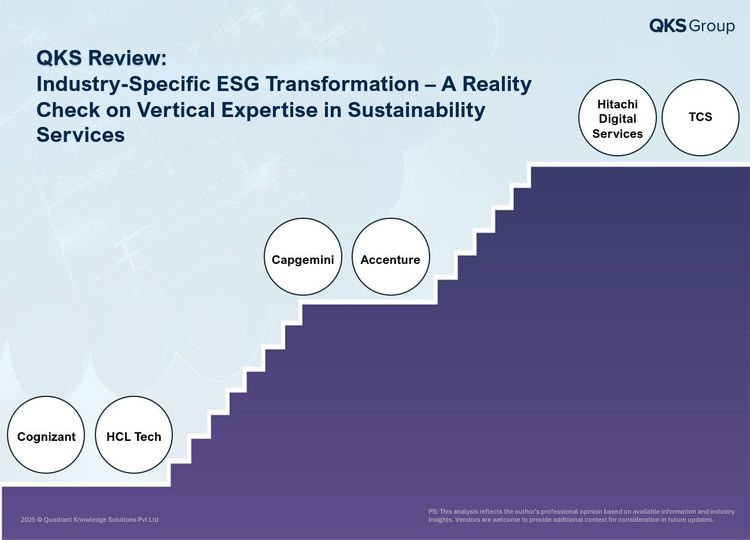
- Heavyweights (TCS, Hitachi Digital Services): Deliver industry-ready platforms and measurable decarbonization impact.
- Selective Specialists (Accenture, Capgemini): Strong in FS and energy; less operational depth in industrials.
- Niche Innovators (Cognizant, HCLTech): ROI-driven, vertical-specific success but limited multi-sector breadth.
- The execution maturity gap is real: enterprises must separate marketing narratives from execution substance.
Vendor Landscape
TCS – Envirozone as a Manufacturing & CPG Engine
TCS has positioned its Envirozone platform as a sector-ready ESG backbone, particularly for manufacturing and consumer goods. Envirozone’s API-first microservices architecture ingests ERP data from SAP, Oracle, and Infor, normalizing it against proprietary ESG KPIs. The platform’s AI-driven supply chain risk engine simulates Scope 3 emissions under multiple scenarios, directly informing budgeting and procurement decisions. Envirozone’s data normalization protocols comply with GHG Protocol, ISO 14064, and EUDR traceability requirements, enabling end-to-end visibility across global value chains. Clients have accelerated sustainability reporting cycles from ten months to two weeks, leveraging real-time dashboards and automated disclosure modules aligned to CSRD and ESRS. TCS’s extensive partnership ecosystem including Microsoft Azure for cloud scaling and CDP for data validation reinforces its manufacturing and CPG leadership.
TCS helps clients operationalize sustainability by linking budgets to ESG outcomes, automating disclosures under frameworks like CSRD/ESRS, and running managed reporting operations. Partnerships with Microsoft Azure for cloud scalability and CDP for disclosure validation add credibility, while the Vertical Sustainability Lab differentiates TCS by co-developing circular economy and carbon capture pilots with global manufacturers. The company’s core strength lies in its breadth of capabilities and consistent execution, though market perception remains a challenge, as many still view TCS primarily as an IT outsourcer rather than a fully developed ESG services provider. Buyers will need to look past this brand stereotype to recognize its sector maturity and strategic relevance.
Hitachi Digital Services – Industrial & Energy Convergence
Hitachi is one of the few providers that can genuinely claim IT/OT convergence in ESG. Its Lumada platform streams machine and grid telemetry using MQTT and OPC-UA into a blockchain-backed data lake ensuring immutable audit trails for ISO 50001. On top of this, digital twin models simulate production lines and energy grids, applying ML to optimize emissions and predict failures. Its Grid-Optimizer module is a highlight, balancing renewable generation with battery dispatch and reducing greenhouse gases.
Hitachi Digital Services supports clients through decarbonization consulting, integration of Lumada with ERP and EHS systems, and managed services for energy and carbon analytics. Its carbon engine provides granular, equipment-level emissions tracking to design decarbonization pathways aligned with SBTi standards. Global co-innovation centers extend this work into domain-specific pilots, such as water reuse for semiconductor manufacturing, hydrogen-ready microgrids for utilities, and intelligent transport solutions for public infrastructure.
These initiatives establish Hitachi as more than a compliance partner, positioning it as a strategic ally in industrial decarbonization. The company’s unique strength lies in its credibility and operational technology heritage. Hitachi Digital Services understands industry and infrastructure, not just IT. While it may not match the scale of consulting leaders in terms of advisory headcount, it compensates with deep technical expertise and practical deployments that bring sustainability initiatives from concept to reality for industrial clients.
Accenture – Energy Transition & Financial Risk Integration
Accenture leverages scale and advisory breadth, but its edge lies in embedding ESG into finance and operations. Its Carbon Risk Engine integrates TCFD/ISSB scenarios into loan portfolios, linking outputs directly into SAP and Oracle EPM for climate stress testing. For utilities, Accenture co-built a Smart Grid Control Tower with GE Digital, boosting renewable curtailment capacity. In retail, its GenAI-driven Consumer ESG Insights drove an uplift in sustainable product sales by tailoring recommendations.
Accenture’s ability to scale strategy into execution, supported by more than 5,000 sustainability consultants and 14 global Sustainability Innovation Hubs. Its services span the full lifecycle from strategy design and platform implementation to managed reporting and sector-specific accelerators all underpinned by a five-pillar Energy Transition Framework that ensures coverage of regulatory, financial, operational, and digital dimensions. Partnerships with leading data, software, and cloud providers add further depth to its ecosystem. Accenture is widely seen as the safe global choice, excelling in energy transition and financial services, though its role in heavy industries often skews toward advisory rather than operational delivery. For manufacturers and asset-intensive sectors, its frameworks may need to be complemented by partners with stronger OT or plant-level capabilities.
Cognizant – Healthcare & Retail Niche Strength
Cognizant has built niche strength in healthcare and retail sustainability, focusing on targeted solutions that deliver fast, measurable returns. In healthcare, it uses LLM-powered ESG assistants on cloud AI platforms to parse EHRs and supplier data, auto-generating governance and social KPIs while maintaining strict compliance with standards like HIPAA and GxP helping hospitals meet reporting requirements without straining clinical systems. In retail, its IoT-enabled Food Waste Monitor links cold-chain sensors with analytics dashboards, achieving a cut in perishable waste for a major food chain within six months, while its CarbonView microservices normalize Scope 1–3 data for integration into ESG reporting platforms. Cognizant’s approach centers on “quick wins”: rapid pilots, often delivered in weeks, that resolve a single pain point and prove ROI. Its services are modular ranging from ESG roadmap advisory to PoC deployments and cloud integrations supported by partnerships with major technology and sustainability providers. The company’s USP lies in its speed and focus, making it attractive to mid-tier enterprises, though it lacks the scale of end-to-end platforms offered by larger peers, which can limit its appeal for organizations seeking enterprise-wide ESG transformation.
HCLTech – Automotive & Healthcare Transformation
HCLTech positions itself as an engineering-driven partner for ESG transformation, with its MVision ESG framework leveraging microservices and ML forecasting to generate ISO 14064-compliant reports up to faster deployments. In the automotive sector, it has enabled real-time Scope 3 attribution by linking PLC telemetry with ERP supplier data, cutting reporting costs by nearly a third, while in healthcare, it has applied blockchain-enabled Digital Thread solutions to connect device manufacturing with recycling, ensuring traceability and compliance. Its Centers of Excellence in these domains co-develop pilots ranging from battery recycling programs to hospital waste reduction initiatives. The services span consulting for Net Zero and regulatory readiness, integration with tools like digital twins and SAP EHS, and managed ESG reporting operations. HCL’s strength lies in tailoring solutions to verticals: automotive clients gain supply chain emissions traceability, while healthcare clients receive compliance-grade lifecycle management. While not a broad-market leader, it has earned credibility in its chosen niches, offering execution-ready solutions for sectors were technical depth and domain specificity matter most.
Capgemini – Financial Services ESG Benchmarking
Capgemini has built its ESG reputation around financial services, where its ESG Lens platform overlays market and climate-risk data directly into credit scoring processes. Hosted on Google Cloud, the solution integrates external datasets such as climate models and ESG scores, while its Risk & Compliance Accelerator Toolkit comes with pre-built SASB, GRI, and TCFD connectors that halve implementation time for banks and insurers. Its influence is reflected in industry benchmarks, with the majority of financial institutions now offering energy-transition advisory shaped in part by Capgemini’s strategic work. Beyond advisory, its services extend to stress-testing, platform integration with core FS systems, and managed ESG reporting operations. While financial services remain its strongest domain, Capgemini is beginning to branch into retail and manufacturing sustainability with new analytics and orchestration packs, though these remain in early rollout stages. The company’s clear strength is its maturity and credibility in financial services, making it a top choice for banks and insurers under regulatory pressure, even if its offerings in other sectors remain more template-based than deeply customized.
End-User Guidance: Critical Buying Decisions for ESG Transformation
- Demand Vertical Proof
Choose vendors with recent case studies and regulatory depth tailored to your industry, not generic ESG platforms. - Check Technical Integration
Prioritize platforms proven to integrate with ERP, IoT, and supply chain systems through tested APIs and protocols. - Insist on Measurable ROI
Focus on quantified outcomes like reporting time cuts, compliance savings, and emissions reduction not feature lists. - Evaluate Platform Maturity
Select scalable platforms with audit-ready data management that can handle ESG data growth over 3–5 years. - Secure Ecosystem Partnerships
Work with providers that bring strong cloud, data, and industry partnerships plus access to innovation labs.
Final Thought
Choosing an ESG partner in 2025 is no longer about brand scale or horizontal coverage. It is about sectoral fluency, technical integration, and verified outcomes. Buyers that prioritize vendors with vertical depth will see faster CSRD/ISSB compliance, deeper supply chain visibility, and operational decarbonization that withstands audit scrutiny. Those who opt for generic frameworks risk falling into compliance theatre meeting deadlines but missing transformation. In ESG transformation, vertical specificity is not optional it is the new baseline. End-users should demand sector-aligned solutions, integration with core enterprise systems, and outcomes that are measurable, not aspirational. Vendors who can blend regulatory expertise, digital platforms, and operational know-how will shape the next phase of ESG maturity.
PS: This analysis reflects the author’s professional opinion based on market briefings, product research, and publicly available information. Vendors are welcome to share additional insights for future revisions.
Disclaimer:
This blog is based on independent research and publicly available information. The insights presented reflect the views of QKS Group and are for informational purposes only. While we strive for accuracy, we do not guarantee completeness or absolute correctness. Vendors are welcome to provide clarifications or updates. If any vendor listed in this analysis wishes to provide additional context or clarification, we welcome a briefing call and will consider incorporating relevant updates. This analysis is not intended to disparage any vendor but to provide an informed, balanced perspective. We encourage open and constructive dialogue to foster transparency and a deeper understanding of the industry.
Author: Ignatius Daniel, Senior Analyst - Internet of Things (IoT) at QKS Group
Vendors: