

13.06.2025
QKS Review
QKS Review: How Enterprise CX-Ready are your Journey Management Tools?
Author:
Palika Jacob S


Executive Summary:
As the Customer Experience (CX) technology market faces rising pressure from real-time personalization demands, integration complexity, and siloed customer insights, organizations are moving beyond traditional journey visualization tools.
This review blog by QKS Group assesses whether journey mapping platform vendors are truly innovating to meet these demands — or merely making incremental updates.
What Modern Journey Mapping Tools Should Deliver:
Today’s platforms must offer more than core features. Critical next-gen capabilities include:
- AI-Based Recommendations for dynamic experience improvement
- Predictive Analytics to anticipate customer behavior and prevent churn
- Automated Insight Discovery that transforms raw feedback into action
Key Findings:
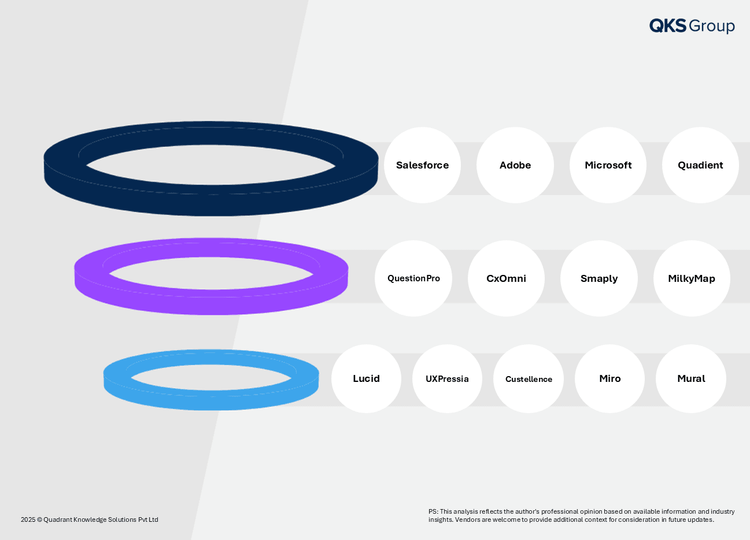
- CX Anchor vendors (Salesforce, Adobe, Medallia, NICE, Qualtrics, Quadient) stand out with comprehensive, enterprise-grade solutions that integrate seamlessly into CX ecosystems and deliver measurable experience transformation.
- CX Enabler vendors (QuestionPro, cxomni, Genesys, Smaply, Milkymap, Totango) show promise in niche areas like journey governance or contact center orchestration, but lack the full-scale integration or real-time orchestration of Anchors.
- CX Supporter vendors (UXPressia, Custellence, Miro, Mural) remain focused on static visualization and collaboration, without the intelligence or integration needed to impact real CX outcomes.
A Tiered Breakdown
Journey mapping is not just about visualizing anymore; it is also about integration. Many tools still operate in silos. Journey mapping has built from stickies and swimlanes to boardroom-level urgency. It promises the ability to diagnose, design, and deliver seamless customer experiences. But the real question is:
Many tools claim they're helping CX, but how many are genuinely linking insight and execution?
The real value in journey mapping originates not from the maps, but how well these tools connect to your larger CX stack. To be genuinely relevant to CX, a tool can not just generate static visuals but must create real-time intelligence, operational impact, and ultimately become a CX engine that senses, personalizes, and optimizes journeys.
To cut through the noise, we analyzed journey mapping platforms across core capabilities critical for moving from static maps to dynamic CX engines: Journey Optimization, Segmentation, Journey Visualization, Insight Discovery, Agent Assistance, and Data Aggregation.
These pillars represent the evolution from pure visualization towards a real-time journey orchestration and personalization. Our tiering of CX Anchors, Enablers, and Supporters, reflects not only feature presence but depth of integration, automation maturity, and strategic fit within the broader CX technology ecosystem.
CX Anchors
At the forefront are platforms embedding journey intelligence directly into operational systems. They are not just vendors of design tools but giant execution engines to connect with real time data pipes, feedback loops, and orchestration models. These solutions are designed to be customer experience-centric and help organizations turn insights to impact on a single platform.
These vendors continually advance by adding AI-based insights, predictive journey triggers, and closed loops and their architecture is designed in a bi-directional fashion with integration across CRM, CDP, VoC and Contact Center ecosystems to continuously adapt customer journeys based on customer signals and business relevance. From a strategic perspective, CX Anchors treat journey-mapping as a core system of engagement within the organization and integrate journey logic into sales, service, and marketing execution. These CX Anchors will be much more appealing to maturing CX organizations who are looking to scale personalization, automate touchpoints, and proactively manage customer moments in all customer channels entered.
- Salesforce: Salesforce remains a dominant force in the CX tech stack, offering deep integration across CRM, CDP, and Marketing Cloud to deliver a unified customer view. Journey mapping in here isn't a stand-alone capability but it's part of the lifecycle orchestration, enhanced by AI-driven personalization and real-time triggers. While Journey Builder may be used independently from the Salesforce’s core CRM, its packaging within Marketing Cloud Engagement means that the ultimate value usually comes from a higher investment in Salesforce.
- Adobe: Adobe combines customer intelligence with creative execution, providing hyper-relevant experiences through real-time CDP, AI-powered personalization, and decision-making workflows. Journey mapping is part of a larger marketing, content automation ecosystem, not a market terrestrial. Although Adobe is highly scalable and intelligent, its main sources of strength in CX still exist massively in marketing contexts, creating concerns around its ability to be stretched into service or operational scenarios.
- Microsoft: Microsoft is gaining traction in the CX domain on the strength of Dynamics 365, Power Platform and Azure AI's integrated capabilities. The platform's journey orchestration is included in wider enterprise workflows, allowing for automated insights, adaptive service interventions and a robust framework for governance of data. Microsoft's value proposition is based on the extensibility of the ecosystem; however, the organization and delivery of Microsoft's CX offering is often nuanced due to the extensiveness of its journey designs leading to a requirement for extensive customization to realize value across multiple stages of a customer's journey.
- Quadient: Quadient is a leader in omnichannel communication management, especially in regulated industries with non-negotiable customer experience benchmarks of compliance, personalization, and contextual messaging. The platform regards communication an important point in the customer journey, ensuring consistency & governance between customer journeys and their respective communication touchpoints. Quadient represents lifecycle messaging more than as a vehicle for orchestrating complex, end-to-end customer experiences. Quadient represents a communication-first engine, not a complete, multi-purpose CX capability.
CX Enablers
CX Enabler platforms have considerable base value in mapping, governance, and feedback inclusion, their ability to execute journeys is dependent on surrounding platforms. They provide reasonable diagnostics and alignment, while orchestration remains emergent or dependent on a third-party tool.
On the technology side, CX Enablers usually have a definition structure already built, cross-channel visualization, and governance at scale. Many are adopting templates, KPI tagging, and collaboration in their offerings, along with some early AI-supported analytics or segmentation options. The areas of automation, real-time decisioning, and native journey orchestration are the areas they are in the process of developing. In the strategy context, Enablers are helping organizations build a centralized journey repository and to scale their respective CX programs. These systems fit organizations well when orchestration tools are already in place and organizations had the need for a governance layer to bring these efforts back together. If brands are looking for tools that enable them to adapt or execute in real-time from a single distributed platform, they are often requiring complements to their CX stack.
- Cxomni: Cxomni asserts itself as a governance-first journey management platform that connects strategy and execution through structured alignment. The platform's capabilities, such as persona integration, customer experience KPI tracking, VoC layering, and journey-based collaboration, act as a centralized system for recording experience data. From a configuration standpoint, it portrays modularity and enterprise governance, helping CX leaders break silos and group collaborators around shared truths. Cxomni does a good job of mapping and building strategy on insights, but the orchestration of real-time actions is handled through integrations, positioning itself as a strong enabler within the CX execution engine.
- QuestionPro: QuestionPro provides a voice of customer (VoC) platform for closed-loop feedback, sentiment analysis, and decision routing that allows organisations to react to customer feedback in near real time. QuestionPro is especially capable of quickly operationalising feedback loops. However, while sharp on diagnostics, it still relies on external systems to drive orchestration and is thus limited in its ability to act autonomously across the wider journey.
- Smaply: Smaply offers a comprehensive journey management platform that allows organizations to visualize, manage, and optimize customer experiences across all touchpoints. This platform features interlinked journey maps, a hierarchical architecture, tracking progress over time, and performance monitoring to achieve a 360° view of the customer journey. Smaply helps to translate user research and insights to create a data-informed decision-making process, enabling users to build journey maps that foster consistent customer experiences and establish a customer-centric information and communication system within an organization. Managing pain points, opportunities, and solutions on a portfolio matrix allows users to take well-informed decisions. It is also cloud-based, which enables real-time collaboration; users can co-create journey maps and personas, even in low-bandwidth environments. The platform excels at mapping and aligning strategic thinking for customer journey development, but still has to develop in the areas of automation and orchestration, which makes it an enabler in the CX ecosystem.
- Milkymap: Milkymap brings structure and depth to journey management through its CX Life Cycle Model, which organizes journeys into Stages, Phases, and other key elements, enabling CX programs to scale with consistency. Its real-time insights, paired with new built-in AI capabilities, automate journey mapping and extract relevant insights from large content sets, helping teams actively enrich and improve customer experiences. While integrations with tools like Power BI and Jira add contextual depth, Milkymap’s core strength lies in transforming fragmented CX efforts into a governed, iterative practice. While it has always addressed strategy and design well, the new intelligence layer is now extending its value into operational execution.
CX Supporters
Supporters constitute the entry level, with a focus on experience visualization, working together, and early-stage design. They are best for organizations that are either just beginning their CX journey or use cases with primacy on ideation and documentation. They come to life in areas where storytelling and team alignment are key but will not have operational impact.
From a technical perspective, these tools focus on the usability level, customizable templates, and collaboration, but lack AI driven insights, data integration, automation or orchestration. Outputs are primarily static and typically do not impact real-time touchpoints or close feedback loops. Strategically, these vendors frame journey mapping as a creative or a planning activity. While valuable for convening workshops, design sprints and messages to executives, these tools are separate from the operational layers of execution that bring journeys to life. They are more akin to collaboration/visualization tools that augment orchestration, and analytics platforms rather leave from a platform perspective.
- Lucid Software: Lucidchart and Lucidspark are not traditional CX software; however, they are effective tools for visual collaboration, process mapping, and stakeholder engagement. Their strength lies in fostering clarity across multiple functional teams, making them suitable platforms for CX design and alignment activities. Nonetheless, a limitation of Lucid Software is the absence of customer data or journey governance. While products such as Lucidchart and Lucidspark are valuable resources for planning, they do not fulfill the requirements for execution or dynamic delivery of a CX.
- UXPressia: UXPressia offers an attractive and user-friendly interface for journey and persona mapping; this makes it an excellent choice for teams where ease-of-use and early-stage clarity become the key business drivers. It is perfect for visual storytelling and alignment, but its limited features like lack of depth in analytics, triggers, or feedback integration, means it offers role as a design tool, not an agent for journey transformation.
- Custellence: Custellence is a process-oriented journey mapping solution that captures a structure and simplicity in workflow design from beginning to end. Nevertheless, its lack of real-time data and orchestration has limited the impact of the overall customer experience, meaning it offers a reasonable mapping tool and a poor connector with the overall CX tech landscape.
- Miro: Miro is a widely used and popular tool as an app for visual brainstorming, sprint planning and fast, visual ideation. System designers and CX designers much prefer Miro when mapping experiences and building alignment sessions and workshops. While Miro has application for mapping journeys, it only functions like a white board; Miro lacks any journey specific intelligence or governance. Miro is not a CX modelling platform.
- Mural: Mural also enables teams to collaborate and co-create and align using interactive canvases. It is a go-to tool for early-phase journey design and innovation workshops. However, like Miro, Mural does not include dynamic data, automation, or integration of feedback, so it functions more as a facilitation tool, not as an engine for CX transformation.
Market Dynamics and What’s Next for Journey Mapping?
The journey mapping space is changing dramatically: from static visuals to dynamic, real-time engines, enabling personalization, closed-loop feedback and pro-active governance. Organizations are looking for more than maps; they are looking for platforms that act on journeys. Buyers (end-users) of journey mapping solutions need to go beyond understanding defensible tiers of journey mapping solutions; it depends on their CX maturity, operational complexity and strategic priorities. As an example, a small, early-stage organization could find value from a Supporter for journey alignment and initial ideation. More mature organizations needing governance and diagnostics could find value from an Enabler. Large enterprises wanting real-time, cross-channel orchestration and closed-loop execution will need CX Anchors.
None of these tiers are baked in.
With the right integrations with CRM, CDP, VoC, and orchestration engines, any journey mapping solution can evolve to a CX Anchor. A Supporter that is highly usable, can become an indispensable layer of design; an Enabler that built analytics and automation, can move to full stack orchestration. The key is interoperability, modularity and the ability to thoughtfully execute greater strategic road-mapping.
The future is data-driven, ethically principled and adaptable CX interventions. The ambit of evolving expectations is accelerating, the journeys are exponentially complex, it is not possible to remain static. Journey mapping will not just be a phase in CX management but will act as connective tissue from signal - to system, insight - to - action.
Disclaimer:
This blog is based on independent research and publicly available information. The insights presented reflect the views of QKS Group and are for informational purposes only. While we strive for accuracy, we do not guarantee completeness or absolute correctness. Vendors are welcome to provide clarifications or updates. If any vendor listed in this analysis wishes to provide additional context or clarification, we welcome a briefing call and will consider incorporating relevant updates. This analysis is not intended to disparage any vendor but to provide an informed, balanced perspective. We encourage open and constructive dialogue to foster transparency and a deeper understanding of the industry.
Author: Palika Jacob S, Analyst - CX Tech at QKS Group
Vendors: