

04.08.2025
QKS Review
QKS Review: “Half in the Cloud, Half in Chaos? Who is Actually Solving Hybrid Integration in EiPaaS”
Author:
Ipsita Chakrabarty


Executive Summary:
As the EiPaaS market faces rising pressure from hybrid enterprise realities, legacy-modern coexistence, and on-prem/cloud fragmentation, organizations are moving beyond traditional cloud-only integration tools.
This review blog by QKS Group assesses whether EiPaaS vendors are truly innovating to meet these demands or merely making incremental updates.
What Modern EiPaaS Platforms Should Deliver:
Today’s platforms must offer more than visual builders and SaaS connectors. Critical next-gen capabilities include:
- Hybrid runtime and agent-based deployments to securely connect on-prem systems with cloud apps
- Protocol-level support and legacy system compatibility to eliminate integration silos
- Process-centric orchestration for real-time, event-driven, and batch workloads across hybrid environments
Key Findings:
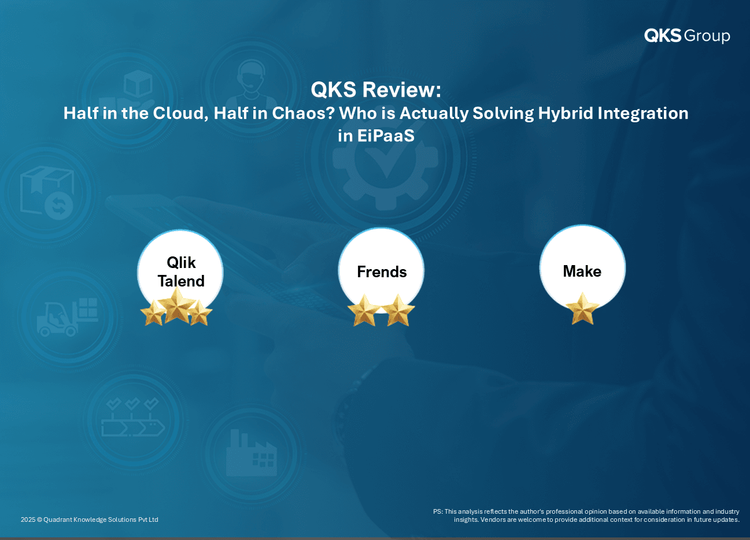
Leading vendors (Talend) stand out with deep hybrid architecture, secure gateways, and full protocol support for complex enterprise workloads.
Capable vendors (Frends) provide practical, lightweight hybrid deployment for process-driven use cases, balancing ease of use with enterprise readiness.
Lagging vendors (Make) excel in cloud-native integrations but lack the architecture and tooling needed for legacy and regulated hybrid environments.
Why Hybrid Integration Is the Real EiPaaS Test
While cloud-native architectures dominate enterprise roadmaps, the truth is that most organizations aren’t fully there and won’t be for years. Critical systems still run on-premise: ERPs, payment processors, supply chain hubs, even healthcare and manufacturing cores. Meanwhile, new SaaS apps emerge daily across departments, creating fragmented data and disconnected workflows.
That’s where hybrid integration becomes a make-or-break capability for EiPaaS platforms. It’s not just about connecting endpoints; it’s about doing so securely, reliably, and with governance across firewalls, APIs, protocols, and teams. Vendors who ignore this complexity in favor of flashy automation features often leave users stranded mid-journey: cloud-ready, but not enterprise-ready.
Make: Cloud-Native Power, Legacy Limitations
Hybrid Reality:
Make was born in the cloud, and its builder reflects that smooth, visual, and SaaS-optimized. It connects effortlessly to modern APIs, webhooks, and cloud services like Slack, HubSpot, or Airtable. However, it lacks built-in support for legacy systems such as mainframes or on-prem SQL servers. There’s no hybrid agent framework, no secure tunneling capabilities, and no tools for batch-heavy or event-driven workloads in regulated environments.
Analyst View:
Make is perfect for digital-native startups or business units working fully in the cloud. But for IT teams managing hybrid stacks, Make’s beauty fades fast. It’s a one-sided integration story that works best when legacy isn't in the equation. Enterprises relying on older systems often find themselves forced to build workarounds or abandon Make for more robust options. The result? Increased maintenance debt and fragile automation chains that hurt scalability.
Qlik Talend: Built for the Messy Middle
Hybrid Reality:
Qlik Talend is battle-tested in hybrid environments. It offers deep connectivity to cloud apps, legacy databases, and everything in between. With its hybrid runtime architecture, on-prem agents, secure data gateways, and native support for protocols like JDBC, FTP/SFTP, and SOAP, Qlik Talend can handle large, regulated, and latency-sensitive environments. It also integrates well with popular cloud data warehouses, data lakes, enabling hybrid data pipelines, and real-time streaming workflows, with diverse patterns like ETL, ELT, CDC, and API delivery all in a unified platform.
Analyst View:
Qlik Talend gets the reality of enterprise integration: complex, regulated, and rarely cloud-only. Its hybrid runtime, protocol breadth, and secure gateways make it ideal for industries where compliance, latency, and on-prem data still matter from banking to pharma. Unlike flashier tools that neglect legacy, Talend is purpose-built for real-world hybrid workloads. That said, its UI and developer experience can feel dated compared to newer platforms, which may slow down experimentation for business users. But for organizations prioritizing stability, governance, and end-to-end pipeline control, Talend delivers where it counts.
Frends: Understated, But Exceptionally Balanced
Hybrid Reality:
Frends might not be a household name, but it’s quietly doing the hard work of connecting hospital systems, factories, and banks the kinds of environments where hybrid isn’t optional. Its lightweight agents deploy securely behind firewalls, enabling local orchestration of workflows while maintaining centralized monitoring. Frends supports hybrid API layers, legacy protocols, XML transformations, and edge-triggered events, offering a strong option for organizations seeking process-first integration across cloud and legacy systems.
Analyst View:
Frends is the quiet hybrid enabler not overselling, just delivering. Its process-centric design and ease of deployment make it a smart choice for midsize firms with real integration pain. Unlike many platforms that demand costly reengineering of existing infrastructure, Frends meets organizations where they are. This minimizes disruption, shortens integration timelines, and improves continuity of operations especially critical in healthcare and manufacturing, where downtime can be costly or even dangerous.
Final Verdict: Don’t Be Fooled by Flash

Analyst POV:
Hybrid integration isn’t glamorous but it’s essential. Because if a platform can’t connect your core banking system, manufacturing ERP, or claims processing engine to your shiny new SaaS stack, it doesn’t matter how many Copilots or AI prompts it offers.
Talend wins on maturity, Frends wins on balance, and Make wins on ease but only for the fully cloud-native. Enterprises need to choose based on architecture fit, not just vendor marketing. Otherwise, they risk building automation castles in the cloud on top of on-prem quicksand.
Disclaimer:
This blog is based on independent research and publicly available information. The insights presented reflect the views of QKS Group and are for informational purposes only. While we strive for accuracy, we do not guarantee completeness or absolute correctness. Vendors are welcome to provide clarifications or updates. If any vendor listed in this analysis wishes to provide additional context or clarification, we welcome a briefing call and will consider incorporating relevant updates. This analysis is not intended to disparage any vendor but to provide an informed, balanced perspective. We encourage open and constructive dialogue to foster transparency and a deeper understanding of the industry.
Author: Ipsita Chakrabarty, Analyst - Application Deployment at QKS Group
Vendors: