

27.06.2025
QKS Review
QKS Review: From Visibility to Velocity: Who’s Orchestrating the Semantic Multi Enterprise Supply Chain Business Network (MESCBN)?
Author:
Avinash Singh


Executive Summary:
As global supply chains evolve into dynamic, interconnected ecosystems, visibility alone is no longer sufficient. QKS Group’s latest analysis reveals that the next wave of Multi-Enterprise Supply Chain Business Networks (MESCBNs) hinges on semantic intelligence, the ability to fuse real-time operational signals with enterprise master data and automate orchestrated responses. Without this contextualization, enterprises risk drowning in fragmented data that fails to drive actionable outcomes in an era demanding velocity and resilience.
What Modern Semantic MESCBNs Should Deliver:
To move from visibility to velocity, next-gen MESCBNs must embed:
- Semantic data modeling to map IoT and operational signals against enterprise hierarchies (products, suppliers, locations).
- Data fusion and contextualization that unifies real-time events with ERP, PLM, TMS, and WMS master data.
- Event-driven orchestration to trigger automated workflows, rerouting shipments, reprioritizing orders, or alerting suppliers instantly.
- Metadata governance and knowledge graphs to maintain scalable, accurate, and meaningful data relationships across multi-tier networks.
- AI-powered reasoning to transform raw signals into prescriptive, business-aligned actions.
Key Findings:
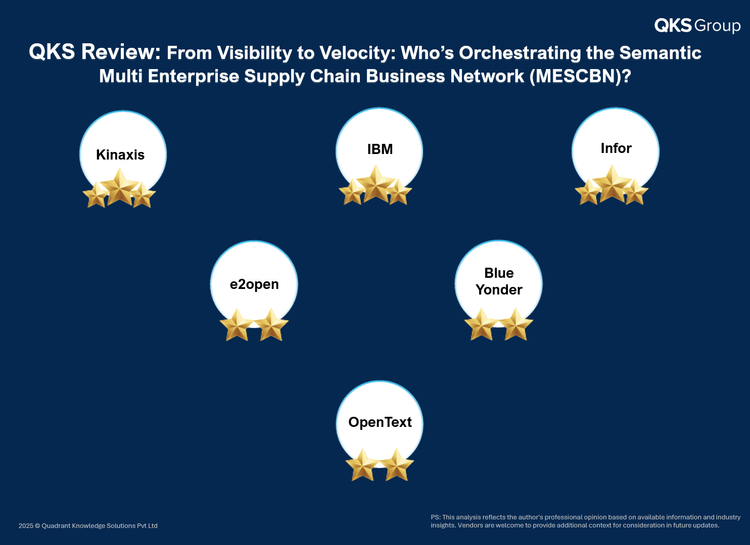
- Semantic Leaders (Kinaxis, IBM): Kinaxis leads with semantic modeling and IoT-master data integration within its Maestro platform, using ML to automate disruption responses. IBM excels with Watson AI’s semantic processing engine, maintaining contextual integrity across complex, multi-tier ecosystems at scale.
- Capable Contenders (Infor, e2open): Infor’s Nexus offers centralized semantic governance but relies on pre-configured templates, limiting adaptability. e2open provides broad IoT ingestion but demands custom configuration to align signals with nuanced business rules.
- Improvement Opportunities (OpenText, Blue Yonder): OpenText offers strong connectivity but lacks deep semantic orchestration, while Blue Yonder’s demand planning strength is offset by underdeveloped real-time IoT integration and semantic linkage.
For years, supply chain transformation has centred around real time data signals from machines, shipments, inventories, and suppliers. But visibility alone doesn’t drive outcomes. Without semantic context, understanding not just what is happening, but why, where, and what it means enterprises are left with digital noise that clutters rather than clarifies.
The next frontier in Multi Enterprise Supply Chain Business Networks (MESCBNs) isn’t about collecting more data; it’s about turning fragmented inputs into intelligent, orchestrated actions across global partner ecosystems.
At QKS Group, we assess vendors not just by the breadth of their features but by the impact they deliver. One finding is clear: the market leaders are no longer just aggregating information they're interpreting it. They contextualize real time operational signals with enterprise master data, enabling automated responses at scale.
From Raw Signals to Strategic Synchronization
A temperature fluctuation in a shipment, a missed scan at a warehouse, or a delayed production run none of these event’s matter unless they’re mapped to business-critical hierarchies like supplier tiers, part criticality, or customer priority levels. That’s the power of semantic data models: they give structure and meaning to transactional noise.
But semantics alone aren’t enough. The leaders in this space are those who:
- Fuse real time operational signals with enterprise master data (ERP, PLM, TMS, WMS).
- Maintain rich metadata hierarchies for product, supplier, location, and asset.
- Deploy event driven architecture to trigger actions rerouting shipments, reprioritizing orders, or issuing supplier alerts without manual intervention.
These capabilities define the difference between merely seeing a disruption and dynamically responding to it.
The Race Toward Semantic MESCBNs
As part of our ongoing Multi Enterprise Supply Chain Business Networks (MESCBNs) market analysis, we benchmarked leading vendors on three critical dimensions:
- Semantic Modeling: How well does the platform represent multi-dimensional business relationships within operational data?
- Data Fusion & Contextualization: Can the platform layer raw signals over master data to create unified, actionable visibility?
- Event Driven Automation: Does the system orchestrate workflows across internal and external stakeholders in real time?
Some vendors excel by offering unified data fabrics, semantic hubs, or knowledge graphs. Others still rely on templates, siloed rules, or manual triggers. The gap between visibility and velocity is widening and enterprises betting on the wrong platform risk staying reactive in an age that demands resilience.
The Semantic Leaders: Kinaxis and IBM
Kinaxis stands out for its approach to IoT master data integration within its Maestro platform. The vendor's semantic modeling capabilities automatically contextualize sensor data within broader supply chain ontologies, ensuring that device level information seamlessly integrates with product hierarchies, supplier relationships, and production constraints. Kinaxis excels at event driven orchestration, using machine learning to transform IoT signals into automated supply chain responses that maintain optimal inventory positions while minimizing disruption risks.
IBM has emerged as another leader through its deep integration of Watson AI capabilities with supply chain master data frameworks. The platform's semantic processing engine automatically reconciles IoT device identifiers with enterprise asset registers, enabling precise tracking and management across complex multi tier networks. IBM's strength lies in its ability to maintain semantic consistency even as IoT ecosystems scale, ensuring that data relationships remain meaningful across thousands of devices and hundreds of partners.
The Capable Contenders
Infor’s Nexus platforms provide centralized management of production, quality, inventory, and maintenance data, aiming to create a unified operational view. Its Data Fabric tools support semantic governance and metadata modeling, while AWS integration allows IoT data synchronization with asset information for analytics and exception detection. However, the platform’s semantic reasoning tends to be template driven and relies on pre-configured models, which may limit adaptability in dynamic IoT environments.
e2open brings breadth but faces challenges in depth. Its platform ingests IoT feeds across global tiers but aligning them with nuanced business rules still demands custom configuration. While event driven actions are supported, the semantic layering often feels bolt on rather than built in. This limits agility in multi tier disruption scenarios.
The Improvement Opportunities
OpenText (via its Business Network Cloud) offers robust B2B connectivity but is still evolving in its semantic integration. Its IoT capabilities are functional but often lack the contextual alignment to trigger actionable orchestration. For enterprises looking to bridge physical and digital flows, OpenText is on the path, but not yet setting the pace.
Blue Yonder, despite its strengths in ML based demand planning, struggles with real time signal integration. Its visibility dashboards are sophisticated but often lag when integrating IoT data across disparate ecosystems. The semantic linkage between logistics signals and enterprise master data is still underdeveloped, limiting its ability to drive prescriptive orchestration in real time.
These vendors must prioritize semantic interoperability and integration extensibility to remain relevant in the new MESCBN era.
Conclusion: Who’s Making the Noise, And Who’s Making It Signal?
As MESCBNs evolve into real time operating systems for the global supply chain, master data becomes the single point of truth. Only those platforms that turn IoT noise into structured, business aligned action will lead the next decade of supply chain transformation.
Kinaxis and IBM are charting that course today, with semantic intelligence, deep integration, and automation at scale.
Wisetech Global and OpenText have the tools, but need to evolve toward true contextual orchestration.
Infor and Blue Yonder? They must go beyond demand sensing and into end to end event response.
Strategic Recommendation:
Prioritize Multi Enterprise Supply Chain Business Networks (MESCBNs) with native semantic models and scalable orchestration. Evaluate not just what data they collect, but what decisions they drive. And beware of hidden costs: retrofitting semantic intelligence into legacy systems is not just expensive, it’s unsustainable.
In a world where volatility is the norm, can your MESCBN distinguish signal from noise, fast enough to make a difference?
Let us know in the comments: What’s your biggest barrier to IoT integration, and who do you think is leading the charge in contextualized orchestration?
Disclaimer:
This blog is based on independent research and publicly available information. The insights presented reflect the views of QKS Group and are for informational purposes only. While we strive for accuracy, we do not guarantee completeness or absolute correctness. Vendors are welcome to provide clarifications or updates. If any vendor listed in this analysis wishes to provide additional context or clarification, we welcome a briefing call and will consider incorporating relevant updates. This analysis is not intended to disparage any vendor but to provide an informed, balanced perspective. We encourage open and constructive dialogue to foster transparency and a deeper understanding of the industry.
Author: Avinash Singh, Analyst at QKS Group
Co-author: Kumar Anand, Associate Director & Principal Industry Analyst at QKS Group
Vendors: