

18.07.2025
QKS Review
QKS Review: From Monoliths to Micro-Infrastructure: Are Traditional HCI Giants Ready for Edge‑First IT?
Author:
Vyshak K


Executive Summary:
As the hyperconverged infrastructure market faces rising pressure from edge-first IT demands - driven by remote operations requiring low-latency processing, autonomous micro-infrastructures, and intermittent connectivity, organizations are moving beyond traditional, hardware-dense HCI appliances. This review blog by QKS Group assesses whether established HCI giants are truly adapting to edge-first requirements or merely repackaging monolithic data-center solutions.
What Modern Hyperconverged Infrastructure Platforms Should Deliver:
Today’s edge-first HCI platforms must offer more than integrated compute, storage, and networking. Critical next-gen capabilities include:
- Micro-infrastructure autonomy with zero-touch provisioning and offline resilience
- Remote lifecycle management and policy-based orchestration at scale
- Container- and composable-first architectures alongside traditional VM support
Key Findings:
Leading vendors (Dell Technologies, HPE) stand out with dual-stack strategies and ruggedized, SaaS-driven edge platforms that balance enterprise reliability and micro-infrastructure flexibility.
Capable vendors (Huawei, Lenovo) show promise by extending their core HCI offerings to edge sites but require careful integration planning or carry legacy dependencies that impede truly lightweight deployments.
Lagging vendors (legacy VMware-centric appliance providers, monolithic-only HCI stacks) remain focused on hardware-dense designs and lack the modular, container-native features essential for autonomous edge operations.
Enterprises deploying edge-first infrastructure are driven by distinct needs: low latency processing, minimal human presence, robust security, and efficient cost models. Edge nodes must autonomously handle compute and data needs - even when cloud connectivity fails - while requiring little on-site IT expertise. The promise is clear: real-time operational efficiency, reduced bandwidth and cloud costs, and improved resilience. Yet achieving these outcomes hinges on partner platforms that are modular, remotely manageable, ruggedized, and cost-effective - traits not typical of monolithic HCI stacks.
Dell Technologies (VxRail + NativeEdge)
Dell’s approach to edge-first IT brings together two distinct hyperconverged strategies: VxRail and NativeEdge, each targeting different customer profiles.
VxRail is Dell’s VMware-based Hyperconverged Infrastructure (HCI) platform, offering resilient vSAN clusters, full lifecycle management, and ruggedized form factors for edge and remote deployments - ideal for customers deeply invested in vSphere.
NativeEdge, by contrast, is a standalone, hypervisor-agnostic edge operations platform. Delivered as a SaaS control plane, it enables zero-touch provisioning, AI workload lifecycle management, and multicloud orchestration. With features like blueprint-driven automation, FDO-based secure onboarding, and support for both brownfield and Dell hardware, NativeEdge is built specifically for scalable, secure edge environments. The platform’s zero-trust security model, policy-based orchestration, and capability to run both containerized and virtual workloads position it as a robust alternative to traditional HCI stacks.
This dual stack approach allows Dell to serve both VMware centric enterprises and customers seeking a flexible, lightweight edge native platform - though large scale micro infrastructure rollouts with NativeEdge still demand thoughtful planning around budget, hardware, and licensing.
Hitachi Vantara (Unified Compute Platform HC)
Hitachi’s Unified Compute Platform HC offers a turnkey, appliance-based hyperconverged solution designed for enterprise-grade performance and resilience. Built on VMware vSphere and vSAN, UCP HC integrates compute, storage, and management into prevalidated configurations that support high-availability clustering, non-disruptive upgrades, and optional GPU acceleration for demanding workloads such as AI and VDI. Management is centralized through Hitachi UCP Advisor, providing low-touch lifecycle operations and tight integration with VMware Cloud Foundation.
While the platform delivers robust capabilities for mission-critical environments, it remains heavily dependent on VMware’s ecosystem. This reliance can constrain cost flexibility and make decoupling from VMware licensing complex. Plus, its enterprise-grade hardware often carries overprovisioning for small-edge sites, potentially leading to underutilized compute and storage in modestly scaled deployments.
HPE (Edgeline Converged Edge Systems)
HPE Edgeline Converged Edge Systems bring a distinctive value proposition to the edge market by combining enterprise-grade compute with ruggedized hardware engineered for harsh environments. From the compact, fanless EL300 (IP50-rated and designed for industrial IoT gateways) to the high-density EL8000 (offering up to 112 Xeon Scalable cores and 6TB memory), Edgeline enables data center-level workloads to run directly at the edge. The platform excels in operational manageability through integrated HPE iLO and Integrated System Manager, which allow remote provisioning, health monitoring, and lifecycle updates across globally distributed deployments. HPE’s OT Link software further bridges operational technology and IT workloads via an open standards-based architecture and a drag-and-drop integration interface. The platform integrates with HPE’s GreenLake edge-to-cloud service model, enabling OPEX-based consumption and centralized fleet management via HPE OneView and HPE iLO. Edgeline also supports containerized workloads and AI at the edge, with GPU and FPGA options for local inferencing.
However, the platform faces several challenges limiting broader adoption. Its market share in hyperconverged infrastructure remains a challenge compared to more mainstream solutions. While the hardware is versatile, the software ecosystem is relatively fragmented, lacking the same maturity and plug-and-play consistency as VMware- or Kubernetes-centric Hyperconverged Infrastructure (HCI) platforms. For enterprises ready to invest in sophisticated OT/IT convergence, Edgeline is a compelling option, but it demands clear planning and specialized skills to extract its full value.
Huawei (FusionCube HCI with MetaVision)
Huawei’s FusionCube targets edge-first use through tightly integrated hardware and software.
Featuring units like the FusionCube 500, which combine compute, storage, and networking into compact 5U nodes, this platform is designed for simple, shelf-ready deployments. Its MetaVision orchestrator enables centralized monitoring and lifecycle automation across clusters. Moreover, support for mixed ARM/x86 architectures and AI-acceleration modules make it flexible for a broad range of edge workloads.
Still, Huawei faces market challenges in Western countries due to regulatory restrictions and limited global support presence. Although its technical approach aligns well with edge needs, supply-chain concerns and limited third-party validation outside Asia may complicate adoption.
Lenovo (ThinkAgile HCI with Multiple Software Bundles)
Lenovo delivers edge-first capabilities by providing flexible hardware paired with buyer selected software stacks - Nutanix, VMware, or Microsoft.
Lenovo’s small-form-factor appliances, backed by its global supply chain, help enterprises deploy edge nodes with familiar software environments. The optional TruScale pay-as-you-go model further lowers upfront spend and simplifies scaling across locations.
That flexibility introduces complexity: enterprises must manage multiple management consoles and licensing models if they choose a multi-stack strategy. Mixed software layers also raise support overhead and may limit integration consistency across a widely distributed edge estate.
Conclusion & Recommendations
The move from centralized monolithic infrastructure to distributed micro-infrastructure demands a balance between enterprise-grade reliability and edge-first practicality.
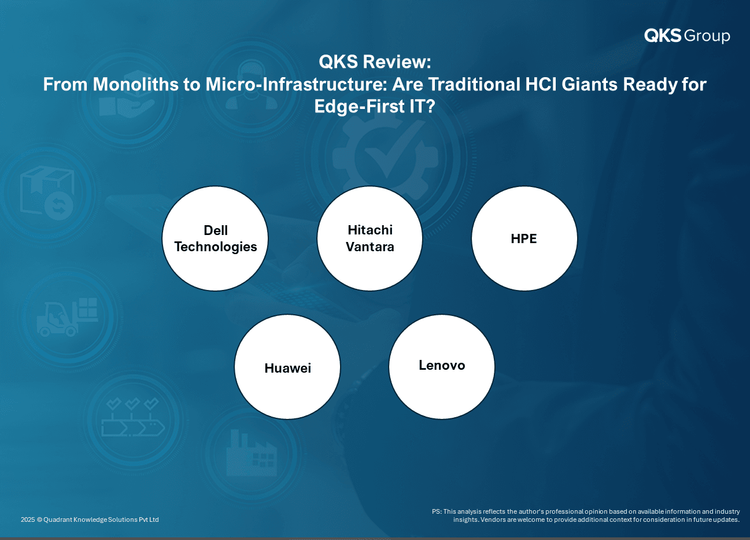
Hyperconverged infrastructure must evolve to address a very different reality - one defined by constrained space, intermittent connectivity, and the need for real-time processing close to where data is generated. The vendors explored here each bring compelling capabilities to this challenge: Dell’s sophisticated orchestration, Hitachi’s reliable enterprise-grade clustering, HPE’s ruggedized convergence of OT and IT workloads, Huawei’s integrated edge appliances, and Lenovo’s adaptable hardware-software pairings. Yet none are immune to the complexity of translating monolithic architectures into micro-infrastructure that can operate independently, scale cost-effectively, and remain simple to manage.
Organizations evaluating hyperconverged solutions for edge deployments should think beyond traditional metrics like throughput or rack density. It is equally important to assess whether a platform will enable operations teams to deploy sites remotely, keep systems patched without on-site intervention, and ensure workloads can fail over seamlessly if connectivity to the core is lost. In many cases, the ability to adopt more modular software stacks or container-first architectures will be just as critical as hardware durability or brand familiarity.
Before deciding on any solution, IT and operations leaders should consider questions such as:
- What level of autonomy must each edge location maintain if the central data centre or cloud is unreachable?
- How will lifecycle management, updates, and support be handled at sites with limited or no IT staff?
- Does the vendor offer a roadmap that clearly addresses the transition to containerized and composable workloads rather than just virtual machines?
- Are licensing, scaling, and hardware refresh strategies sustainable if deployments expand from a few locations to hundreds?
Ultimately, the shift from monolithic infrastructure to distributed edge platforms is more than a technical evolution - it is a strategic commitment to reimagining how compute, storage, and management are delivered. For enterprises willing to rethink their assumptions, this transition offers a real opportunity to create more agile, resilient, and cost-effective digital operations. The question remains: who among the traditional HCI giants will be ready to lead in this new era of edge-first IT, and who will be left adapting from behind?
Disclaimer:
This blog is based on independent research and publicly available information. The insights presented reflect the views of QKS Group and are for informational purposes only. While we strive for accuracy, we do not guarantee completeness or absolute correctness. Vendors are welcome to provide clarifications or updates. If any vendor listed in this analysis wishes to provide additional context or clarification, we welcome a briefing call and will consider incorporating relevant updates. This analysis is not intended to disparage any vendor but to provide an informed, balanced perspective. We encourage open and constructive dialogue to foster transparency and a deeper understanding of the industry.
Author : Vyshak K, Analyst - Edge Computing Systems at QKS Group
Vendors: