

22.09.2025
QKS Review
QKS Review: From Copilots to Autonomous Agents - Who’s Really Delivering Agentic AI in Multichannel Marketing Hubs?
Author:
Richa Choubey


Executive Summary:
As the Multichannel Marketing Hub (MMH) market faces rising pressure from hyper-personalization demands, CX velocity, and AI commoditization, organizations are moving beyond traditional segmentation and content recommendation engines.
This review blog by QKS Group assesses whether MMH vendors are architecting persistent, policy-bound AI agents that drive autonomous, measurable engagement or merely offering assistive tools that speed up human workflows without true autonomy.
What Modern MMH Platforms with Agentic AI Should Deliver:
Today’s platforms must offer more than AI-generated content or smart suggestions. Critical agentic capabilities include:
- Persistent AI agents that operate autonomously across multi-step workflows
- Governed decision frameworks with policy enforcement and uplift validation
- Real-time orchestration and learning loops that adapt based on causal outcomes
Key Findings:
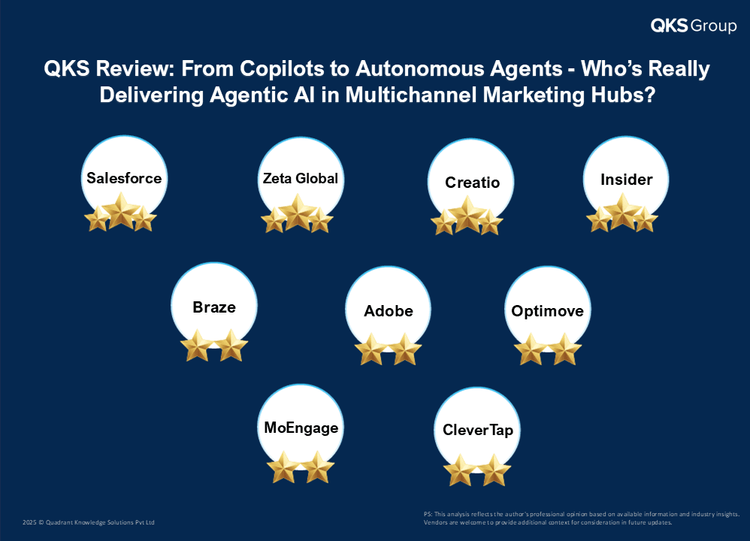
Agentic AI Leaders such as Salesforce, Zeta, Creatio and Insider demonstrate end-to-end autonomy with live AI agents executing chained workflows, optimizing via reinforcement learning, and enforcing outcomes through governed feedback loops. These platforms are redefining MMH as a self-evolving system.
Contenders in Transition like Braze, Adobe, and Optimove are investing heavily in AI-first architectures and closed-loop orchestration but currently remain anchored in assistive roles or partial autonomy. Their path to agentic execution depends on product integration maturity and enterprise readiness.
Assistive AI Providers including MoEngage and CleverTap offer valuable productivity enhancements via segmentation, scoring, and personalization but lack persistent agents, uplift optimization, or autonomous workflow chaining, making them suitable for augmentation, not full automation.
AI has become the competitive centerpiece in multichannel marketing hubs (MMH), but vendors often conflate assistive AI (recommendations, content assists) with agentic AI (persistent, autonomous, chained workflows that operate under policies and measurable feedback loops). True agentic AI must go beyond “prompt in, output out” rather it should integrate real-time data, enforce governance, and continuously learn through uplift measurement. Here’s how the key players stack up when stripped of marketing spin.
Salesforce’s Marketing Cloud Next embodies an agentic architecture in which AI agents act autonomously across campaign design, audience segmentation, content creation, and cross-channel orchestration. Strengthened by Agentforce and grounded in real-time signals from Data Cloud, the system creates a self-adapting loop where agents continuously optimize engagement strategies based on live customer interactions. This construct echoes reinforcement learning but is disciplined by causal validation, ensuring outcomes are both explainable and measurable. The model shifts marketing from broadcast communication to always-on, two-way engagement, transforming static “do-not-reply” channels into interactive experiences. For analytically advanced organizations, the framework offers evidence-based ROI, scalable personalization, and operational efficiency.
Zeta’s AI offerings embed intelligence, causality, and real-time execution into a single platform, positioning them as a strong, scientifically grounded alternative to more ad hoc automation tools. The architecture isn’t just sprinkled with “AI” rather its built with AI at its core. From Zeta Intelligence, which strengthens predictive, generative, and actionable marketing insights via numerous consumer identifiers and real-time signals, to the AI Agents and Agent Studio of Zeta’s Experience Manager, the platform is designed for marketers to ask, answer, and act with precision. Its offerings include pre-built agents across common marketing tasks (audience segmentation, campaign QA, messaging, etc.), as well as no-code tools to build custom agents. Agentic Workflows chain multiple agents to execute complex end-to-end strategies, evolving over time. Each agent and workflow acts on insights in real-time with identity data, predictive intelligence, and auto-optimization. Zeta ensures that outcomes are measurable, drift is minimized, and ROI is grounded in evidence rather than assumption.
Creatio structures its AI as a platform layer embedded in the Freedom UI runtime, combining agentic, generative, and predictive capabilities that operate natively inside standard CRM apps and any no-code apps built on the platform. The 8.2 “Energy” release introduced a unified AI environment, positioning AI as the core execution layer of the stack rather than a peripheral add-on. The Creatio AI Command Center centralized configuration and governance, serving as the operational hub for deploying out-of-the-box and custom agents with controls over scope, autonomy, and rollout across Sales, Service, and Marketing. The 8.3 “Twin” release further formalized this transition where Creatio.ai agents can function as autonomous entities that can perceive context, make decisions, and execute multi-step workflows end-to-end while remaining within defined policy and governance boundaries. This allows AI Agents to execute higher-order tasks such as orchestrating campaigns, resolving cases, or driving sales processes without requiring continual user prompts. Unlike simple assistants, Agents can be orchestrated into role-based processes, embedded contextually in other UIs (like Outlook, Teams or Zoom) or triggered invisibly in workflows, with built-in permissions, observability, and auditability. Creatio’s near-term roadmap emphasizes governed autonomy, cross-workflow orchestration, scalable application of agents across roles and domains, and embedding AI as an operational participant in business execution, moving far beyond isolated UI helpers toward a fabric of autonomous, collaborative digital actors.
Insider has emerged as a robust player with its Agent One framework, an orchestration platform designed to manage chained marketing workflows under compliance and real-time intelligence. Unlike assistive copilots, Agent One demonstrates persistent multi-step autonomy by identifying segments, generating actions, activating campaigns, and monitoring results across Insider’s engagement ecosystem. Its strength is closed-loop optimization, combining predictive decisioning with automated uplift-based iteration, ensuring campaigns not only run but improve continuously. However, the platform’s breadth still leans heavily on Insider’s native ecosystem, organizations with complex external martech stacks may face challenges fully operationalizing Agent One without customization.
Braze has built its reputation on ease of use and rapid experimentation, with Canvas Flow and Experiment Paths simplifying engagement design. AI features accelerate segmentation, personalization, and testing, democratizing access for marketing teams without deep data expertise. The recent acquisition of OfferFit (2025) signals Braze’s intent to close its autonomy gap. OfferFit specializes in reinforcement learning-driven experimentation and autonomous optimization, capabilities that could enable Braze to move beyond assistive AI toward adaptive orchestration. However, the integration is still fresh, and until OfferFit’s algorithms are natively embedded across Braze’s platform, autonomy remains aspirational. Today, Braze’s AI is still marketer-guided rather than self-directed.
Adobe’s Sensei GenAI, integrated with Firefly models, dominates in multimodal generation offering content, image, video, and asset tagging. Embedded in Experience Cloud and Journey Optimizer, it enhances productivity, accelerating campaign design and creative execution. Its technical advantage lies in tight creative and marketing integration, making Adobe invaluable for design-intensive organizations. Yet, judged against agentic AI benchmarks, Adobe falls short because it augments workflows but does not yet demonstrate persistent autonomy across segmentation, orchestration, and uplift validation. It is a creative accelerator, not a self-governing system. However, Adobe’s roadmap suggests a pivot toward agentic frameworks, though its near-term value remains tied to augmentation, not autonomy.
Optimove’s OptiGenie extends the company’s AI-first architecture into customer-led marketing, embedding predictive modeling and orchestration within a framework of self-optimizing decisioning. Its core lies in dynamically forecasting customer behaviors such as churn or purchase propensity and automating next-best-action recommendations at scale through Self-Optimizing Streams. This creates individualized journeys while maintaining a data-driven rigor anchored in segmentation and real-time analytics. For analytically mature enterprises, OptiGenie functions as a closed-loop system for maximizing customer lifetime value, reallocating resources toward treatments validated by predictive accuracy and campaign impact. Yet, this sophistication comes with trade-offs: costs, occasional bugs, and limited reporting granularity may constrain adoption. Moreover, organizations without strong experimental or analytical cultures risk underleveraging OptiGenie’s strategic optimization engine precision. Ultimately, its value rests on the enterprise’s ability to operationalize AI-led orchestration as a disciplined, evidence-based approach to customer engagement.
MoEngage’s Merlin AI supports segmentation, predictive scoring, and generative content, with strong adoption in Asia’s mobile-first markets. Its strength lies in real-time personalization at regional scale, offering cost-effective AI augmentation to mid-market enterprises. Technically, it offers good speed-to-value for resource-constrained teams. Yet, Merlin remains assistive: there are no persistent agents, uplift loops, or governance frameworks in place. This makes MoEngage a time-saver rather than a transformer. However, its incremental AI may suit fast-growing regional businesses, though it risks losing competitiveness as global players set agentic AI as the new benchmark.
CleverTap specializes in behavioral analytics, mobile engagement, and retention modeling, excelling in app-centric industries. Its Clever AI delivers predictive churn analysis, segmentation, and personalization, enabling marketers to act on detailed in-app behavioral data. From a technical perspective, it is highly effective in mobile-first growth use cases. Yet, CleverTap’s AI is still assistive rather than agentic. Campaign orchestration remains human-driven, and there are no mechanisms for autonomous chaining, policy enforcement, or uplift-validated loops. However, while strong in its niche, CleverTap risks stagnation if agentic frameworks become table stakes in customer engagement platforms.
Analyst Take
The evolution of multichannel marketing hubs reflects a growing divide between assistive and agentic AI. Most vendors continue to emphasize productivity accelerators like content generation, segmentation, and recommendations, that reduce manual effort but still rely on human orchestration. True agentic AI, however, requires persistent autonomy, governed workflows, uplift validation, and real-time adaptability. Only a select few platforms such as Salesforce, Zeta, and Insider are demonstrating meaningful progress toward this paradigm, while others remain anchored in assistive roles. For enterprises, the strategic question is not whether a vendor has “AI,” but whether the system can self-direct, self-correct, and deliver measurable outcomes at scale. The winners in this landscape will be those who treat autonomy as an architectural principle rather than a feature add-on.
Disclaimer:
This blog is based on independent research and publicly available information. The insights presented reflect the views of QKS Group and are for informational purposes only. While we strive for accuracy, we do not guarantee completeness or absolute correctness. Vendors are welcome to provide clarifications or updates. If any vendor listed in this analysis wishes to provide additional context or clarification, we welcome a briefing call and will consider incorporating relevant updates. This analysis is not intended to disparage any vendor but to provide an informed, balanced perspective. We encourage open and constructive dialogue to foster transparency and a deeper understanding of the industry.
Author: Richa Choubey, Senior Analyst – MarTech at QKS Group
Vendors: