

24.09.2025
QKS Review
QKS Review: From Alerts to Action, Evaluating NDR Solutions for Intuitive Interfaces and Fast Response
Author:
Mohnish Rathore


Executive Summary:
As the cybersecurity market faces rising pressure from increasingly sophisticated cyber threats and the need for rapid, adaptive threat detection, organizations are moving beyond traditional Network Monitoring and Security Information tools.
This review blog by QKS Group assesses whether Network Detection and Response (NDR) vendors are truly innovating to meet these demands or merely making incremental updates.
What Modern NDR Should Deliver:
Today’s platforms must offer more than core packet capture and alerting. Critical next-gen capabilities include:
• Ease of Deployment and Rapid Time-to-Value: Solutions should deploy quickly with minimal setup effort.
• Intuitive User Interfaces and Workflows: Security teams should be able to analyze and respond to threats efficiently, without struggling through complex configurations.
• Adaptive Threat Detection Powered by Automation and AI: Platforms must proactively identify attacker behavior and adjust to evolving threats in real time.
Key Findings:
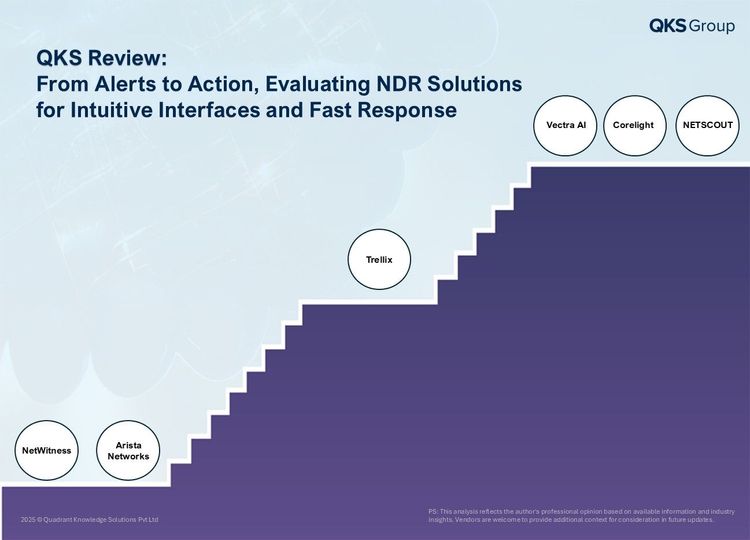
• Leading vendors Corelight, NETSCOUT, and Vectra AI stand out by delivering intuitive interfaces, fast setups, and adaptive analytics that help security teams focus on threat detection and response rather than system management.
• Trellix shows strong visibility coverage across IT, OT, and cloud environments but struggles with complex administration interfaces and rigid workflows that slow investigation processes.
• NetWitness delivers powerful analytics and deep network visibility but demands significant technical effort to deploy and operate, making it better suited for large enterprises with specialized teams.
• Arista emphasizes zero-trust and in-depth diagnostics but lacks usability and adaptive threat detection focus, resulting in a steep learning curve and slower operational adoption.
Corelight is built on open-source technologies like Zeek and Suricata, giving it a strong foundation in network visibility. What sets it apart is its focus on simplicity without compromise. The platform offers pre-packaged virtual appliances and sensor images, making deployment remarkably fast. The interface itself is designed for clarity, letting security teams focus on network traffic analysis rather than wrestling with configurations. Integration flexibility is another strong point, Corelight plays well with established tools like Elasticsearch, Splunk, and Chronicle, as well as major cloud platforms. This allows teams to build the security architecture they need without vendor lock-in. While technically capable users may invest time in advanced setups, the balance between ease of use and extensibility makes Corelight a solid choice for organizations wanting to start strong and scale intelligently.
NETSCOUT’s Omnis Cyber Intelligence platform emphasizes user-friendliness and real-time insight. From the moment it’s deployed, it offers clear dashboards and easy-to-configure workflows, transforming complex packet-level analysis into actionable alerts. One of the reasons NETSCOUT stands out is its focus on making real-time, adaptive threat detection accessible to a broad range of enterprises, including mid-sized firms without large security teams. The platform’s architecture reduces setup complexity while delivering high-fidelity data and adaptive threat analytics that feed directly into decision-making. It strikes a good balance between advanced capabilities and ease of use, positioning itself as a solution that scales with an organization’s maturity.
Vectra AI offers rapid deployment and operational simplicity, particularly for hybrid cloud and data center environments. Its AI-driven automation enables fast visibility into attacker behavior, minimizing manual configuration steps. Vectra’s interface provides intuitive workflows that highlight actionable signals, not raw data dumps, letting security teams focus on remediation rather than analysis paralysis. The platform also integrates smoothly with cloud environments and major service providers, reducing deployment friction further. Overall, Vectra’s combination of automation, clear design, and fast setup makes it an attractive option for organizations seeking adaptive threat detection without a steep learning curve.
Trellix offers wide coverage across IT, OT/ICS, and cloud environments, which sounds promising at first. However, the administration interface tends to complicate the experience. Configurations are complex, and the system relies on rigid workflows for reporting and alerting, limiting investigative agility. Alerts often lack deep context, making it more difficult to trace root causes quickly. While Trellix has strong visibility capabilities, its user experience doesn’t cater well to teams prioritizing fast deployment or ease of use. It seems better suited to large enterprises with deep technical expertise who can afford the time and resources for a complex setup.
NetWitness is powerful in terms of visibility and analytics, with real-time network traffic analysis and advanced data capture. But the learning curve is steep, and first-time deployments demand significant effort. Integrating newer network devices doesn’t happen smoothly, and the interface lacks intuitiveness. Documentation is sparse, adding to the challenges of configuration and operation. As a result, while NetWitness excels in visibility, it doesn’t offer the same level of adaptive threat detection or ease of use as some of its competitors, making it more appropriate for large enterprises with highly specialized security teams.
Arista’s NDR solution focuses on zero-trust principles and in-depth diagnostics, but this strength comes with complexity. The query language isn’t user-friendly, requiring significant time to master, and the workflows don’t facilitate rapid deployment or easy threat investigation. Adaptive threat detection doesn’t receive particular emphasis. Instead, the system feels geared toward organizations with highly specialized security engineering teams that can navigate its complexities and maximize its analytical depth.
Conclusion
Ease of deployment and usability aren’t just nice-to-have features in an Network Detection and Response solution—they’re critical to turning data into action. Corelight, NETSCOUT, and Vectra AI rise to the top by delivering intuitive interfaces, fast setups, and minimal friction when going live. These solutions enable security teams to focus on detecting and responding to threats, not on fighting the product.
On the other hand, Trellix, RSA NetWitness, and Arista offer powerful visibility and deep analytics but come with complexity that can slow down deployment and daily operations. These solutions may still be the right choice for large enterprises with significant security resources, but they are less appealing for teams seeking agility and operational simplicity.
At the end of the day, if your goal is to have an NDR solution that accelerates your security operations without excessive setup time or steep learning curves, Corelight, NETSCOUT, and Vectra AI should be at the top of your shortlist.
Disclaimer:
This blog is based on independent research and publicly available information. The insights presented reflect the views of QKS Group and are for informational purposes only. While we strive for accuracy, we do not guarantee completeness or absolute correctness. Vendors are welcome to provide clarifications or updates. If any vendor listed in this analysis wishes to provide additional context or clarification, we welcome a briefing call and will consider incorporating relevant updates. This analysis is not intended to disparage any vendor but to provide an informed, balanced perspective. We encourage open and constructive dialogue to foster transparency and a deeper understanding of the industry.
Author: Mohnish Rathore, Analyst - Customer Identity and Access Management (IAM)
Vendors: