

29.08.2025
QKS Review
QKS Review: Evaluating Cloud Security Gateways – Which Platforms Deliver True AI-Driven Protection for SaaS, Web, and Encrypted Traffic?
Author:
Aiyaz Ahmed


Executive Summary:
As enterprises accelerate SaaS adoption and expand remote access, securing web, SaaS, and encrypted traffic has become a foundational requirement in cloud security. Cloud Security Gateways (CSGs) now serve as the control point for policy enforcement, threat detection, and data protection. With encrypted traffic and SaaS API usage growing rapidly, the effectiveness of these platforms increasingly depends on their ability to integrate AI-driven inspection, anomaly detection, and adaptive policy orchestration.
This QKS Group review assesses whether leading CSG vendors are delivering operationally mature, AI-centric enforcement for SaaS and encrypted traffic, or relying on conventional DNS-first or appliance-based approaches that limit inspection depth and detection accuracy.
What Modern Cloud Security Gateways Should Deliver:
To meet the demands of SaaS-heavy, encrypted environments, CSG platforms should provide:
- AI/ML-driven inspection across inline and API-based channels
- Adaptive policy orchestration with automated enforcement actions
- Scalable TLS/SSL decryption and anomaly detection for encrypted flows
- Real-time telemetry correlation across distributed PoPs and user sessions
Key Findings:
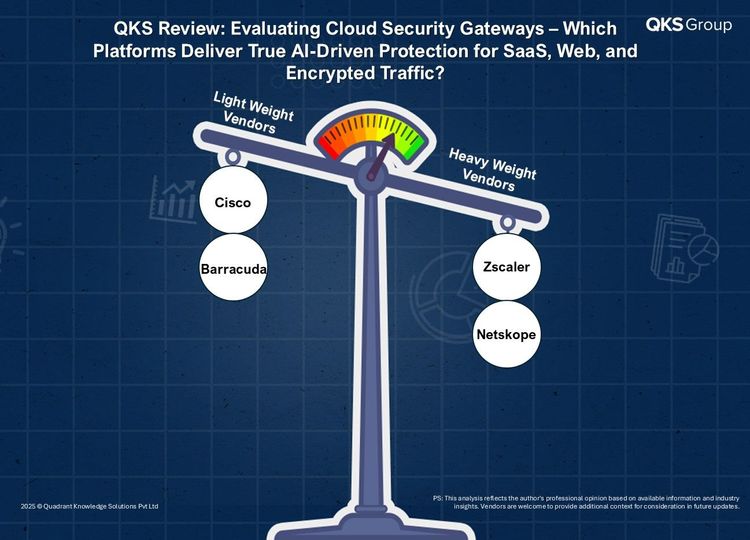
- Zscaler, Netskope demonstrate advanced AI-driven inspection and automated enforcement, integrating SaaS APIs and inline proxy models to detect anomalies, assign dynamic risk scores, and orchestrate policy actions at scale.
- Cisco Umbrella and Barracuda rely more heavily on DNS-layer controls or hybrid appliance/cloud models, offering reliable baseline protections and AI-assisted threat detection. However, their approaches provide limited inspection depth for SaaS APIs and require more manual tuning or capacity planning when scaling encrypted traffic inspection.
The New Perimeter: SaaS, Web, and Encrypted Traffic
As enterprises adopt cloud-first strategies and increase SaaS usage, securing web, SaaS, and encrypted traffic has become a critical part of modern security architecture. Cloud Security Gateways provide policy enforcement, threat detection, and data protection between users and cloud resources. Modern solutions combine TLS/SSL inspection, API integrations, telemetry analysis, and AI/ML-driven detection to identify anomalies, prioritize risks, and enable automated containment.
This review benchmarks four cloud security gateway platforms and classifies them based on operational maturity, AI-driven enforcement, and breadth of cloud coverage. Vendors are grouped as AI-Centric Cloud Security Gateways, platforms demonstrating advanced AI-enabled detection, adaptive policy orchestration, and automated containment and Hybrid / Conventional Cloud Security Gateways, platforms providing standard protections, often relying on DNS or appliance-based models with limited AI integration. This classification highlights differences in detection methods, policy enforcement, and cloud coverage.
AI-Centric Cloud Security Gateways
Zscaler operates a cloud-native Zero Trust Exchange with globally distributed points of presence. Its AI models aggregate telemetry from web traffic, SaaS APIs, and device posture to generate dynamic risk scores. Inline enforcement can block sessions, quarantine devices, or revoke access, and the platform provides cross-PoP telemetry correlation for alert context.
How consistently can Zscaler prioritize threats and manage false positives across high-volume SaaS traffic?
Netskope uses a combination of inline proxy enforcement and API-based integration to provide visibility into sanctioned and unsanctioned cloud applications. Its AI-driven anomaly detection monitors user behavior, account activity, and file-level content, and automated policy recommendations address detected anomalies across inline and API channels.
How effectively can Netskope’s AI adapt to changing SaaS environments and identify anomalous behavior?
Hybrid / Conventional Cloud Security Gateways
Cisco Umbrella provides DNS-layer threat protection and cloud SWG functions with Talos threat intelligence. The platform blocks known malicious domains and collects telemetry for analysis, but DNS-first controls do not include inline inspection for encrypted SaaS traffic or API-only channels.
Does reliance on DNS-first controls leave gaps in encrypted or API-only traffic inspection?
Barracuda offers appliance-based SWG and cloud-managed firewall capabilities with network-focused AI-assisted threat detection. It supports TLS inspection and hybrid deployments, though scaling to large, multi-region SaaS traffic flows may require configuration and capacity planning.
How effectively does Barracuda handle distributed SaaS traffic while maintaining AI-driven detection accuracy?
Final Insights
The evaluation highlights a divide between platforms embedding AI-driven inspection and adaptive enforcement, and those maintaining more conventional gateway architectures. Zscaler and Netskope illustrate the use of AI to automate risk detection and policy orchestration across SaaS, web, and encrypted traffic. Cisco Umbrella and Barracuda, in contrast, rely more heavily on DNS-layer controls or appliance-centric models, providing consistent protections but with different levels of inspection depth. These differences surface practical trade-offs in detection accuracy, scalability, and SaaS coverage.
Across these models, the common thread is that SaaS growth, encrypted flows, and distributed access are outpacing static enforcement. AI-driven inspection is emerging less as an optional capability and more as the operational backbone of cloud security gateways. The real consideration for enterprises is not if AI-driven enforcement becomes necessary, but how quickly they are prepared to integrate it into their cloud security architecture.
Disclaimer:
This blog is based on independent research and publicly available information. The insights presented reflect the views of QKS Group and are for informational purposes only. While we strive for accuracy, we do not guarantee completeness or absolute correctness. Vendors are welcome to provide clarifications or updates. If any vendor listed in this analysis wishes to provide additional context or clarification, we welcome a briefing call and will consider incorporating relevant updates. This analysis is not intended to disparage any vendor but to provide an informed, balanced perspective. We encourage open and constructive dialogue to foster transparency and a deeper understanding of the industry.
Author: Aiyaz Ahmed, Analyst at QKS Group
Vendors: