

18.06.2025
QKS Review
QKS Review: Evaluating AI in Mobile Engagement Automation Platforms: Leaders vs Contenders
Author:
Richa Choubey


Executive Summary:
As the Mobile Engagement Automation (MEA) market evolves under pressure from hyper-personalization demands, customer churn risks, and operational complexity, organizations are moving beyond traditional campaign execution tools.
This review blog by QKS Group assesses whether MEA vendors are embedding AI deeply enough to support predictive engagement, real-time orchestration, and scalable automation or still relying on rule-based workflows masked as intelligent features.
What Modern AI-Powered Mobile Engagement Platforms Should Deliver:
Today’s platforms must offer more than automated segmentation. Critical next-gen AI capabilities include:
- Behavior-aware, real-time orchestration across multiple channels
- Predictive analytics that guide timing, content, and next-best action
- Embedded intelligence layers that operate without manual intervention
Key Findings:
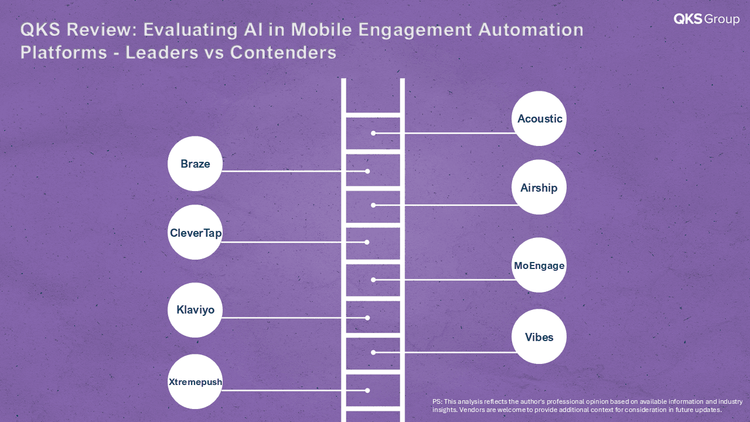
AI Leaders such as Acoustic, Braze, Airship, and CleverTap stand out with deeply embedded AI that drives adaptive journeys, predictive segmentation, generative content, and low-latency orchestration transforming engagement from rule-based to intelligent.
AI Contenders like MoEngage, Klaviyo, Vibes, and Xtremepush demonstrate promising AI capabilities across personalization and prediction but remain dependent on clean data pipelines, backend integration, or require user-side operational maturity to extract full value.
Lagging platforms were not formally categorized in this analysis, but the absence of algorithmic transparency, underdeveloped decision automation, and reliance on static logic in some tools indicates a growing gap in readiness for AI-first engagement ecosystems.
AI-powered Mobile Engagement Automation (MEA) platforms are rapidly transforming how brands connect with users, enabling businesses to orchestrate highly personalized, real-time interactions across channels. From push notifications to SMS, in-app messaging, and beyond, AI is becoming the silent engine driving smarter user segmentation, behavior prediction, and dynamic content delivery. Yet, the market remains fragmented in terms of AI maturity. While some platforms have embedded AI as a core operational layer, others provide a mix of manual workflows and predictive assistance. This analysis classifies key market vendors into two categories: Leaders and Contenders based on the maturity, accessibility, and execution depth of their AI capabilities.
AI Leaders: Platforms with Advanced Personalization and Automation
Acoustic positions itself as an AI-first mobile engagement platform, offering a comprehensive suite of capabilities that support real-time, personalized marketing across email, SMS, push, WhatsApp, and in-app messaging. Through Acoustic Connect, the platform uses behavioral and transactional data to automate customer journeys and adapt content delivery dynamically. Its AI-driven segmentation and predictive analytics identify high-value users, forecast churn, and suggest next-best actions, enabling marketers to optimize engagement with minimal manual input. AI-generated tagging and content suggestions streamline asset management and campaign creation, while sentiment analysis helps refine messaging tone for relevance. The unified Insights dashboard supports cross-channel performance monitoring, including email heatmaps and behavioral analysis. Acoustic also applies deep learning models to orchestrate multi-touch journeys and automate timing decisions across channels. Its combination of real-time intelligence, intelligent automation, and scalable personalization makes it particularly suitable for mid-market or enterprise teams aiming to increase retention, conversion, and operational efficiency without compromising on contextual engagement.
Braze’s comprehensive AI-driven platform combines real-time personalization, predictive analytics, and automated journey orchestration. The platform’s Connected Content AI integrates external data sources to deliver context-aware messaging to the organizations, while its Intelligent Timing uses machine learning to optimize delivery moments for higher engagement. Their segmentation engine also helps organizations to categorizes users by behavior, location, and preferences, enabling targeted push, in-app, and email campaigns. BrazeAI™ also includes generative tools like a copy assistant and image generator, helping organizations to streamline content creation. Its predictive models help users to identify churn risk and purchase intent, allowing them to adjust strategies based on user signals. The platform’ Personalized Paths feature allows organizations to automate decision-making on message timing, content, and channels. With the acquisition of OfferFit, Braze added reinforcement learning in its platform to continuously refine campaigns. As its AI tools are embedded into the Canvas orchestration engine thus supporting organizations with data-driven engagement across channels. Also, the platform is designed for scale enables enterprises to increase retention and customer value without additional manual effort.
Airship leads in AI-powered mobile engagement through its strong legacy in push notifications, in-app messaging, and customer journey automation. The platform analyzes user behavior in real-time by leverages predictive AI models allowing marketers to send contextually relevant content at the right time and on the optimal channel. Its dynamic content personalization ensures every user experience is unique thus enhancing both retention and app engagement. While its analytics provide users with ongoing feedback loops for strategy development, Airship's AI-driven orchestration engine translates live behavioral signals into active engagement paths. The platform's emphasis on "micro-moments" helps users to deliver hyper-personalized, high-frequency interactions throughout the entire user experience. Airship supports scalable engagement strategies that feel uniquely curated by including enterprise-grade automation and intelligent decisioning embedded into the core architecture.
CleverTap developed its AI edge on TesseractDB, a proprietary architecture meant to process massive volumes of real-time behavioral data, enabling the platform to continuously adapt to user activity and deliver hyper-targeted user experiences across push, in-app, web, SMS, and email. The platform’ behavioral segmentation along with artificial intelligence operates in real time ensures that campaigns reflect current user intent. Its features like Flows AI and Automated Journeys intelligently orchestrate engagement across lifecycle stages, optimizing timing, content, and channels. CleverTap enables companies to create tailored journeys at scale by eliminating guesswork by predictive analytics and automated decisioning. CleverTap provides a strong foundation for companies trying to combine agility with intelligence that supports operational efficiency and strategic insight.
AI Contenders: Platforms with Balanced but Dependent Intelligence
MoEngage delivers a strong AI proposition through its Sherpa engine, which helps brands predict user behavior, segment audiences dynamically, and deliver context-aware campaigns across mobile channels. The platform is particularly effective in churn prediction and lifecycle management, using behavioral signals to automate re-engagement strategies. However, MoEngage’s AI performance is tightly coupled with data quality. While Sherpa offers significant value in dynamic segmentation and campaign adaptation, organizations must invest in proper setup and data hygiene to realize its full potential. For data-mature teams, MoEngage is a scalable solution with meaningful automation depth.
Klaviyo’ MEA platform integrates predictive and generative AI, across mobile and email engagement, enables users to auto-generate content, segment intelligently, and forecast consumer behavior including churn or next purchase. The platform’ features like review automation and smart send times provide users with campaigns temporal responsiveness and accuracy, but its effect mostly relies on technical readiness and historical data volume. Its restricted data environments might compromise the value of AI, and depending too much on created content could weaken message authenticity. The platforms complex integrations may also require developer support. Klaviyo shines where infrastructure exists to support it, especially for teams trying to translate data into real-time insight and scaled customized messaging.
Vibes focus on SMS marketing, mobile wallet campaigns, and rich media messaging, specialize in AI-powered mobile engagement. The platform enables organizations to deliver personalized and real-time mobile experiences with its AI-driven automation platform thus helps in reducing customer churn. Its ML-based audience segmentation algorithm ensures that organizations target the right users with relevant offers and updates. However, the platform lacks transparency in its AI model operations, making it harder for brands to refine their engagement strategies effectively. Also, while it shines in mobile-first engagement, its AI-driven analytics are not as good as some of its competitors, limiting data-driven optimizations. For users looking to execute large-scale SMS and mobile wallet campaigns, the platform provides reliable AI-powered automation that enhances customer interactions.
Xtremepush clearly emphasizes regulatory compliance and data governance while bringing AI-driven personalizing to omnichannel campaigns. Its recommendation engine and predictive segmentation enable precise outreach across SMS, push, email, and web. The platform suits industries where data control and privacy are absolutely vital. It does not, however, have the real-time flexibility and intuitive interfaces as found in other platforms. It’s dynamic content personalization and journey orchestration have AI capabilities, but they are underdeveloped. Though not for companies looking for innovative engagement agility, Xtremepush is a good choice for security-conscious sectors.
Analyst Take
The Mobile Engagement Automation market is rapidly shifting from rule-based workflows to AI-native architectures that anticipate, adapt, and automate user interactions at scale. Vendors like Braze, Acoustic, Airship, and CleverTap have demonstrated a forward-thinking approach, embedding AI across the engagement lifecycle with a focus on real-time responsiveness, data orchestration, and behavioral insight. Contenders such as Vibes and Klaviyo show clear potential, though success depends on the user’s technical maturity and data infrastructure. Meanwhile, lagging platforms risk obsolescence unless they modernize their AI engines to meet rising personalization and automation demands. For enterprise buyers, platform selection should not hinge solely on feature breadth but on the tangible value AI delivers across segmentation, execution, and lifecycle optimization. Ultimately, AI is no longer a value-add, it is the operating logic for modern engagement.
Disclaimer & Invitation:
This blog is based on independent research and publicly available information. The insights presented reflect the views of QKS Group and are for informational purposes only. While we strive for accuracy, we do not guarantee completeness or absolute correctness. Vendors are welcome to provide clarifications or updates. If any vendor listed in this analysis wishes to provide additional context or clarification, we welcome a briefing call and will consider incorporating relevant updates. This analysis is not intended to disparage any vendor but to provide an informed, balanced perspective. We encourage open and constructive dialogue to foster transparency and a deeper understanding of the industry.
Author: Richa Choubey, Analyst – MarTech at QKS Group
Vendors: