

25.06.2025
QKS Review
QKS Review: End-to-End Vulnerability Management – Which Vendors Deliver and Who Falls Short?
Author:
Sujitsinh Dubal


Executive Summary:
As the Vulnerability Management market faces rising pressure from complex attack surfaces, alert fatigue, and the lack of continuous validation, organizations are moving beyond traditional scanning tools.
This review blog by QKS Group assesses whether vulnerability management vendors are truly innovating to deliver end-to-end lifecycle coverage or merely reinforcing outdated detection-and-reporting approaches.
What Modern Vulnerability Management Platforms Should Deliver:
Today’s platforms must offer more than core features. Critical next-gen capabilities include:
• Risk-based prioritization informed by real-world exploitability and business context
• Automated remediation workflows with patch validation and SLA tracking
• Comprehensive visibility across IT, OT, IoT, and hybrid cloud environments
Key Findings:
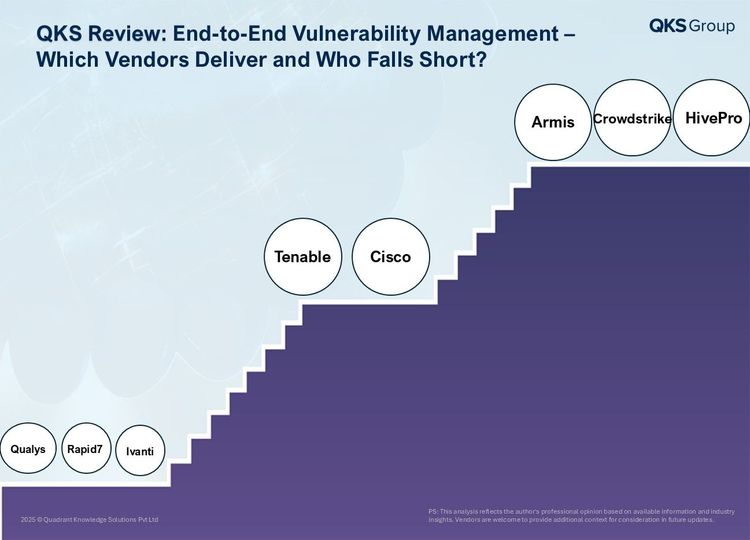
Leading approaches from NorthStar, NopSec, Anchore, Aqua Security, and BreachLock demonstrate forward momentum in continuous validation, automation, and DevSecOps alignment.
Capable vendors such as Ivanti and Cisco Kenna show partial maturity but remain limited in end-to-end remediation and integrated validation.
Lagging platforms including CrowdStrike, Qualys, Rapid7, Tenable, Armis, and HivePro continue to focus on scanning, with minimal lifecycle coverage, limited automation, or constrained scalability falling short of enterprise needs.
The vulnerability management market remains fragmented, with most vendors excelling in isolated areas while failing to deliver a complete end-to-end solution. The previous blog highlighted how top vendors like CrowdStrike, Qualys, Rapid7, and Tenable struggle to provide a seamless vulnerability lifecycle. Now, let’s take the conversation a step further by exploring emerging approaches, analysing key vendors, and highlighting solutions that are attempting to bridge the gaps in vulnerability management.
Why Current Solutions Are Failing
Traditional vulnerability management vendors focus on scanning, reporting, and some level of prioritization, but very few address the entire process, including remediation validation and automation. The biggest challenges in this space include:
- Lack of Prioritization Based on Real Risk: Many tools rely on outdated CVSS scores instead of using real-world threat intelligence and business context.
- Fragmented Remediation Workflows: Security teams are forced to manually track fixes, slowing down response times.
- Limited Visibility Beyond Traditional IT: Many vendors still struggle with OT, IoT, and cloud environments, leaving major attack surfaces exposed.
- No Continuous Validation: Organizations apply patches but rarely validate if they were effective in stopping real-world threats.
Vendor Analysis: How Leading Solutions Stack Up
Let's break down where the major players stand in this market and how they are addressing (or failing to address) the critical challenges.
CrowdStrike: Endpoint-Obsessed and Blind to the Bigger Picture
CrowdStrike dominates in endpoint vulnerability detection but falls behind in managing vulnerabilities across networks, cloud, and IoT/OT environments. While Falcon excels at identifying endpoint risks, it lacks broader attack surface visibility, especially in operational technology (OT) environments. Additionally, it has limited integrations with External Attack Surface Management (EASM) tools, a growing necessity for identifying internet-facing risks.
Qualys: The Master of Scanning, But Lacking in Prioritization
Qualys is known for scanning everything, but its biggest flaw is treating all vulnerabilities equally, leading to alert fatigue and inefficient remediation. It still lacks strong integrations for Breach and Attack Simulation (BAS), which is crucial for validating whether vulnerabilities have been effectively remediated. While VMDR (Vulnerability Management, Detection, and Response) is one of the most comprehensive scanning tools available, it falls short in real-world risk prioritization.
Rapid7: Slick UI, Shallow Functionality
Rapid7’s InsightVM claims to be a comprehensive vulnerability management tool, but it lacks depth in several areas. The tool provides a sleek user interface, yet struggles with remediation orchestration and prioritization beyond basic threat feeds. Moreover, it lacks integration with Cyber Asset Attack Surface Management (CAASM) and BAS solutions, leaving organizations unable to fully validate their fixes.
Tenable: Covers Everything, Masters Nothing
Tenable attempts to be an all-in-one solution, offering scanning, reporting, and some prioritization capabilities. However, its risk-based vulnerability management (RBVM) tool, Lumin, lacks depth when applied to complex IT environments. Additionally, Tenable has limited capabilities for patch validation and remediation workflows, often relying on third-party integrations.
Cisco (Kenna Security): Great at Prioritization, Weak at Remediation
Cisco’s Kenna Security excels in risk-based prioritization but lacks native scanning capabilities and remediation automation. Without strong CAASM and BAS integrations, organizations must rely on additional tools to bridge the gaps in their vulnerability management workflow. For an enterprise security giant, Cisco’s piecemeal approach is surprising and limits its effectiveness in managing vulnerabilities end-to-end.
Armis: OT and IoT Specialist, But a Fragmented Offering
Armis specializes in IoT and OT asset discovery but lacks its own vulnerability scanning capabilities. While it provides excellent visibility into connected devices and unmanaged assets, it still requires integration with other tools like Tenable or Qualys for a full vulnerability management solution. Armis does not offer robust risk prioritization, remediation tracking, or validation, making it a niche player rather than a complete solution.
HivePro: Buzzword-Driven, Lacking Enterprise Depth
HivePro claims to focus on threat intelligence-driven prioritization, but it struggles with scalability and depth. The Uni5 platform lacks advanced integrations with BAS and EASM tools and provides limited automation for remediation workflows. Additionally, HivePro’s platform has been criticized for being too lightweight for enterprise-grade vulnerability management, making it more suitable for smaller organizations with simpler security needs.
Newer Approaches in the Market
While most traditional vendors are slow to innovate, some companies are attempting to solve these persistent challenges with more advanced solutions.
1. Risk-Based Prioritization
Tools like NorthStar and NopSec Unified VRM take a more intelligent approach by incorporating threat intelligence, exploitability analysis, and business context into vulnerability prioritization. Instead of overwhelming security teams with thousands of vulnerabilities, these solutions focus on the few that truly matter those with a high probability of being exploited in the wild.
For example, NorthStar’s approach reduced a sample organization’s vulnerability backlog from 1.23 million findings to just 834 truly critical issues, a game-changer for overburdened security teams.
2. Automating Vulnerability Remediation
Some vendors are shifting from merely identifying vulnerabilities to actively fixing them. Ivanti, for instance, automates endpoint patching but lacks broader IT environment coverage. More comprehensive solutions like Alfa Group’s RHDVM provide end-to-end vulnerability lifecycle management, integrating automated remediation workflows to ensure fixes are tracked and completed.
3. SBOM-Driven Supply Chain Security
With software supply chain attacks on the rise, Anchore offers Software Bill of Materials (SBOM)-powered vulnerability management, ensuring continuous security across the software development lifecycle. This approach enables real-time detection of software component vulnerabilities, making it invaluable for DevSecOps teams.
4. Exposure Management & Continuous Testing
Companies like BreachLock are moving beyond traditional vulnerability management by incorporating attack surface management (ASM) and offensive security validation. Instead of waiting for vulnerabilities to be discovered through scans, these platforms continuously test an organization’s security posture, ensuring risks are proactively identified and remediated.
5. Integrated Cloud and DevOps Security
Cloud environments introduce new challenges that legacy vulnerability management tools aren’t designed to handle. Aqua Security and Runecast are tackling this problem with code-to-cloud vulnerability management and agentless scanning across hybrid cloud environments. By embedding security from development to production, they help eliminate vulnerabilities before they ever reach runtime.
Where the Market Needs to Go
Despite these advancements, the vulnerability management market still has a long way to go. A truly effective vulnerability management solution must:
- Integrate Risk-Based Prioritization: Move beyond CVSS scores and leverage real-world threat intelligence.
- Automate Remediation Workflows: Reduce manual effort with automated patching and fix validation.
- Provide End-to-End Visibility: Cover all assets, including OT, IoT, and cloud environments.
- Continuously Validate Fixes: Use BAS and exposure management techniques to ensure vulnerabilities are truly mitigated.
- Seamlessly Fit into DevSecOps Pipelines: Enable security at every stage of software development.
Final Thoughts: What Should End Users Do?
For security teams evaluating vulnerability management solutions, the key takeaway is this: avoid vendors that only do scanning and reporting. Look for solutions that integrate prioritization, remediation, validation, and automation into a single workflow.
Instead of blindly trusting vendor claims, organizations should test solutions against real-world attack scenarios, ensuring they offer actionable insights rather than just dashboards filled with vulnerabilities.
Until vendors evolve into true, lifecycle-first platforms, organizations will continue to struggle with inefficiencies, wasted resources, and unmitigated risks. The future of vulnerability management must shift from merely identifying threats to actively securing environments in real time.
Disclaimer:
This blog is based on independent research and publicly available information. The insights presented reflect the views of QKS Group and are for informational purposes only. While we strive for accuracy, we do not guarantee completeness or absolute correctness. Vendors are welcome to provide clarifications or updates. If any vendor listed in this analysis wishes to provide additional context or clarification, we welcome a briefing call and will consider incorporating relevant updates. This analysis is not intended to disparage any vendor but to provide an informed, balanced perspective. We encourage open and constructive dialogue to foster transparency and a deeper understanding of the industry.
Author: Sujitsinh Dubal, Analyst - Network Security at QKS Group
Vendors: