

27.06.2025
QKS Review
QKS Review: Digital Twins in Transportation: Moving from Visibility to Predictive Logistics.
Author:
Moumita Neogy


Executive Summary:
Executive Summary:
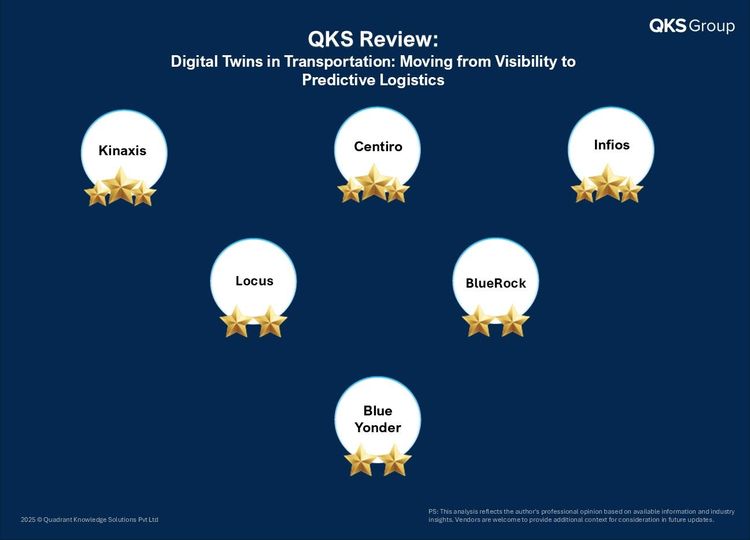
In an era where real-time visibility has become the norm, the next evolution in transportation management lies in predictive logistics powered by digital twins. This blog evaluates six key vendors-Kinaxis, Centiro, Infios, Locus, Blue Yonder, and BlueRock-through the lens of digital twin maturity, simulation depth, and predictive execution. While some vendors exhibit strong visibility and simulation capabilities, most still fall short of delivering real-time, AI-driven decision-making. The blog emphasizes that true transformation requires moving beyond post-event insights to platforms that can anticipate disruptions, simulate outcomes, and orchestrate proactive actions. As volatility intensifies across global logistics networks, digital twins are no longer optional-they are the new standard for resilient, intelligent transportation systems.
In a logistics environment defined by volatility, velocity, and vanishing margins, real-time visibility is no longer a competitive edge - it's table stakes. The real shift is happening deeper: transportation systems that not only observe but predict, simulate, and optimize continuously.
Enter the age of the digital twin - a synchronized, AI-powered virtual replica of logistics networks that doesn’t just mirror reality but helps rewire it before breakdowns occur.
This evaluation dissects six vendors - Kinaxis, Centiro, Infios, Locus, BlueYonder, BlueRock- through the lens of digital twin maturity, simulation depth, and how far their platforms have truly moved from visibility to cognitive logistics execution.
Anatomy of a Predictive Transportation Digital Twin
Legacy TMS platforms still operate with post-event intelligence: route deviations, missed ETAs, carrier failures - all surfaced after damage is done. A modern digital twin for transportation should offer:
- Continuously synchronized logistics models, updated with real-world telemetry, traffic, and disruption data
- AI-powered simulation engines to model “what-if” transport scenarios in real-time
- Predictive alerting and prescriptive decisioning, not just status dashboards
- Deep integration with warehouse, inventory, and demand systems, enabling true supply chain orchestration
If your TMS can’t simulate, predict, or self-correct - it’s not future-ready.
- Kinaxis: Strategic Twin Strength, Operational Twin Gap
Kinaxis has long led the charge in concurrent planning and supply chain simulation. Its RapidResponse platform shines in modelling macro-level disruptions and cascading lead-time risks.
However, when it comes to transportation-specific twins-such as real-time route re-optimization or dynamic carrier switching-its capabilities are still developing. The company’s strategic simulation depth isn’t matched by real-time logistics execution.
In Short: Kinaxis knows how to plan for what should happen, but its grasp on what is happening on the road needs to mature.
- Centiro: Clarity in Execution
Centiro has earned a solid reputation for managing complex last-mile and parcel networks with commendable control and traceability. It enables shippers and retailers to gain high-visibility oversight of logistics flows.
Yet, this strength in clarity does not translate into foresight. There’s a notable absence of twin-based scenario planning, AI-led simulation, or proactive disruption mitigation. Centiro remains strong on visibility but light on cognition.
In Short: Execution is its forte. Prediction still needs attention.
- Infios: Digitally Capable
Infios brings digital strength to process orchestration and workflow enablement across logistics nodes. It executes well in digitizing operations and enabling visibility layers within legacy infrastructure.
However, its footprint in simulation-based transport planning, AI-driven disruption modelling, or predictive twin architecture is currently lacking. The company plays in the digital enablement space but has yet to step into the predictive logistics arena.
In Short: Digitally mature, but still distant from predictive intelligence.
- Locus: Simulation Built In, but Intelligence Tapped Out
Locus places simulation at the core of its logistics engine-distinguishing itself from platforms that treat planning and execution as separate silos. The system enables enterprises to model routing scenarios, account for real-world disruptions, and evaluate logistics strategies before they go live, helping teams move from reactive decisions to proactive optimization.
What sets Locus apart is how tightly it integrates simulation with real-time execution. The platform doesn’t just forecast outcomes-it acts on them. From dynamic re-routing and automated dispatch to disruption-aware planning, Locus handles many logistics decisions autonomously. While policy configuration and exception handling remain customizable, the system is designed to continuously adapt without waiting for manual input.
In short: Locus brings together simulation and automated execution in a way that supports fast, intelligent logistics decisions-grounded in data, and built for change.
- BlueRockTMS: Analytics Potential, but Lacking Transportation Depth
BlueRock positions itself as a supply chain analytics provider, yet its digital twin story is nearly invisible. No notable public use cases, no dedicated simulation engine, and no transportation-specific AI frameworks.
It’s a platform with ambition, but aspiration not equal to execution. Until twin-based transport optimization becomes more than a buzzword in their stack, BlueRock remains on the sidelines of predictive logistics.
In Short: There’s nothing wrong with ambition. But without evidence, it's just a pitch deck. BlueRock isn’t just behind- it’s not even playing the right game.
- Blue Yonder: Ambitious Integration, Cumbersome Execution
Blue Yonder's transportation platform is ambitious-blending machine learning, demand sensing, and predictive simulation into one decision layer. It can simulate modal disruptions, balance sustainability metrics, and prescribe rerouting logic-on paper.
But the cost of implementation, steep learning curve, and integration-heavy architecture slow down real-world value realization. For many, the cognitive capability exists-but remains locked behind complexity.
In Short: Twin capabilities are impressive, but the barrier to entry is high.
Final Thoughts: Prediction Is the Next Frontier
Transportation leaders are under more pressure than ever. It’s not just about knowing where things are. It’s about knowing what’s coming next and being ready for it.
In today’s fast-changing logistics world, just knowing about problems isn’t enough- you need to stay one step ahead of them. That’s where digital twins come in. They don’t just show what’s happening; they help you test different options and make smarter choices before issues even occur.
Transportation systems must move beyond simply tracking events. The real value lies in predicting what’s next and being ready for it - because reacting in real time is already too late.
Disclaimer:
This blog is based on independent research and publicly available information. The insights presented reflect the views of QKS Group and are for informational purposes only. While we strive for accuracy, we do not guarantee completeness or absolute correctness. Vendors are welcome to provide clarifications or updates. If any vendor listed in this analysis wishes to provide additional context or clarification, we welcome a briefing call and will consider incorporating relevant updates. This analysis is not intended to disparage any vendor but to provide an informed, balanced perspective. We encourage open and constructive dialogue to foster transparency and a deeper understanding of the industry.
Author: Moumita Neogy, Analyst - Supply Chain Execution (SCE) at QKS Group
Co-Author: Kumar Anand, Associate Director& Principal Industry Analyst at QKS Group
Vendors: