

27.06.2025
QKS Review
QKS Review: David vs Goliath in SD-WAN: The Rise of Single-Vendor SASE Solutions
Author:
Kaushik V


Executive Summary:
As the Enterprise Networking market faces rising pressure from multi-vendor environment, Data protection, data sovereignty, and security risks, organizations are moving beyond traditional SASE tools.
This review blog by QKS Group assesses whether SASE vendors are truly innovating to meet these demands - or merely making incremental updates.
What Modern SASE Should Deliver:
Today’s platforms must offer more than core features. Critical next-gen capabilities include:
- Single Source of Truth
- Seamless integration
- Security Posture Management
- Data Storage and Management
Key Findings:
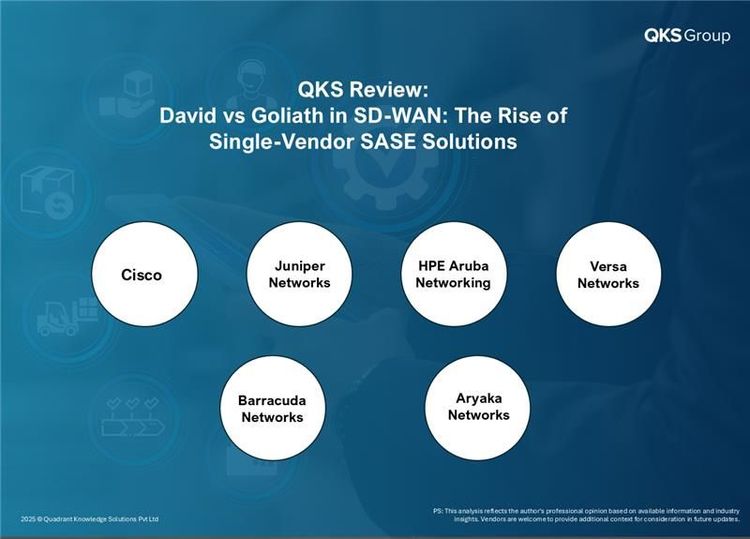
- Leading vendors (Cisco, Juniper Networks, HPE Aruba Networking) stand out with comprehensive, enterprise-grade solutions, with strong global presence.
- Capable vendors (Barracuda Networks, Aryaka Networks, Versa Networks) show promise in niche areas but lack brand recognition or global scale.
The SD-WAN market has moved well beyond just intelligent path selection and centralized control. As cloud adoption and distributed workforces reshape enterprise connectivity, the need for converging networking and security has become non-negotiable. This is where Single Vendor SASE, or Secure Access Service Edge from a unified provider, emerges, not just as a trend but as a strategic imperative. Beyond simplicity and integration, the success of these solutions hinges on the vendor's core networking architecture: their control and data plane design, WAN fabric depth, security insertion points, and orchestration intelligence.
What is Single Vendor SASE:
Single Vendor SASE (Secure Access Service Edge) is when a single provider delivers both SD-WAN and security features, including Secure Service Edge (SSE) and Security Service Architecture (SSA). Unlike multi-vendor setups, this approach ensures seamless integration, better performance, and easier management. It simplifies operations, enhances security, and optimizes network performance by eliminating the need to coordinate multiple vendors.
Why is Single Vendor SASE Offering Capability Required for SD-WAN Purchases?
When purchasing an SD-WAN solution, organizations increasingly seek vendors that can also offer SASE capabilities. This is driven by the growing demand for:
- Simplified IT Operations: Managing multiple vendors can be cumbersome, requiring additional resources for integration and troubleshooting. A single vendor offering streamlines operations and reduces management overhead.
- Consistent Security Posture: A unified security framework ensures consistent policies across the network without relying on third-party integrations that may introduce compatibility issues.
- Optimized Performance: A tightly integrated SD-WAN and security stack reduces latency and improves overall network efficiency.
- Cost Efficiency: Enterprises can reduce costs associated with multiple vendor contracts, licensing, and operational expenses.
- Future-Proofing Investments: With the industry shifting towards SASE, choosing an SD-WAN vendor with strong security capabilities ensures long-term viability and scalability.
In this market, a few giants dominate with broad portfolios, expansive global reach, and deeply integrated platforms. Yet, a number of challenger vendors are rising with agile, programmable, and purpose-built platforms that often outpace the Goliaths in technical flexibility and innovation. This "David vs. Goliath" scenario is not just about market size—it's about architectural strength and operational depth.
David Vs Goliath:
Goliaths:
- Cisco: Cisco remains a dominant force in the SD-WAN and SASE market, driven by its Viptela-based SD-WAN platform, which provides granular application-aware routing using segment routing and dynamic path selection. Its integration with Cisco Umbrella brings DNS-layer security, cloud-based firewalls, and secure web gateway capabilities into a unified platform. Cloud OnRamp enhances SaaS performance using telemetry and real-time optimization. Cisco’s fabric supports a hierarchical policy architecture that allows enterprises to manage global, regional, and local security controls with minimal latency overhead. The vManage console ties control and orchestration into a single pane, giving administrators fine-grained insight into routing performance, security posture, and application usage. Cisco’s scale and architectural depth make it ideal for global enterprises with complex hybrid environments.
- Juniper Networks: Juniper Networks delivers a fundamentally different approach with its Session Smart Routing (SSR) model, which discards traditional IP-based forwarding for a session- and identity-driven model. Coupled with Mist AI, Juniper enables intent-based WAN routing where traffic decisions are made based on SLA awareness and user session intelligence. The platform is bolstered by real-time telemetry and adaptive path steering. Security is deeply embedded into the stack, with ATP, IDS/IPS, and policy management managed through Security Director Cloud. Mist’s AI engine brings powerful observability, enabling proactive issue detection, root cause analysis, and remediation. This approach results in deterministic, high-performance SD-WAN behavior with deeply converged security policies, particularly suited for distributed edge environments and application-aware routing use cases.
- HPE Aruba Networking: HPE Aruba Networking, through its EdgeConnect platform (acquired from Silver Peak), offers a high-performance SD-WAN fabric that operates on first-packet classification. This enables applications to be identified and routed correctly from the very first packet, without requiring deep flow inspection or full flow caching. The architecture supports forward error correction, tunnel bonding, and WAN optimization techniques such as compression and latency mitigation. Aruba’s integration with its own security platform allows for Zero Trust enforcement at the edge, using identity-based segmentation and unified policy controls. Aruba Central serves as the cloud-based orchestrator, combining AI-driven network assurance with centralized visibility and control. With a strong edge focus, Aruba’s solution is well-suited for enterprises with complex campus, branch, and IoT environments requiring secure, low-latency transport.
David(‘s):
- Barracuda Networks: Barracuda Networks addresses the mid-market and distributed enterprise space with a strong security-centric SD-WAN platform. Barracuda SecureEdge combines SD-WAN routing with in-house firewalling, SWG, CASB, and ZTNA in a tightly integrated stack. The solution is designed for ease of deployment, offering zero-touch provisioning and centralized cloud management. While its routing logic is not as advanced as some competitors, Barracuda delivers consistent security enforcement and web access controls directly at the edge. Its in-line filtering capabilities are ideal for organizations seeking to simplify their network security footprint without extensive customization. With a cost-efficient model and minimal hardware overhead, Barracuda excels in environments that require rapid rollout, centralized control, and baseline secure connectivity.
- Aryaka Networks: Aryaka Networks takes a different architectural approach by owning a private Layer 2 backbone that forms the foundation of its SD-WAN offering. Rather than relying on IPsec overlays through the public internet, Aryaka provides deterministic performance through direct interconnection between global PoPs. This model allows Aryaka to guarantee low latency, jitter, and packet loss—ideal for latency-sensitive applications such as video conferencing or VoIP. Aryaka SmartSecure delivers built-in security through NGFW, SWG, and ZTNA capabilities, integrated at the edge. SmartInsights, its orchestration and analytics platform, offers unified policy management, observability, and SLA visibility. With its network-as-a-service model, Aryaka abstracts both the underlay and overlay for enterprises, providing predictable performance, centralized orchestration, and simplified operations across global footprints.
- Versa Networks: Versa Networks has developed a multi-service platform that delivers networking and security services through a single-pass parallel processing engine. Unlike most SD-WAN vendors that bolt on security, Versa’s VOS operating system was built from the ground up to provide firewalling, UTM, NGFW, SWG, ZTNA, and CASB services natively within the SD-WAN stack. Its architecture supports high degrees of multi-tenancy, programmability, and dynamic service chaining, making it especially attractive to MSPs and large global enterprises. The AI-driven analytics engine provides continuous behavioral monitoring, threat detection, and SLA enforcement, all while running on a distributed fabric. Versa’s ability to provide granular user, application, and device-level policies across networking and security domains makes it one of the most technically comprehensive platforms in the market today.
Conclusion: Architecture is the Differentiator
In today’s SD-WAN market, the shift to Single Vendor SASE is more than just a purchasing trend—it’s an architectural necessity. Enterprise buyers must now assess vendors not just for surface-level integrations, but for their ability to deliver programmable, policy-aware, identity-driven networking that adapts in real-time to both performance and security demands.
Vendors like Cisco, Juniper, and HPE Aruba offer robust, enterprise-scale SD-WAN solutions with tightly integrated security, well-suited for large-scale global operations. Meanwhile, Versa and Aryaka continue to innovate at the platform level, offering flexibility, real-time policy control, and cloud-optimized performance. Barracuda remains a strong option for mid-market enterprises seeking simplicity, cost control, and integrated edge security.
In a space where “single vendor” is increasingly the norm, the winners will be those with true networking pedigree, those who can deliver secure, intelligent, and programmable fabrics at scale.
Disclaimer:
This blog is based on independent research and publicly available information. The insights presented reflect the views of QKS Group and are for informational purposes only. While we strive for accuracy, we do not guarantee completeness or absolute correctness. Vendors are welcome to provide clarifications or updates. If any vendor listed in this analysis wishes to provide additional context or clarification, we welcome a briefing call and will consider incorporating relevant updates. This analysis is not intended to disparage any vendor but to provide an informed, balanced perspective. We encourage open and constructive dialogue to foster transparency and a deeper understanding of the industry.
Author: Kaushik V., Analyst at QKS Group
Vendors: