

19.06.2025
QKS Review
QKS Review: Customer Experience (CX) Smoke and Mirrors
Author:
Palika Jacob S


Executive Summary:
As the customer experience (CX) market faces rising pressure from declining response rates, fragmented customer touchpoints, and demand for real-time personalization, organizations are moving beyond traditional feedback and Voice of Customer (VoC) tools.
This review blog by QKS Group assesses whether journey management vendors are truly innovating to meet these demands—or merely making incremental updates under the guise of experience transformation.
What Modern Journey Management Platforms Should Deliver:
Today’s platforms must offer more than core features. Critical next-gen capabilities include:
- Real-time orchestration: Delivering adaptive, personalized journeys based on behavior and context—not just feedback.
- Integrated journey visualization and analytics: Mapping experiences holistically while tying them to operational and emotional outcomes.
- Feedback-enhanced optimization: Using VoC as a guide, not a driver—embedding feedback within the journey to improve it, not just measure it.
Key Findings:
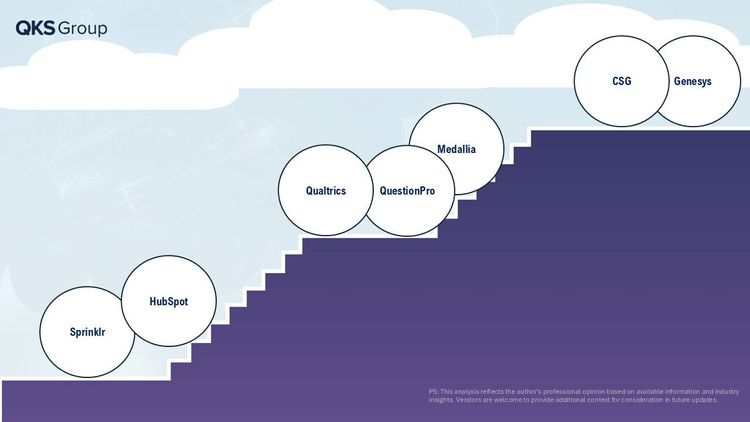
- Leading vendors (Genesys, CSG) stand out with comprehensive, enterprise-grade solutions where orchestration and journey execution take center stage.
- Capable vendors (QuestionPro, Medallia, Qualtrics) show promise by integrating VoC and journey insights, but often fall short of real-time or proactive execution.
- Lagging vendors (Sprinklr, HubSpot) remain focused on surface-level feedback or workflow automation and risk losing relevance as the industry moves toward true journey-centric transformation.
Stop Chasing VoC Scores & Start Managing Journeys That Actually Move the Experience
Customer expectations have evolved. It's not just about receiving fast service or filling out a feedback form anymore; they want context, relevance, and action. In this environment, journey management isn't a nice-to-have; it's the horsepower of the modern customer experience. The platforms that stand out today are those that can turn fragmented touchpoints into connected journeys, and fleeting feedback into sustained experience improvements. This blog doesn’t ask who listens best but asks who orchestrates, adapts, and delivers best. Here’s how the leading players really stack up when journey management is the primary lens.
Tier 1: Intelligent Journey Management Pioneers
Genesys: Orchestration-Led, Interaction-Tuned
Genesys takes a journey orchestration-first approach. The platform is designed to bring together the channels and optimize real-time interactions across the service ecosystem. So, journey management, here, means understanding intent across touchpoints on any individual journey and adapting real-time, 'with or without feedback' in a manner that drives success. It is one of those platforms that has an orchestration agenda that is anticipatory as opposed to reactive. It’s integration with VoC is limited but Genesys shines is in the ability to optimize a journey (throughout the whole of the service) on live behaviour, situational context, and journey of touch interaction. Accordingly, if your organization prioritizes controlling operational journeys, Genesys is out to win it.
CSG: Journey Engine, Not Just Feedback Wrapper
CSG Xponent takes an innovative approach to journey management, treating it as a discipline and not just a feature. Instead of grounding its experience platform primarily in surveys or CRM logic, CSG starts with real-time orchestration. What makes CSG Xponent unique is its ability to recognize behavior signals, make contextual decisions, and facilitate adaptive interactions across the course of journeys. Modular applications within CSG Xponent aren’t just customer journey add-ons—they’re accelerators for organizations looking to proactively shape and optimize every customer interaction. Feedback is important, but CSG Xponent incorporates it as one of the many signals that guides the journey and not as the sole trigger. For organizations that are tired of bolt-on journey solutions and reactive feedback loops, CSG presents an alternative as a platform designed for end-to-end journey execution, not solely on measurement.
Tier 2: Strong VoC Players Trying to Become Journey-Relevant
Qualtrics: Intelligence-First, Journey-Lite
While Qualtrics is a strong player in the experience management conversation because of its signal and analytics breadth, it becomes a different tune when viewed through a journey-centric lens. Of course, there are very useful insights and recommendations within CustomerXM and Qualtrics iQ. However, orchestration appears to be more of an extension of survey data, "trigger" based rather than engineering new, proactive, multi-touch experiences. Journey mapping is supported, but not the focal point of the application. Even with all those great data and signal capabilities, organizations who are aiming to design and optimize experiences in the moment, Qualtrics provides powerful data, but leaves execution wanting.
Medallia: Feedback-Driven Journeys, Not Journey-Native
Medallia has been a long-standing practitioner of turning signals into action due to its impressive abilities to capture signals and analyze feedback in real time. These capabilities have been further enhanced with the Thunderhead acquisition, which introduced journey orchestration to an already robust experience management platform and ultimately represented a new opportunity to develop proactive experience delivery. However, journey management still feels somewhat bolted onto the feedback engine and the resultant personalization, much like Qualtrics, relies on what a customer has said or done, rather than a holistic understanding of their journey state. The system certainly strengthens reactivity but is yet to provide its users with a resilient proactive journey orchestration system.
QuestionPro: The Dark Horse of Integrated Journey Mapping
Since their acquisition of SuiteCX, QuestionPro has gone from being a VoC player to a legitimate journey management contender. Their platform allows users to build, visualize and analyze customer journeys with feedback directly layered in at each stage of the journey. This integrated design and delivery allows teams to recognize pain points and transfer insights back into journey-level interventions (as opposed to simply responses). Real-time orchestration is still some way off from meeting the likes of Genesys, but QuestionPro has delivered on an important promise: allowing organizations the ability to manage customer journeys on a holistic basis, with customer insight embedded within, not informing but facilitating the journey going forward.
Tier 3: Usable but Limited for Enterprise-Grade Journey Management
HubSpot: Workflow Over Journey, Simplicity Over Depth
HubSpot is a straightforward and well-integrated platform that provides journey management primarily through its marketing and service automation. Being a CRM, HubSpot offers basic visibility into journeys, and you can create workflows triggered by customer behaviors. However, HubSpot does best with campaign logic and not with true real-time journey orchestration. It does have feedback tools that are lightly integrated, and you are constrained (workflow-wise) from easily changing customer experiences in real-time. HubSpot is functional for growing businesses needing visibility without complexity, but at this point, journey management is not transformative with HubSpot.
Sprinklr: Social Pulse, Limited Pathing
Sprinklr's most significant strength is its ability to listen to the digital noise and signals stemming from social media, reviews, forums, and identify signals earlier. The listening is extremely valuable to brands to see how their customers perceive them, but does not very easily turn into structured journey design or orchestration. Journey management with Sprinklr doesn't begin with proactive design; rather, it is about reacting to unstructured data. While the feedback provided from Sprinklr is strong, the journey adaptation from insight is manual at best. From a brand perspective, particularly public sentiment and engagement, Sprinklr delivers. For brands seeking control over their journey in real-time, Sprinklr will not deliver in a meaningful way.
Final Take: Journey Management Is the New Frontier But Few Platforms Own It
It's a journey not a channels world. The winners are the ones that can anticipate what customers need, create paths for customers to follow and accurately and continuously optimize those journeys. Genesys and QuestionPro are the closest to this vision (on opposite ends of the spectrum) with Genesys starting with an orchestration-first engineering point of view and QuestionPro coming from visual planning based upon feedback. Qualtrics and Medallia are at least good for insight but are still making the transition from VoC-first to journey relevant. HubSpot and Sprinklr have their limited utility but don't have the orchestration capacity to be seen as leaders in this new era.
A customer journey that does not take customer feedback into account is not customer centric. And customer feedback without a journey context is seldom an effective lever for real experience improvement. If your goal is to manage experiences and not merely measure them, it is critical that you select a platform that treats the journey as a product and not a byproduct.
Disclaimer:
This blog is based on independent research and publicly available information. The insights presented reflect the views of QKS Group and are for informational purposes only. While we strive for accuracy, we do not guarantee completeness or absolute correctness. Vendors are welcome to provide clarifications or updates. If any vendor listed in this analysis wishes to provide additional context or clarification, we welcome a briefing call and will consider incorporating relevant updates. This analysis is not intended to disparage any vendor but to provide an informed, balanced perspective. We encourage open and constructive dialogue to foster transparency and a deeper understanding of the industry.
Author: Palika Jacob S, Analyst - CX Tech at QKS Group
Vendors: