

25.06.2025
QKS Review
QKS Review: Crossing the threshold: Vendor Capability Distribution for Autonomous Enterprise Transition
Author:
Kunal Pakhale


Executive Summary:
Executive Summary
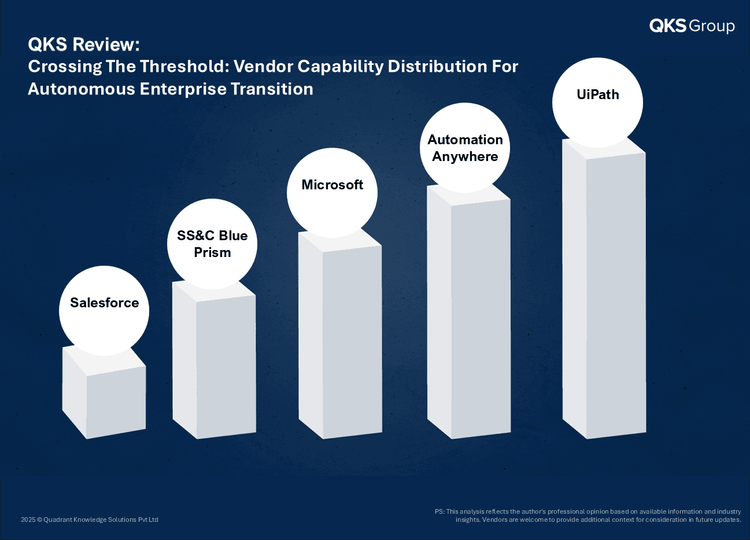
The automation landscape is rapidly evolving, and RPA vendors are progressing toward the vision of an autonomous enterprise, where intelligent automation systems can operate independently using AI and agentic capabilities. It outlines a maturity from basic rule-based automation to fully agentic process automation (APA), evaluating vendors based on their position along this path. UiPath and Automation Anywhere are leading the race with advanced AI integration, agentic frameworks, and strong platform ecosystems. Microsoft Power Automate is quickly catching up by leveraging OpenAI integration and a democratized automation approach. In contrast, SS&C Blue Prism offers strong compliance and governance but lags in native AI maturity, while Salesforce focuses primarily on CRM-centric use cases with limited general Robotic Process Automation capabilities. The blog emphasizes that the vendors who accelerate their shift to APA through AI investment, simplified UX, and robust ecosystems will shape the next era of enterprise automation.
The way to Autonomous Enterprise
Robotic Process Automation (RPA) solution providers are on a transformative journey as they compete for enterprise-wide automation. The goal is to become an autonomous enterprise where intelligent automation can think, adapt, and act independently, not only automate repetitive tasks. Vendors must, however, cross several critical thresholds, each representing a milestone in technological and strategic advancement, before they can achieve complete autonomy.
The development from rule-based automation to the incorporation of advanced AI and, eventually, to Agentic Process Automation (APA) can be broken down into several distinct thresholds that each vendor has to cross to become autonomous:
1. Robotic Process Automation: The framework on which structured, repetitive tasks are handled by rule-based automation.
2. AI Integration: Using AI to improve decision-making and flexibility.
3. AI Ecosystem: The ecosystem where most of the automation is driven via AI
4. Agentic Process Automation: The transition point where automation systems manage complex workflows autonomously.
5. Autonomous Enterprise: The ultimate scenario, in which automation powered by AI coordinates enterprise-wide processes without the need for human involvement.
This path establishes the readiness of vendors for enterprise transformation in the future, in addition to the maturity of automation technologies.
The Position of RPA Vendors in the APA Competition
Key vendors are racing toward APA at varying rates. While some vendors are moving quickly and investing strategically in AI, others are taking their time and continuing to build upon their RPA roots.
Examining these providers in greater detail reveals their distinct advantages, difficulties, and automation maturity trajectory.
Leading the Way in APA Readiness - UiPath
UiPath has established itself as a leader in AI-driven automation by continuously expanding its product portfolio and investments in AI. UiPath offers the deepest and broadest functionality and is at the forefront of AI integration. It’s pushing the limits with agentic automation and has every tool, from process mining to test automation, in one stack; however, this adds to complexity and cost. UiPath is ideal for organizations seeking a comprehensive platform and willing to invest in maximizing automation, as well as those who can handle the governance of such a powerful tool. It remains a top performer across both functional depth and autonomous enterprise readiness.
The company has systematically transformed from a traditional RPA provider to an advanced AI-driven automation platform, demonstrating exceptional capability in integrating advanced technologies. Its product portfolio, coupled with significant investments in analytics and autonomous agents, positions UiPath at the forefront of enterprise automation transformation. The platform's vast community ecosystem further accelerates its innovation, allowing for continuous refinement and adaptation of its technological offerings. Its leadership in the automation space is highlighted by its capacity to regularly surpass important milestones.
Automation Anywhere combines a balanced RPA feature set with cloud-first delivery. It’s particularly strong for businesses that want quick deployment (web-based, SaaS RPA) and a mix of attended/unattended capabilities. AA is pushing boundaries in concept, its vision of the autonomous enterprise and agentic automation is ambitious and closely matches UiPath’s in narrative. It has integrated essential AI (IQ Bot) and is actively adding more (generative AI partnerships). AA is slightly more focused than UiPath, it doesn’t have every peripheral product, but what it has (core RPA, docs, analytics) it does well. It could improve by expanding its ecosystem, e.g., more native mining, more AI models out-of-box, and ensuring its pricing doesn’t hinder scale.
The vendor has successfully navigated the complex transition from rule-based automation to an AI-centric approach, creating a platform that can adapt to the most demanding enterprise environments. Its comprehensive AI capabilities enable organizations to move beyond traditional process automation, offering intelligent workflows that can think, learn, and evolve. The company's strategic focus on creating an accessible yet powerful automation solution has been critical in establishing its leadership position in the APA race. However, the fact that it has jumped over the AI integration threshold, indicating an ambitious path for APA, shows its clear dedication to the development of the AI ecosystem.
Microsoft Power Automate has democratized Robotic Process Automation and infused it with AI. Its strength is the huge user base it can empower and the seamless integration with everyday tools and enterprise systems via connectors. Microsoft is arguably leading in AI integration simply by integrating OpenAI’s tech into the automation experience for millions of users. Where it falls short is the heavy-duty, large-scale unattended RPA scenarios, those complex needs might strain Power Automate’s current capabilities or require additional Azure engineering. But Microsoft is continuously improving in that regard e.g., new hosted machine pools. If an organization’s aim is to enable a broad base of employees to automate and to quickly leverage AI for efficiency, Power Automate is a top pick. It has clearly become a top performer when considering its exponential growth and AI momentum.
Its ability to take advantage of Microsoft's AI developments makes it a strong candidate in the transition to an autonomous organization. Microsoft Power Automate represents a compelling approach to democratizing automation through seamless ecosystem integration. Leveraging the robust Microsoft technological infrastructure, the platform has rapidly accelerated its APA capabilities by tapping into the company's extensive AI research and development resources. Its strength lies not in specialized RPA features but in its ability to provide affordable, accessible automation solutions that can be easily integrated into existing Microsoft-centric organizational environments. The platform's pricing strategy and broad accessibility make it an attractive option for organizations seeking to initiate their automation journey without significant upfront investments.
SS&C Blue Prism has strong security, compliance, and scalability attributes that make it a popular option for highly regulated businesses. However, the vendor's approach to technological integration has begun to pose significant challenges in the rapidly evolving automation landscape. While maintaining strong credentials in highly regulated industries, Blue Prism's methodical and conservative strategy for AI ecosystem development risks creating a technological shortfall against more agile competitors. The vendor's slow progression towards AI suggests a potential disconnect between its traditional strengths and the emerging requirements of modern enterprise automation. Its long-term competitiveness may be hampered by this slower pace as organizations seek more sophisticated, self-learning automation systems.
SS&C Blue Prism stands out for enterprise-grade reliability and governance. It was originally designed for back-office automation at scale, with robust security and a development approach that enforces best practices. However, Blue Prism is lagging in innovation speed. It has known gaps in attended automation, document AI, and cloud-native ease, often relying on third parties or extra effort to fill these gaps. Blue Prism is an excellent choice where stability and compliance are paramount, and change is slow.
Salesforce (Einstein Automate/MuleSoft RPA) is strongly positioned for Salesforce-centric processes, but is not a full-spectrum RPA solution yet. Its key advantage is that it brings together API integration, RPA, and AI all within Salesforce’s low-code platform. For companies deeply using Salesforce, this yields high ROI, automation in the same environment as your CRM/ERP with unified tooling. However, Salesforce’s RPA is relatively immature outside of that context. It likely lags in supporting a wide variety of desktop apps and doesn’t have the community or rich component marketplace of the others. Also, if you’re not a Salesforce shop, you wouldn’t consider it. So, Salesforce is pushing boundaries within its domain, embedding RPA in a mainstream business platform, which is innovative in its own way, but compared to dedicated RPA vendors, it’s behind in capability and independent innovation. As Salesforce enhances Einstein Automate, it could become a one-stop intelligent automation choice for those in its ecosystem, but it has a way to go to match the RPA veterans on general use cases.
Accelerating the Transition to Agentic Process Automation
- For Robotic Process Automation vendors to lead the next phase of automation, they must intensify their efforts in key areas:
- Putting Money into AI and Machine Learning: Utilizing deep learning and natural language processing (NLP) to improve decision-making skills.
- Creating Strong AI Ecosystems: Encouraging collaborations to facilitate smooth AI integrations.
- Improving Accessibility: To encourage acceptance, deployment complexity and cost obstacles should be reduced.
- Simplifying UI/UX and providing extensive training materials to promote learning and usage are examples of user-centric innovation.
RPA vendors can accelerate their shift to APA by adopting these tactics, which will increase the autonomy, scalability, and intelligence of business automation.
Who is the APA Race Winner?
In the emerging race toward agentic process automation — where autonomous software agents combine RPA, AI, and decision-making to dynamically manage processes, UiPath and Automation Anywhere are clearly pulling ahead. UiPath has aggressively positioned itself as the front-runner, with its AI Center, Document Understanding, and new Agentic Automation features, orchestrating AI agents alongside traditional bots. Automation Anywhere is close behind, heavily marketing its Autonomous Enterprise vision and Agentic Process Automation (APA) system, integrating generative AI into its cloud-native platform to create an ecosystem where bots and AI work in concert. Both vendors are actively embedding large language models (LLMs) and self-learning capabilities into their automation stack, making them the most mature players in this space.
Microsoft Power Automate is catching up fast, leveraging its deep integration of OpenAI models across its Power Platform; Copilot already assists users in designing flows, but Microsoft’s approach emphasizes democratized, human-assisted AI rather than fully autonomous agents managing enterprise processes (though technically, the components are there). SS&C Blue Prism, on the other hand, brings strong orchestration and governance but lags in native AI integration and relies on third-party AI services, it’s still evolving from a robust automation engine to an agentic platform. Salesforce, while innovative within its own CRM-centric ecosystem, is the most niche: its Einstein AI and MuleSoft Robotic Process Automation provide AI-driven insights and task execution, but it has yet to position itself as a leader in cross-enterprise agentic automation. In short, UiPath and Automation Anywhere are the current leaders in this race, Microsoft is surging, and Blue Prism and Salesforce are contenders with focused (but narrower) plays.
Leading vendors are investing in AI, while laggards run the risk of slipping behind if they don't speed up their APA and AI development. Vendors who surpass these crucial benchmarks and enter the era of truly autonomous enterprises, surpassing traditional RPA, will have the future. As AI-driven automation continues to redefine business operations, those who lead the APA revolution will shape the future of enterprise automation.
Disclaimer:
This blog is based on independent research and publicly available information. The insights presented reflect the views of QKS Group and are for informational purposes only. While we strive for accuracy, we do not guarantee completeness or absolute correctness. Vendors are welcome to provide clarifications or updates. If any vendor listed in this analysis wishes to provide additional context or clarification, we welcome a briefing call and will consider incorporating relevant updates. This analysis is not intended to disparage any vendor but to provide an informed, balanced perspective. We encourage open and constructive dialogue to foster transparency and a deeper understanding of the industry.
Author: Kunal Pakhale, Senior Analyst - Process Automation Solutions at QKS Group
Vendors: