

17.07.2025
QKS Review
QKS Review: Cracking the Code: How NDR Vendors Tackle AI Anomalies and Encrypted Traffic
Author:
Mohnish Rathore


Executive Summary:
As the cybersecurity market faces rising pressure from increasingly encrypted traffic, AI-powered threats, and hybrid cloud complexity, organizations are moving beyond traditional intrusion detection and log-based security tools. This review blog by QKS Group assesses whether Network Detection and Response (NDR) vendors are truly innovating to meet these demands or merely making incremental updates.
What Modern NDR Solutions Should Deliver:
Today’s platforms must offer more than core packet inspection or rule-based detection. Critical next-gen capabilities include:• AI-driven anomaly detection that adapts to changing behaviours without relying on signatures.
• Encrypted Traffic Analysis (ETA) without decryption to preserve privacy and visibility.
• Seamless integration with hybrid environments for unified visibility across cloud, on-prem, and edge.
Key Findings:
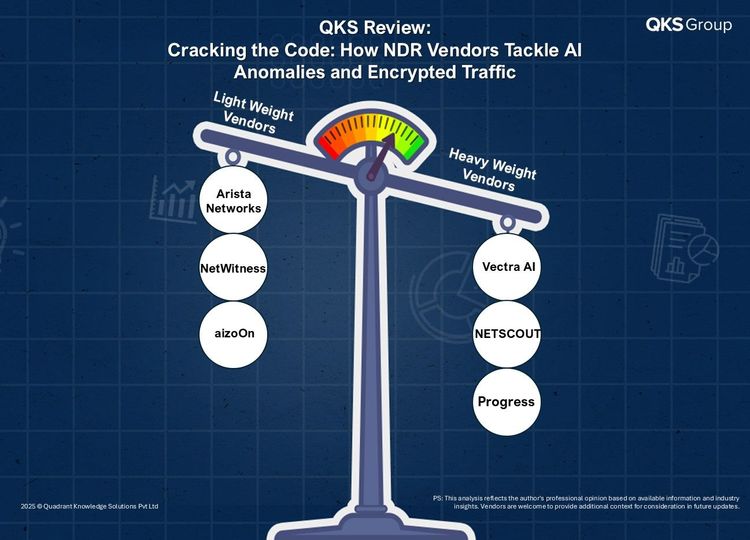
• Leading vendors (Vectra AI, NETSCOUT) stand out with comprehensive, enterprise-grade solutions offering behavioural AI and advanced ETA across complex networks.
• Capable vendors (Progress, Arista Networks, NetWitness) show promise in niche areas like tunable detection or deep packet inspection but lack either ease of use or technical maturity at scale.
• Lagging vendor (aizoOn) remains focused on basic capabilities and struggles with high false positives, limited AI, and shallow encrypted traffic inspection, risking obsolescence in high-threat environments.
In this blog, I’m comparing how six Network Detection and Response (NDR) vendors, Vectra AI, NETSCOUT, Progress, Arista Networks, aizoOn, and NetWitness, handle two key features: AI-powered threat detection and analyzing encrypted traffic without decrypting it. We'll see who’s doing it well, who’s improving, and where some may need to step up.
Heavyweight Vendors
Vectra AI stands out in the NDR space for its powerful AI-driven anomaly detection and its ability to analyze encrypted traffic without needing to decrypt it. By leveraging over 150 behavior-based detection models, Vectra continuously monitors network, identity, and cloud activity to flag both known and unknown threats based on deviations from normal behavior. What makes it particularly impressive is how it applies machine learning directly to encrypted traffic, identifying malicious patterns without compromising data privacy or performance, ideal for today’s compliance-driven environments. Users frequently praise its real-time detection, seamless integrations, and scalability across hybrid networks. That said, some have noted that the platform can be complex to set up and may require skilled resources to fully unlock its potential. Additionally, while its detection capabilities are top tier, reporting features could be more granular to aid detailed investigations. Overall, Vectra AI brings cutting-edge intelligence to threat detection, with just a few considerations around usability and ramp-up time.
NETSCOUT's Omnis Cyber Intelligence (OCI) platform delivers robust AI-driven anomaly detection and encrypted traffic analysis without decryption, making it a strong contender in the Network Detection and Response market. Leveraging its patented Adaptive Service Intelligence (ASI) technology, NETSCOUT converts raw packets into rich Layer 2–7 metadata, enabling real-time threat detection and retrospective analysis across hybrid environments. This approach allows for early warning of malicious activities, continuous attack surface monitoring, and comprehensive contact tracing, all without the need to decrypt traffic, thus preserving privacy and compliance. Users appreciate OCI's deep packet inspection capabilities and its seamless integration with existing security tools like SIEM and SOAR platforms. However, some users have noted that the platform's complexity can lead to a steep learning curve, and the initial setup may require significant time and expertise. Additionally, while NETSCOUT offers various pricing tiers, the cost may be a consideration for smaller organizations. Overall, NETSCOUT's OCI stands out for its comprehensive visibility and advanced threat detection capabilities, with some considerations around usability and cost.
Progress Flowmon has emerged as a solid player in the NDR space, especially for its strong AI-driven anomaly detection and encrypted traffic analysis without decryption. Its Anomaly Detection System (ADS) uses over 200 machine learning and entropy-based models to identify subtle behavioral deviations across hybrid and multi-cloud environments, spotting threats like lateral movement, insider misuse, and data exfiltration, even within encrypted traffic. Flowmon stands out for its flexibility and transparency, allowing security teams to fine-tune detection thresholds, whitelist safe anomalies, and integrate easily with SIEMs, firewalls, and threat intelligence feeds. Unlike many black-box solutions, Flowmon gives analysts visibility and control, and in real-world testing, it detected early threat indicators that some competitors missed. That said, tuning the system for optimal performance can be time-consuming in complex environments, and its reporting and investigation features could be more advanced. Overall, Flowmon offers a well-balanced NDR solution for organizations that want visibility without sacrificing privacy, but it does require some technical finesse to get the most out of it.
Lightweight Vendors
Arista Networks' Network Detection and Response (NDR) platform brings a compelling approach to AI-driven anomaly detection and encrypted traffic analysis, but it also presents several technical limitations that organizations should consider. On the positive side, Arista's platform offers intuitive dashboards and a Security Knowledge Graph, providing meaningful data visualization and behavior-based machine learning to enhance traffic analysis, including encrypted traffic. While Arista's encrypted traffic analysis capabilities are notable, they primarily focus on metadata and behavioral patterns without decrypting the content. This approach, while preserving privacy, may limit the depth of analysis and the ability to detect sophisticated threats that hide within encrypted payloads. User feedback also highlights areas for improvement. Some users have noted that the platform's query language could be more user-friendly, and there is room for enhancement in its encrypted traffic analysis features. In summary, while Arista's NDR platform offers valuable features for network visibility and threat detection, organizations should be aware of its limitations in handling novel threats and the depth of encrypted traffic analysis. Careful consideration and potential supplementary solutions may be necessary to ensure comprehensive network security.
NetWitness offers a comprehensive NDR platform that excels in deep packet inspection, behavioral analytics, and encrypted traffic analysis, giving security teams the ability to uncover threats hidden within encrypted communications while integrating well with SIEM and threat defense tools. Its capability to decrypt traffic for deeper insights is a significant strength, especially in high-risk environments. However, the platform does come with notable technical challenges—users frequently report a steep learning curve during setup, difficulty integrating newer devices, and a lack of user-friendliness in both the interface and use case creation. Additionally, its reliance on manual configuration can result in extended deployment times and potential errors, requiring skilled personnel and increased operational overhead. While NetWitness is powerful and feature-rich, organizations must be prepared to invest time and resources to fully utilize its capabilities.
azioOn’s NDR solution aims to provide AI-driven anomaly detection and encrypted traffic analysis, but it struggles in several technical areas that impact its effectiveness. While the platform offers basic visibility into network traffic and some behavioral analytics, its anomaly detection capabilities often fall short when handling complex or evolving threats, as it relies heavily on signature-based methods rather than advanced machine learning models. Users have reported challenges with high false positive rates, which can overwhelm security teams and reduce trust in alerts. Additionally, the platform’s encrypted traffic analysis is limited mostly to metadata inspection, lacking the depth needed to identify sophisticated threats hiding within encrypted payloads. On the positive side, azioOn does offer a straightforward interface and basic alerting mechanisms that can be suitable for smaller or less complex networks. Overall, while azioOn covers fundamental NDR features, its technical limitations and lack of advanced AI-driven analytics make it less suitable for organizations facing sophisticated or high-volume threats.
Conclusion
In conclusion, Network Detection and Response (NDR) solutions are essential for modern cybersecurity, offering vital visibility and threat detection across complex, encrypted, and hybrid networks. As we've seen, vendors like Vectra AI, NETSCOUT, and Progress lead the way with advanced AI-driven anomaly detection and effective encrypted traffic analysis, though each comes with its own trade-offs in usability and setup complexity. On the other hand, platforms like Arista Networks, NetWitness, and azioOn show potential but face technical challenges that may impact their effectiveness in highly dynamic environments. Ultimately, selecting the right NDR solution depends on an organization’s specific needs, balancing detection accuracy, ease of deployment, and ongoing management to stay ahead of evolving cyber threats.
Disclaimer:
This blog is based on independent research and publicly available information. The insights presented reflect the views of QKS Group and are for informational purposes only. While we strive for accuracy, we do not guarantee completeness or absolute correctness. Vendors are welcome to provide clarifications or updates. If any vendor listed in this analysis wishes to provide additional context or clarification, we welcome a briefing call and will consider incorporating relevant updates. This analysis is not intended to disparage any vendor but to provide an informed, balanced perspective. We encourage open and constructive dialogue to foster transparency and a deeper understanding of the industry.
Author: Mohnish Rathore, Analyst - Customer Identity and Access Management (IAM) at QKS Group
Vendors: