

23.06.2025
QKS Review
QKS Review:Continuous Controls Monitoring: Who’s Leading Real-Time Risk, and Who’s Still Playing Catch-Up?
Author:
Sahil Dhamgaye


Executive Summary:
Executive Summary:
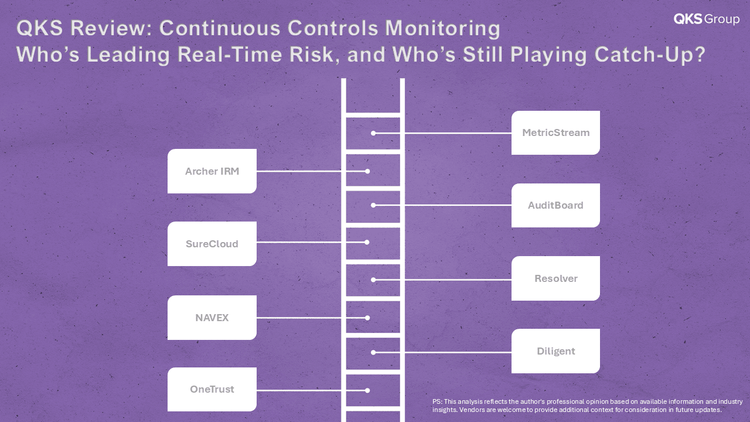
Real-time risk visibility and Continuous Controls Monitoring (CCM) are redefining GRC, separating innovators from laggards. Vendors like MetricStream and Archer IRM lead with advanced, real-time capabilities but face adoption hurdles due to complexity. AuditBoard, Resolver, and SureCloud show progress in automation but fall short in external threat visibility and deep integrations. NAVEX, Diligent, and OneTrust remain compliance-centric, with limited real-time risk detection.
Key industry gaps include poor integration with security operations, high deployment complexity, and a narrow focus on compliance over dynamic risk management.
The takeaway: Real-time CCM is now a must-have. Vendors that can’t deliver actionable, continuous risk insights will quickly fall behind.
Introduction:
Continuous Controls Monitoring (CCM) and real-time risk visibility are transforming GRC from a reactive function into a proactive, intelligence-driven powerhouse. In an era where cyber threats and compliance risks evolve by the second, relying on periodic assessments is like flying blind. Some vendors are aggressively innovating in this space, while others are merely rebranding old capabilities as ‘real-time.’ Here’s where key players stand.
- MetricStream: One of the strongest players in CCM, MetricStream integrates automated control testing with real-time risk intelligence. It enables organizations to monitor IT, compliance, and operational risks continuously, using AI-driven analytics. However, implementation complexity remains a challenge, making it harder for organizations to achieve full automation without significant effort.
- Archer IRM: Archer offers advanced CCM capabilities, particularly in IT risk and cybersecurity control monitoring. It integrates with external risk feeds, enabling organizations to detect vulnerabilities and misconfigurations in real-time. However, usability concerns remain—deploying and fine-tuning Archer’s CCM capabilities can be resource-intensive, limiting its accessibility to smaller enterprises.
- AuditBoard: AuditBoard has made strong progress in CCM, offering automated control testing and evidence collection through a wide range of OOTB integrations, APIs, and data lake support like Snowflake. These capabilities now extend well beyond audit teams, supporting continuous monitoring across risk, compliance, and IT. However, broader adoption for real-time security and operational risk use cases still often hinges on customer data infrastructure maturity. Recent enhancements, like the ServiceNow CMDB integration, point to growing investment in this space.
- SureCloud: SureCloud takes a more flexible, mid-market approach to CCM, offering real-time risk dashboards and automated control testing. However, its ability to integrate with security tools is being further developed. While it provides a more agile continuous controls monitoring experience, it needs to expand its integration capabilities further.
- Resolver: Resolver has integrated automation-driven control monitoring but lacks full real-time risk visibility. Its platform focuses on streamlining compliance through automated evidence collection, yet it does not offer continuous external threat monitoring. While Resolver’s CCM functions are evolving, it risks falling short of delivering true continuous monitoring beyond internal controls.
- NAVEX: NAVEX offers strong policy and compliance monitoring and also delivers proactive risk intelligence through real-time dashboards, dynamic KRIs, and workflow-triggered alerts. However, its focus has primarily been on automating control assessments rather than on actively detecting and responding to control failures as they happen. Compared to vendors investing in continuous threat intelligence feeds, NAVEX’s approach still leans more on retrospective control testing rather than continuous, proactive detection.
- Diligent: Diligent has expanded its CCM capabilities through acquisitions and integrations, particularly around IT and operational risks. However, its real-time risk visibility is limited. While its platform supports control automation, it doesn’t provide the depth of threat intelligence needed for real-time security risk monitoring.
- OneTrust: OneTrust has built strong automation for compliance and privacy-related controls but is not yet a leader in real-time risk monitoring. While it excels in privacy-centric CCM, it lacks the external risk visibility and advanced security analytics found in MetricStream or Archer. Its roadmap suggests it’s moving in the right direction, but its CCM capabilities today are still maturing.
Continuous Controls Monitoring Challenges and the Gaps Vendors Must Address
- Beyond Compliance: Many vendors still treat CCM as an extension of compliance automation rather than a tool for dynamic risk management.
- Integration with Security Operations: True real-time risk visibility requires integration with SIEM, SOAR, and threat intelligence platforms which is something only a few vendors are prioritizing.
- Ease of Deployment: The most advanced CCM solutions still come with steep implementation challenges, making adoption difficult for many organizations.
Final Verdict: Who’s Leading, Who’s Falling Behind?
MetricStream and Archer IRM are leading the way with sophisticated, real-time continuous controls monitoring capabilities, though usability and implementation complexity remain barriers to scale. SureCloud is gaining traction with mid-market agility, but its integration depth still lags top-tier competitors. AuditBoard and Resolver have made major strides in automation and evidence collection, yet they continue to fall short on real-time, external risk visibility. NAVEX and OneTrust are still playing catch-up, focused more on compliance automation than dynamic risk monitoring.
Continuous control monitoring isn’t just an enhancement; it’s becoming a fundamental requirement for modern risk management. Vendors that fail to deliver real-time visibility won’t just be behind; they’ll be irrelevant in a world where risk changes by the second.
PS: This analysis reflects the author's professional opinion based on available information and industry insights. Vendors are welcome to provide additional context for consideration in future updates.
Disclaimer:
This blog is based on independent research and publicly available information. The insights presented reflect the views of QKS Group and are for informational purposes only. While we strive for accuracy, we do not guarantee completeness or absolute correctness. Vendors are welcome to provide clarifications or updates. If any vendor listed in this analysis wishes to provide additional context or clarification, we welcome a briefing call and will consider incorporating relevant updates. This analysis is not intended to disparage any vendor but to provide an informed, balanced perspective. We encourage open and constructive dialogue to foster transparency and a deeper understanding of the industry.
Author: Sahil Dhamgaye, Analyst - Risk & Compliance at QKS Group
Vendors: