

24.07.2025
QKS Review
QKS Review: Composable, Scalable, API-Ready - The New PIM Standard
Author:
Dharun R


Executive Summary:
As retail brands are looking for greater agility and integration in omnichannel commerce, organizations are moving beyond monolithic PIM solutions to composable, API‑first platforms.
This review blog by QKS Group assesses whether PIM vendors are genuinely enabling scalable, headless experiences or simply rebranding legacy systems with modern terminology.
What Modern PIM Platforms Should Deliver:
Today’s platforms must offer more than a single source‑of‑truth repository. Critical next‑gen capabilities include:
- A composable, modular architecture that supports headless commerce
- API‑first design for real‑time integration across systems
- Scalable infrastructure and microservices for rapid deployment
Key Findings:
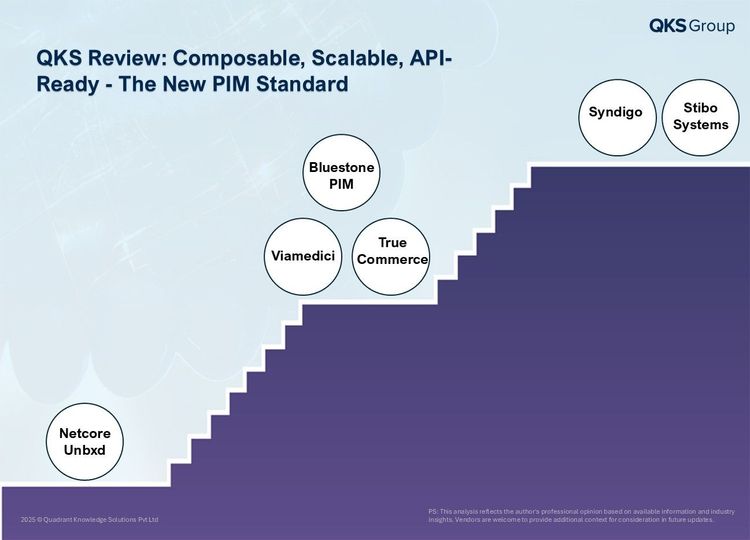
Leading vendors (Stibo Systems, Syndigo) deliver robust composable PIM architectures with comprehensive API frameworks and scalability for enterprise brands.
Capable vendors (Bluestone PIM, Viamedici, TrueCommerce) provide modular designs and modern APIs but may lack full enterprise-grade scale or composability.
Lagging vendors (Netcore, Unbxd) continue to operate legacy PIM systems with minimal API support and limited architectural flexibility.
Product Information Management (PIM) is no longer just about enrichment or content syndication. It all comes down to responsiveness, real time collaboration and speed to market. Brands need to adapt and change direction quickly, whether they are launching into new markets, adapting to changes in retailer needs, or configuring for personal dynamic content.
So, what is the differentiator between the leaders and everyone else? Real composability, API-first thinking, and architecture that flexes with business demands. We looked at six vendors through that lens. Here’s how they stack up.
Syndigo and Stibo Systems: Leading the Pack
Syndigo and Stibo Systems are setting the bar for modern PIM.
Syndigo provides true composability, allowing brands to connect governance, enrichment, and syndication, all in a modular, API-first architecture. Its workflows are designed for speed and collaboration, allowing content, ecommerce, and compliance teams to work simultaneously without the chaos.
Stibo Systems, meanwhile, delivers on the enterprise side with deep data modeling, governance control, and reliability at scale. It’s built for global retailers juggling regulatory complexity and massive product portfolios. While Stibo may require stronger implementation support, it’s unmatched for retailers that need to enforce data standards across divisions, regions, and systems without slowing down growth.
TrueCommerce ,Viamedici and Bluestone PIM: Proven Platforms, Evolution at a Pace
TrueCommerce Product Information Management (PIM) works well as part of its larger ecosystem, especially for retailers already using its EDI and supply chain tools. It ensures stable data sync and solid baseline governance but lacks composable features or content agility. For basic product data needs, it’s dependable. For teams aiming to personalize at scale or support frequent product updates, it may eventually feel restrictive.
Viamedici brings maturity in classification, attribute modeling, and cross-domain hierarchy. It serves regulated or manufacturing-adjacent verticals well. But in retail’s more fluid, campaign-driven environment, it requires customization to support agile content development. The structure is there, but flexibility needs work.
Bluestone PIM combines an API-first, microservices-based architecture with proven scalability in enterprise ecosystems. Its modular, composable design empowers organizations prioritizing flexibility and governance. However, small and mid-market businesses without strong IT maturity may face higher integration effort and find Bluestone PIM less suitable.
Netcore Unbxd: Directionally Right, But Gaps Remain
Netcore Unbxd excels in AI search and personalization, and their PIM is fast to set up and easy to navigate. But it hasn’t matured into a full-fledged platform. Content rules, governance controls, and schema flexibility are still limited. For smaller D2C brands, Unbxd may fit. For retailers managing complex catalogs, channels, and compliance layers, it’s a stretch.
The PIM Mandate: Don’t Just Store Data. Orchestrate It.
The job of Product Information Management (PIM) isn’t just to manage product data anymore. It’s to enable real-time coordination across ecommerce, marketing, supply chain, and compliance. The best platforms help teams move faster and more confidently, without sacrificing control.
Final Thought: Future-Proofing Starts with the Right Foundation
A flexible collaboration-friendly scalable Product Information Management (PIM) infrastructure is not just desirable but needed, especially for retailers who are expanding into new markets, moving into new product experiences and navigating changing consumer expectations. Choosing a PIM platform is a meaningful technology decision but also a thoughtful strategic decision. The platforms that flex in today's environment, are the ones that will help you stay ahead tomorrow.
Disclaimer:
This blog is based on independent research and publicly available information. The insights presented reflect the views of QKS Group and are for informational purposes only. While we strive for accuracy, we do not guarantee completeness or absolute correctness. Vendors are welcome to provide clarifications or updates. If any vendor listed in this analysis wishes to provide additional context or clarification, we welcome a briefing call and will consider incorporating relevant updates. This analysis is not intended to disparage any vendor but to provide an informed, balanced perspective. We encourage open and constructive dialogue to foster transparency and a deeper understanding of the industry.
Author: Dharun R, Analyst at QKS Group
Co-Author: Kumar Anand, Associate Director & Principal Industry Analyst at QKS Group
Vendors: