

24.06.2025
QKS Review
QKS Review: CLM Platforms in 2025: Who's Moving the Market and Who Needs to Catch Up? - PART 2
Author:
Abhishek Dubey


Executive Summary:
In 2025, Contract Lifecycle Management (CLM) platforms are no longer evaluated simply on repository strength or e-signature integration, they are judged by their ability to deliver real-time visibility, intelligent automation, and seamless collaboration between legal and business stakeholders. The vendors that stand out are those building intelligence and usability into the core of contracting workflows. In this second part of our QKS Review series, we examine seven additional CLM vendors to assess who is moving the market and who is falling behind.
What Today’s Enterprises Expect from CLM Platforms:
Leading enterprises expect CLM platforms to offer:
- End-to-end lifecycle visibility from intake to post-signature
- AI-augmented clause insights and risk detection
- Configurable workflows without developer dependency
- Deep integration across procurement, sales, and legal
- Clear product direction and execution maturity
Key Findings:
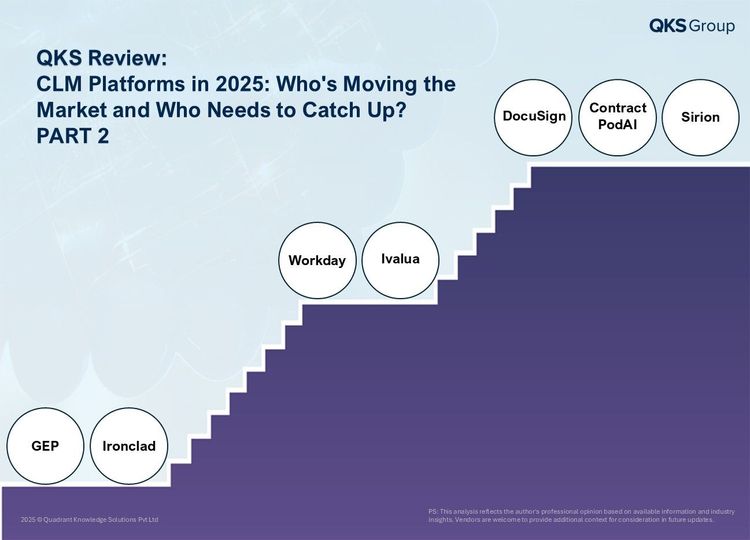
- Delivering Tangible Value (Sirion, ContractPodAi, DocuSign): These vendors are enabling measurable gains in contract velocity, governance, and compliance. Their platforms are not just feature-rich, they are execution-ready, with well-integrated AI, outcome tracking, and scalable collaboration.
- Mature, But Strategically Ambiguous (Ivalua, Workday/Evisort): These vendors offer strong functional capabilities, but their CLM story is either diluted by broader platform priorities or lacks architectural clarity. While adoption remains steady, differentiation is thinning.
- Struggling to Meet Benchmarks (GEP, Ironclad): These vendors lag on lifecycle maturity, negotiation tooling, and configurability. Their CLM components still feel modular or incomplete, with limited evidence of readiness for large-scale, enterprise use.
This blog underscores a growing divide between platforms that are solving real-world CLM challenges and those still refining their value proposition. As enterprises raise expectations around visibility, automation, and cross-functional enablement, execution, not just intent, will define the next generation of CLM leaders.
Platforms That Are Delivering Tangible Value
These vendors are driving the shift from contract repositories to decision platforms. They have made substantial investments in AI, clause intelligence, and business user empowerment- delivering tools that enable faster negotiation, consistent governance, and cross-functional alignment. These aren’t just platforms that check boxes, they shape how work gets done.
Sirion: Contract Intelligence Rooted in Outcome-Based Governance
Sirion continues to position itself as a platform that understands the complexity of contract management beyond signature. Its post-award obligation tracking, performance management, and AI-backed insights support advanced use cases, especially in large enterprises with third-party vendor dependencies. The system architecture is designed to ensure clause-level tracking and auditability, while its negotiation workflows reflect real-world stakeholder collaboration. Sirion has demonstrated maturity in both roadmap execution and alignment with business outcomes.
ContractPodAI: Unified Legal Lifecycle, Modular CLM Execution
ContractPodAi's approach is grounded in use-case-centric AI applications. Its repository, metadata tagging, clause suggestions, and auto-extraction tools support both legal and business users. The Leah assistant and the guided workflows accelerate contract turnaround, especially in high-volume legal operations. Customer feedback has consistently highlighted responsiveness, usability, and the platform's capacity to evolve with organizational needs.
DocuSign CLM: Embedded Workflows with Platform-First Accessibility
Docusign CLM has moved well beyond e-signature into end-to-end agreement lifecycle management. With native AI-assisted features in common collaboration tools such as Microsoft Word, version comparison, and playbook-based clause suggestions, it supports agreement workflows from drafting through negotiation. Clause management and approval rules can be customized per department, and Salesforce integration remains a strength for sales-driven contracting. The system has evolved to support legal governance and visibility at scale.
Mature, but Facing Strategic Ambiguity
These platforms have solid capabilities and serve a wide base, yet there's a sense that their Contract Lifecycle Management (CLM) vision isn’t as clearly articulated as it once was. Whether due to architectural transitions or evolving market focus, these vendors need to clarify how their CLM roadmap aligns with modern enterprise needs.
Ivalua: Integrated S2P with CLM Caught Between Modules
Ivalua brings contracting capabilities tightly coupled with procurement excellence. Its CLM offering is configurable, supports clause and template libraries, and integrates natively with sourcing workflows. Organizations benefit from the ability to handle complex authoring processes, multi-level approvals, and global governance structures. GenAI integration for clause review is being piloted with promising early results. Ivalua stands out for its alignment between operational procurement needs and legal compliance requirements.
Workday (Evisort): AI-Rich, But Needs Platform Consolidation
Workday’s CLM, through Evisort, emphasizes simplicity, automation, and fast time to value. The interface is designed for non-technical users, enabling business and legal teams to automate intake, tagging, and workflows without developer intervention. The AI capabilities focus on clause detection, metadata auto-fill, and risk identification during review. Integration with storage and productivity tools accelerates user adoption, making it a pragmatic choice for lean legal teams.
Struggling to Meet Today’s CLM Benchmarks
These platforms continue to under-deliver on core expectations. Whether due to underdeveloped negotiation tools, fragmented user experiences, or low visibility into platform direction, they fall short of what modern enterprises require. In some cases, Contract Lifecycle Management (CLM) feels like a side module rather than a strategic product.
GEP: Process-Centric Sourcing, but CLM Lacks Maturity
GEP’s CLM is bundled within its broader SMART platform yet lacks clarity as a standalone contracting solution. While onboarding and vendor registration are well integrated, the contract authoring and redlining experience feels constrained by rigid templates and limited workflow adjustability. AI capabilities are emerging but not consistently available across use cases. GEP would benefit from deeper investment in lifecycle tracking and in aligning CLM with post-signature contract performance.
Ironclad: UX-Focused, But Governance and AI Depth Still Evolving
Ironclad delivers an appealing user interface and intuitive workflow builder, but questions remain around its depth in enterprise contracting. The lack of relational data modeling, limited metadata flexibility, and challenges in document hierarchy organization have been reported by users. AI capabilities like smart import are improving, but configuration limitations reduce value in complex, multi-party negotiations. Ironclad needs to demonstrate maturity in operational complexity, not just usability.
Conclusion: Where Do We Go from Here?
The 2025 Contract Lifecycle Management (CLM) landscape is increasingly defined by execution over promise. Vendors leading the charge are those embedding AI where it counts, enabling collaboration without compromising control, and delivering measurable results. Meanwhile, others are stuck in transition, either lacking clarity, consistency, or the ability to evolve with enterprise demands. As organizations raise the bar for visibility, automation, and governance, the divide between intelligent platforms and legacy models is becoming stark. This two-part analysis reflects that shift. The question isn’t who has CLM, it’s who’s solving for it. And not every vendor has that answer yet.
Disclaimer:
This blog is based on independent research and publicly available information. The insights presented reflect the views of QKS Group and are for informational purposes only. While we strive for accuracy, we do not guarantee completeness or absolute correctness. Vendors are welcome to provide clarifications or updates. If any vendor listed in this analysis wishes to provide additional context or clarification, we welcome a briefing call and will consider incorporating relevant updates. This analysis is not intended to disparage any vendor but to provide an informed, balanced perspective. We encourage open and constructive dialogue to foster transparency and a deeper understanding of the industry.
Author: Abhishek Dubey, Analyst - Revenue Lifecycle Management at QKS Group
Vendors: