

23.06.2025
QKS Review
QKS Review: CLM Platforms in 2025: Who's Moving the Market and Who Needs to Catch Up?
Author:
Abhishek Dubey


Executive Summary:
The Contract Lifecycle Management (CLM) landscape in 2025 is undergoing a strategic shift, from static contract repositories to intelligent, enterprise-ready platforms that support policy enforcement, collaboration, and AI-driven insights. Today’s users demand more than storage and e-signature; they expect dynamic authoring, risk monitoring, negotiation intelligence, and post-award compliance, all integrated within a unified system.
In this QKS Review blog, we evaluate six vendors not by sales volume, but by real-world platform maturity and enterprise impact. This is the first in a two-part series analysing 13 vendors based on firsthand research, analyst briefings, and user feedback.
What Modern CLM Platforms Must Deliver:
Modern CLM platforms must go beyond document control to offer:
- Clause-level intelligence and deviation analysis
- Configurable workflows with minimal IT dependency
- Real-time negotiation tools and parallel review support
- Pre- and post-award contract governance
- Seamless integration across procurement, finance, and legal systems
Key Findings:
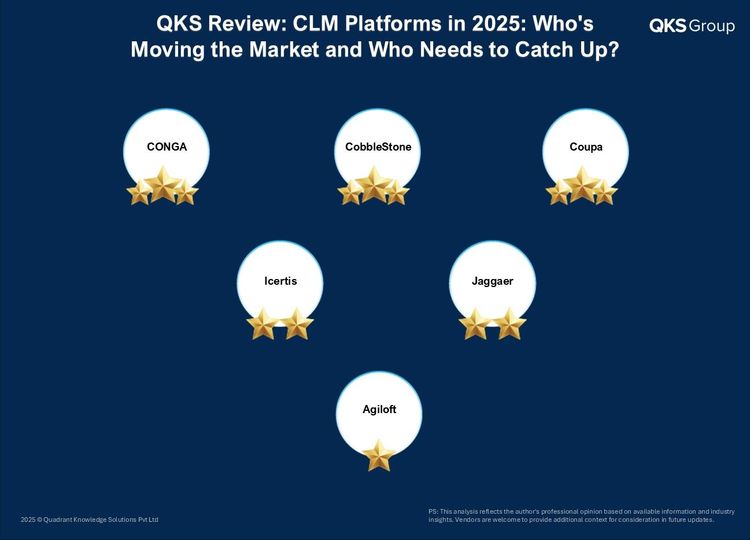
- Leading with Clarity and Capability (Conga, CobbleStone, Coupa): These platforms bring strong authoring, negotiation, clause intelligence, and configurable workflows into a cohesive experience. Their focus on automation, usability, and compliance enables faster outcomes and improved risk control.
- Solid Foundations, But Gaps in Visibility (Icertis, Jaggaer): These vendors offer solid functional foundations but face gaps in usability, collaboration, or roadmap clarity. Without renewed investment in user experience and transparency, they risk falling behind more agile peers.
- Still Catching Up to Modern CLM Expectations (Agiloft): Despite promising flexibility, these platforms struggle with fragmented workflows, inconsistent AI execution, and limited support maturity. For them, the challenge is moving from technical configurability to business-ready execution.
As the market sharpens its expectations around CLM, vendors must demonstrate real-time intelligence, configurability, and end-to-end usability. This blog captures who is delivering on that vision and who still has ground to cover. Part 2 will continue this evaluation across seven additional platforms.
Leading with Clarity and Capability
These are the platforms that stand out, not just for what they offer on paper, but how those features translate into enterprise readiness. They bring strong authoring tools, negotiation support, clause intelligence, and flexible configuration into a cohesive, scalable product. Their systems are not just functional, they’re enabling faster outcomes and measurable operational gains.
Conga: Enabling Scalable Governance and AI-Driven Contract Intelligence
Conga brings a structured yet adaptable approach to contract lifecycle management, with its deep functionality embedded into its Salesforce-native platform as well as its open SaaS Conga Advantage Platform. The system’s strength lies in unifying self-service contracting, dynamic clause recommendations, and collaborative negotiation within a governed and auditable framework. Its ability to handle parallel and hybrid review flows, complete with clause locking and in-line legal playbooks, caters well to enterprise-scale complexity. Conga’s AI capabilities extend beyond search and tagging, supporting clause deviation analysis and risk identification, while the analytics suite delivers cycle-time insights, clause tracking, and compliance metrics out of the box. By blending robust policy enforcement with real-time collaboration and multilingual, cross-regional support, Conga positions itself as a CLM solution purpose-built for enterprises that require both flexibility and operational rigor.
CobbleStone: Balancing Configurability with Practical Lifecycle Execution
CobbleStone demonstrates a grounded yet powerful approach to CLM through a platform that is both operationally versatile and functionally deep. Its modular framework covers pre-award and post-award contract lifecycles with equal rigor, enabling dynamic authoring, clause libraries, and conditional workflows that are directly configurable without writing code. What stands out is CobbleStone’s ability to deliver enterprise-grade governance with minimal IT dependency. The platform’s AI engine, VISDOM, is not just a cosmetic addition, it meaningfully supports metadata tagging, clause comparison, and contract intake automation. Add to this a native e-signature stack, strong configurability across sectors like healthcare and the public sector, and deployment flexibility via SaaS or private hosting, and CobbleStone becomes a strong fit for organizations that need control, adaptability, and visibility at scale.
Coupa: Operational Efficiency with Procurement-Driven Contracting
Coupa has made significant strides in elevating CLM from a tactical contract storehouse to a compliance-enabling component within its broader spend management suite. The ability to connect contracts with invoices, PO data, and sourcing outcomes makes it valuable for procurement-heavy organizations. Authoring and approval workflows are flexible, and integration with signature platforms is seamless. While analytics could be more proactive, Coupa delivers well on lifecycle consistency and transaction-level compliance.
Solid Foundations, But Gaps in Visibility
These vendors have credible offerings and a broad user base. However, lack of recent transparency, roadmap clarity, or execution depth across key contract lifecycle management functions has placed them in a holding pattern. They’re not lagging outright but they’re no longer shaping the conversation either. The potential is there, but the proof points remain limited.
Icertis: Strong Foundation, but Limited Visibility into Platform Trajectory
While Icertis is often cited as a market leader, analyst engagement and customer feedback point to increasing rigidity in day-to-day operations. Users report difficulty in modifying workflows post-deployment, limited business-user configurability, and reliance on IT teams for updates. Although its AI strategy is well-communicated, there are questions around real-time clause analysis, negotiation collaboration, and the visibility of contract risks during review. More transparency and clearer articulation of enterprise usability would benefit the platform.
Jaggaer: Broad S2P Integration, but Shallow CLM Differentiation
Jaggaer provides a functional CLM module, but customers highlight challenges in customizing approval flows, managing external collaboration, and navigating clause libraries. The UI is considered outdated, and post-go-live support remains a recurring concern. The system is capable of handling standard procurement contracts but lacks the flexibility required for enterprise-wide deployment across varied legal and business contexts. Greater investment in user experience and lifecycle reporting is needed.
Still Catching Up to Modern CLM Expectations
In this, the vendor continues to operate in the lower half of the maturity curve. Their platforms often lack the workflow sophistication, negotiation tooling, or AI automation needed to meet enterprise-scale demands. In some cases, contract lifecycle management is treated more as an add-on than a dedicated solution, resulting in disconnected experiences and limited value realization for users.
Agiloft: Feature Fragmentation and CLM Identity Drift
Agiloft’s reputation for extreme configurability remains a double-edged sword. While customization is possible without coding, user feedback often highlights confusion during implementation and inconsistent support for complex reporting or analytics. The upgrade cycle has at times disrupted deployments, and AI features are not yet fully embedded in business processes. Agiloft would benefit from simplifying the admin experience and providing stronger implementation governance.
Conclusion: Signals from the Field
The CLM landscape is shifting toward platforms that reduce cycle times, enforce policy at scale, and empower business users without sacrificing legal oversight. Vendors like Conga and CobbleStone are shaping that trajectory. Others risk stagnation if they don’t move beyond checklists and into execution.
In Part 2, I’ll examine platforms like Sirion, ContractPodAI, DocuSign, GEP, Workday (Evisort), Ivalua, and Ironclad, where the mix of promise, performance, and product direction continues to vary widely. Stay tuned.
Disclaimer:
This blog is based on independent research and publicly available information. The insights presented reflect the views of QKS Group and are for informational purposes only. While we strive for accuracy, we do not guarantee completeness or absolute correctness. Vendors are welcome to provide clarifications or updates. If any vendor listed in this analysis wishes to provide additional context or clarification, we welcome a briefing call and will consider incorporating relevant updates. This analysis is not intended to disparage any vendor but to provide an informed, balanced perspective. We encourage open and constructive dialogue to foster transparency and a deeper understanding of the industry.
Author: Abhishek Dubey, Analyst - Revenue Lifecycle Management at QKS Group
Vendors: