

24.06.2025
QKS Review
QKS Review: Choosing Your CX Engine: Salesforce vs. Adobe
Author:
Palika Jacob S


Executive Summary:
As the enterprise Customer Experience (CX) market faces rising pressure from real-time personalization demands, AI-driven decisioning, and omnichannel consistency, organizations are moving beyond traditional campaign automation tools.
This review blog by QKS Group assesses whether enterprise journey management vendors like Salesforce and Adobe are truly innovating to meet these demands or merely making incremental updates.
What Modern Enterprise Journey Management Platforms Should Deliver:
Today’s platforms must offer more than core features. Critical next-gen capabilities include:
- Real-time orchestration that adapts to customer signals across channels
- Unified data architecture that fuels AI-driven decisioning at scale
- Scalable experience design that moves beyond marketing to serve cross-functional use cases
Key Findings:
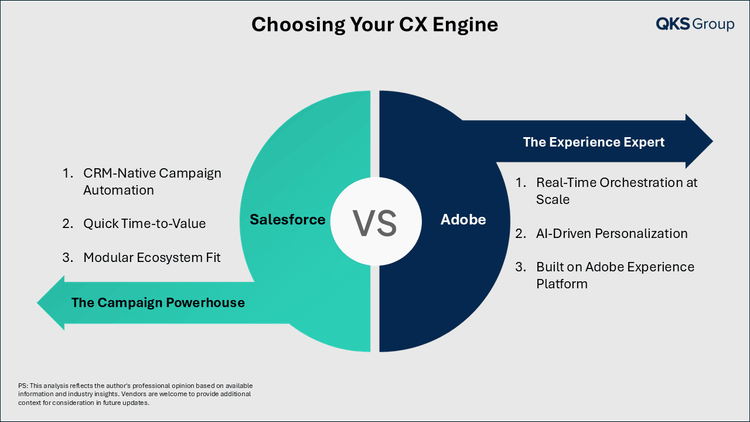
- Salesforce Journey Builder delivers strong CRM-centric campaign activation with user-friendly tools but struggles with siloed architecture and limited real-time intelligence.
- Adobe Journey Optimizer enables powerful, adaptive experience orchestration through a unified data layer but requires significant investment and deep alignment with the Adobe ecosystem.
Salesforce vs. Adobe for Enterprise Journey Management
Customer journeys are not just maps but they act as the backbone of modern experience orchestration and define how brands connect with customers on a scale. As enterprise Customer Experience (CX) strategies mature, the leading platforms like Salesforce and Adobe double down on their journey management tools. But a side-by-side comparison of their journey management tools – Salesforce Journey Builder & Adobe Journey Optimizer- may reveal the critical differences that come in their capabilities, direction and maturity. Here is a breakdown of how these tools stack up against each other,
- Capabilities Faceoff
Salesforce Journey Builder is a tool that enables automation of customer interactions across key digital channels including email, mobile, advertising, and the web. Marketers can define entry criteria, segment audiences, configure decision splits, and personalize communications based on behavioral data. Its drag-and-drop visual interface makes campaign creation accessible even for non-technical users. However, its strength lies in serving marketing automation use cases rather than orchestrating holistic customer experiences. Its major advantage lies in its native CRM integration, which allows seamless access to Salesforce data and improves campaign precision across channels. Journey Builder can arrange real-time triggers, utilising the Salesforce CDP, enabling responsiveness per the customer (Individual) instead of as a cohort. With that being said, it's not uncommon for users to feel friction when navigating between the different clouds, (Marketing, CDP, and Service), causing operational silos.
Adobe Journey Optimizer, however, is unique in providing real-time contextual experience orchestration, combining AI-based decisioning, unified customer profiles, and omnichannel journey execution on a single platform. The platform can handle real-time and scheduled journeys and react to real-time customer signals across any channel: web, app, email, and call center. Adobe's key strength lies in the fact that it is wholly integrated and offers a complete, unified data environment. Journey Optimizer uses real-time profiles to personalize experiences on the go, augmented with Adobe Sensei intelligence for next-best-action suggestions. Additionally, it supports B2B and B2C use cases at scale. However, the implementation of Journey Optimizer can require considerable resources and often require expert assistance. Furthermore, the Journey Optimizer UI can be overwhelming for teams who are not already nest into the Adobe ecosystem for the experience hub. Finally, the full power of this tool will only be realized once an organization fully accepts the greater Adobe stack especially Adobe Experience Platform (AEP).
- Strategic Direction: Martech Tool vs. Experience OS
Salesforce uses a CRM and marketing perspective for journeys. The Journey Builder component is a channel optimizer, where, at the end of the day, the tool facilitates addressable messaging, based on expected customer actions. The platform's primary use is to enable marketing teams to manage lifecycle campaigns at scale. And, under the broader context of Salesforce's AI focus (e.g. Einstein), Salesforce is layering journey management with helpful predictive aspects, with the core capabilities still focused on the campaign.
Adobe views Journey Optimizer as the experience layer, inclusive of all customer experiences, like marketing, better experience support, product and others. It is about not just sending messages but about creating an experience across the marketing/experience and support organization and also, all systems involved. The view is about context, real-time deciding, and ability to make every relationship adaptable, and Journey Optimizer is seen as a foundational layer in the Experience Cloud.
- Ecosystem Compatibility: Integration vs. Unification
Salesforce Journey Builder offers strong integration across its stack, but Marketing Cloud and other clouds (e.g., Sales, Service) can feel like separate silos without a unified interface. Journey Builder works great if you are fully steeped in the Salesforce ecosystem, but pulling in external data or real-time signals is a heavy lift.
Adobe Journey Optimizer works best when working in a unified data environment. The AEP creates a single customer view, which Journey Optimizer uses natively. However, it also assumes all Adobe technology is already in place - or requires significant upfront investment to realize its promise.
Choosing the Right Partner
When it comes down to selecting a journey management tool, the decision isn’t driven by feature count but by strategic alignment with your organizational goals.

In essence, choose Salesforce Journey Builder if your goal is to launch effective, CRM‑backed campaigns quickly and reliably. Choose Adobe Journey Optimizer if you’re building towards a future of adaptive, intelligence‑driven Customer Experience (CX), able to engage customers across channels in real time and at scale.
Disclaimer:
This blog is based on independent research and publicly available information. The insights presented reflect the views of QKS Group and are for informational purposes only. While we strive for accuracy, we do not guarantee completeness or absolute correctness. Vendors are welcome to provide clarifications or updates. If any vendor listed in this analysis wishes to provide additional context or clarification, we welcome a briefing call and will consider incorporating relevant updates. This analysis is not intended to disparage any vendor but to provide an informed, balanced perspective. We encourage open and constructive dialogue to foster transparency and a deeper understanding of the industry.
Author: Palika Jacob S, Analyst - CX Tech at QKS Group
Vendors: