

29.08.2025
QKS Review
QKS Review: Carrier Selection Intelligence and Dynamic Rate Shopping: Which MCPMS Vendors Deliver True Cost Optimization?
Author:
Avinash Singh


Executive Summary:
As e-commerce surges and parcel volumes climb, carrier selection has become a frontline lever for cost, speed, and customer experience. Multi-Carrier Parcel Management Solutions (MCPMS) promise smarter decisions and dynamic optimization, but QKS Group’s analysis finds a divide: some vendors enable true AI-driven intelligence and automation, while others remain stuck in static rate comparisons and manual workflows.
What Modern MCPMS Platforms Should Deliver
To deliver true cost optimization and competitive advantage, next-generation MCPMS must provide:
- Scalable Carrier Networks & Integration Flexibility: Broad parcel, LTL, and cross-border coverage with rapid API/EDI onboarding.
- Dynamic Rate Shopping & Optimization: AI/ML-driven algorithms that balance surcharges, fuel, transit times, and delivery commitments in real time.
- Automated Compliance & Regulatory Adherence: Built-in labeling, customs documentation, and updates for VAT, IOSS, and hazmat shipments.
- End-to-End Tracking, Visibility & Returns: Standardized data across carriers with proactive notifications and integrated returns flows.
- Data Intelligence as a Strategic Asset: Clean, standardized parcel data powering cost control, sustainability, and customer experience.
Key Findings
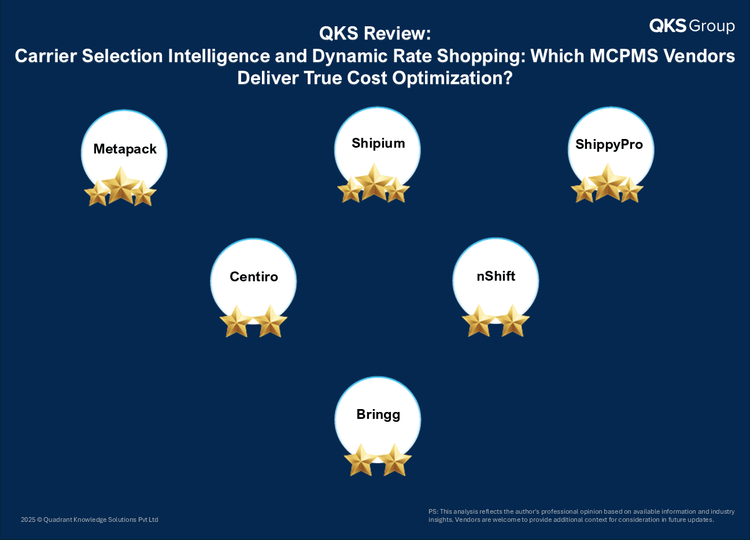
- Leading Vendors – Metapack, Shipium, ShippyPro: Deliver enterprise-grade optimization with AI-driven carrier selection, strong automation, and robust global or regional carrier networks.
- Capable Vendors – Centiro, nShift: Offer solid rules-based orchestration and extensive carrier libraries, but lack the scale, AI depth, or compliance automation required for advanced cost optimization.
- Innovation Gap Vendors – Bringg: Excels in last-mile orchestration and dynamic fleet management but falls short in core MCPMS capabilities such as rate shopping, compliance, and standardized parcel visibility.
With e-commerce moving at a fast speed, carrier selection is no longer a back-office decision; it’s the frontline lever for cost, speed, and customer experience.
Multi-Carrier Parcel Management Solutions (MCPMS) promise enterprises smarter carrier choices and real-time rate optimization. But here’s the real question: Are you using a platform that simply lets you connect to carriers or one that intelligently optimizes every shipment for true cost savings?
At QKS Group, where we analyze competitive intelligence and customer insights across logistics technologies, one thing is clear: not all MCPMS vendors deliver on the promise of cost optimization. Some platforms are re-defining carrier intelligence with AI-driven rate shopping and seamless compliance, while others remain stuck in manual workarounds and limited integrations.
Can your business afford hidden costs, integration delays, or sub-optimal carrier routing while competitors squeeze every cent of efficiency from their parcel operations?
The true value of an MCPMS lies in four essentials:
- Carrier Network & Integration Flexibility
A wide, multi-modal carrier network (parcel, LTL, cross-border, last-mile) combined with plug-and-play API/EDI onboarding ensures enterprises can expand quickly without manual setups. - Dynamic Rate Shopping & Optimization
Advanced algorithms factor in surcharges, fuel, and delivery windows balancing cost and speed in real time. AI/ML-driven intelligence separates true optimization from static rate comparison. - Labeling, Compliance & Regulatory Adherence
Automated carrier-compliant labels, customs docs, and regulatory updates (EU VAT, IOSS, hazmat) reduce manual work, prevent penalties, and keep global shipments moving without delays. - Tracking, Visibility & Returns Enablement
Standardized tracking across carriers, proactive delivery updates, and integrated returns management turn visibility into cost savings while improving the customer experience.
Vendor Showdown
The Leaders:
Metapack sets the level for enterprise-grade multi-carrier orchestration. Its platform offers 350+ integrations with global carriers through a single API, leveraging machine learning for quick label response times even during peak periods. Metapack's AI-driven carrier allocation engine uses real-time warehouse, carrier, and consignment data to ensure selection perfectly matches delivery requirements while optimizing costs. End-users note its ability to handle massive volumes with contracted uptime guarantees, making it ideal for enterprises with complex, high-volume shipping operations. The platform's open architecture also ensures seamless ERP integration, minimizing deployment friction.
Shipium stands out for its AI-driven carrier selection that analyses dynamic time-in-transit values, achieving on-time delivery performance during peak periods. Shipium's platform excels in eligibility management and business rule configuration, offering both self-service UI controls and API-level customization for maximum flexibility. Customers highlight its ability to reduce shipping costs through intelligent downgrades automatically selecting cheaper ground services when they can still meet delivery commitments without compromising customer expectations. The platform's focus on data science-driven optimization makes it particularly valuable for retailers seeking to balance cost and speed.
ShippyPro delivers comprehensive automation with 180+ carrier integrations and rapid carrier onboarding capabilities. Its platform excels in European markets with strong multi-language support and regional carrier coverage. ShippyPro's Optimizer provides real-time analysis of carrier costs and transit times, helping identify inefficiencies and optimization opportunities across different regions.
The Contenders:
Centiro has strong parcel management capabilities, with a rules-based engine that lets enterprises define the right service by cost, SLA, or delivery promise. Its self-onboarding capability helps cut carrier integration time, appealing to fast-scaling shippers. The platform supports parcel, LTL, and same-day couriers, making it flexible across modes. But scale is the issue, its global carrier reach and AI-driven optimization are not yet on par with market leaders. The question for enterprises: Does Centiro’s agility outweigh its still-maturing global muscle?
nShift has built one of the largest carrier libraries in Europe, with over 450 integrations across multiple markets. Its strength lies in unifying checkout, shipping, tracking, and returns bridging logistics with the customer experience. Retailers praise its ability to improve conversions and reduce inbound service queries. Yet, its optimization depth remains limited; AI-driven cost intelligence and compliance automation are not its strongest suits. Is nShift’s breadth enough if cost optimization is your top KPI?
Bringg doesn’t play the classic Multi-Carrier Parcel Management Solutions (MCPMS) game it’s an orchestration engine designed to manage last-mile execution across in-house fleets, 3PLs, gig drivers, and parcel carriers. It is trusted by major retailers and food service chains to streamline and scale their fulfillment operations. Its edge is dynamic, real-time decision-making on how and who delivers, factoring in traffic, SLAs, and capacity. But it doesn’t handle rate-shopping, customs paperwork, or label compliance the core of MCPMS. Which begs the question: Is Bringg a parcel optimizer or just a last-mile specialist?
Strategic Guidance: Choosing MCPMS for the Next Decade
Selecting the right Multi-Carrier Parcel Management Solutions (MCPMS) isn’t about today’s cost it’s about tomorrow’s flexibility. Enterprises must prioritize:
- Scalable Carrier Networks: Platforms that can grow with your geographic and modal needs.
- Advanced Optimization Intelligence: AI-driven decisioning that balances cost, speed, and service level in real time.
- Compliance Automation: Hidden costs often emerge not in rates but in fines, delays, and manual fixes.
- Data Quality & Visibility: Clean, standardized parcel data is the fuel not just for cost savings but for sustainability reporting and customer experience.
The winners will be those who treat parcel data not as transactions, but as a strategic asset.
Will your MCPMS be a silent cost leak or a competitive advantage that powers customer loyalty and operational efficiency?
In a world where shipping costs continue to rise and customer expectations accelerate, the choice of your parcel management platform isn’t just an IT decision it’s a bottom-line weapon.
Disclaimer:
This blog is based on independent research and publicly available information. The insights presented reflect the views of QKS Group and are for informational purposes only. While we strive for accuracy, we do not guarantee completeness or absolute correctness. Vendors are welcome to provide clarifications or updates. If any vendor listed in this analysis wishes to provide additional context or clarification, we welcome a briefing call and will consider incorporating relevant updates. This analysis is not intended to disparage any vendor but to provide an informed, balanced perspective. We encourage open and constructive dialogue to foster transparency and a deeper understanding of the industry.
Author: Avinash Singh, Analyst - Supply Chain Execution (SCE) at QKS Group
Co-Author: Kumar Anand, Associate Director & Principal Industry Analyst at QKS Group
Co-Author: Nithin Bhaskaran, Senior Analyst at QKS Group
Vendors: