

30.09.2025
QKS Review
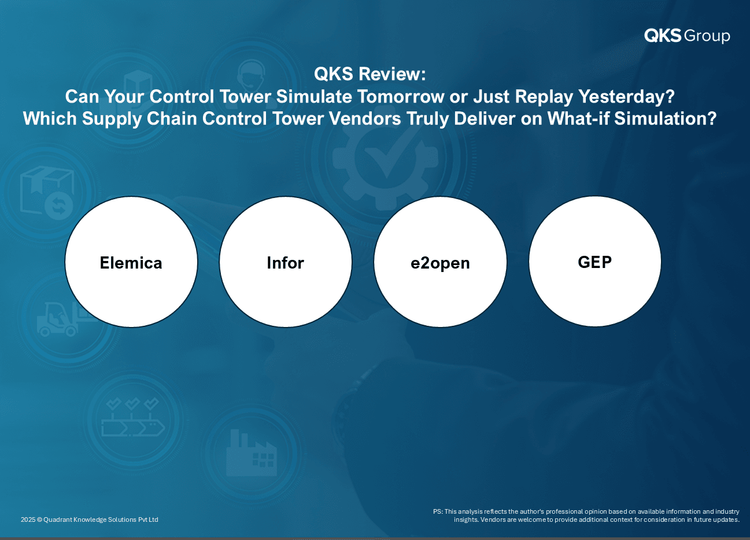
QKS Review: Can Your Control Tower Simulate Tomorrow or Just Replay Yesterday? Which Supply Chain Control Tower Vendors Truly Deliver on What-if Simulation?
Author:
Avinash Singh


Executive Summary:
As the Supply Chain Control Tower (SCCT) market faces intensifying pressure from global disruptions, demand volatility, and AI-driven planning expectations, organizations are moving beyond visibility dashboards. The new imperative is foresight the ability to simulate multiple futures and prescribe the best course of action.
This review blog by QKS Group evaluates whether SCCT vendors are truly delivering next-generation simulation capabilities or simply replaying historical data with incremental improvements.
What Modern Control Towers Should Deliver:
Today’s platforms must go further than descriptive analytics and reactive monitoring. Critical forward-looking capabilities include:
- Scenario modeling and flexibility to test countless “what-if” conditions across multi-tier networks
- Simulation speed and scale to run parallel models in near real time
- Prescriptive and trade-off analytics to recommend optimized actions balancing cost, service, and risk
- Integration with real-time data and execution systems for true closed-loop orchestration
Key Findings:
- Leading vendors (Elemica, Infor) stand out with scalable simulation engines, prescriptive intelligence, and seamless integration into live operations.
- Capable vendors (e2open, GEP) provide strong simulation and integration features but remain in transition toward the speed, depth, and closed-loop execution required by global enterprises.
Which Supply Chain Control Tower Vendors Truly Deliver on What-if Simulation?
In today’s unpredictable global economy, replaying yesterday’s data isn’t enough supply chains need the ability to simulate tomorrow.
Supply Chain Control Towers (SCCTs) promise to deliver this foresight. But ask yourself: Are you relying on a platform that merely visualizes past disruptions or one that can run “what-if” scenarios and prescribe the best path forward?
At QKS Group, where we specialize in supply chain technologies and end-user intelligence, one thing is clear: not all SCCTs are created equal. Some vendors are embedding AI-driven simulation engines that model complex global networks in real time while others are still stuck at descriptive dashboards.
Can your supply chain afford to react after the fact while competitors anticipate disruptions before they hit?
Simulation: The Non-Negotiable Capability for Future-Ready Control Towers
Organizations no longer have the luxury of dashboards that only replay history. Whether it’s a sudden port closure, a raw material shortage, or a surge in customer demand, SCCT platforms must be able to simulate multiple futures and recommend which one to pursue.
The leaders in this space don’t just monitor they simulate, prescribe, and act, linking decisions directly to cost optimization, service continuity, and risk reduction.
But integration complexity and scalability remain critical hurdles.
How fast can your chosen platform model a disruption across your global, multi-tier network without delaying action?
Meanwhile, business resilience and agility are boardroom priorities. Leading SCCTs now leverage AI-powered simulation to test thousands of scenarios in parallel, helping organizations optimize cost, service, and sustainability.
Is your Control Tower helping you anticipate risk and trade-offs or simply replaying historical data?
Technology Powerhouses: How Simulation Engines Separate Leaders from Laggards
The future belongs to platforms that fuse real-time data, AI-driven simulation, and prescriptive decision engines into a single closed-loop system of insight and execution.
At their best, SCCTs don’t just tell you what happened they model what could happen next, prescribe the best response, and execute it seamlessly.
But here’s the reality: not every vendor’s “simulation” lives up to the promise.
True simulation means building and testing “what-if” scenarios ranging from supplier shutdowns to logistics reroutes while quantifying trade-offs across cost, service, and risk.
Granular modeling down to supplier, lane, and SKU level is now the expectation not a premium feature.
Prescriptive recommendations tied directly into ERP, WMS, and TMS workflows are becoming mandatory not optional.
Is your current SCCT platform enabling proactive decisions or just replaying events after the damage is done?
Vendor Showdown
- Elemica:
Elemica excels in flexible scenario modeling, with drag-and-drop interfaces that allow users to test countless variables across global, multi-tier networks. The AI-powered simulation engine runs scenarios at scale with minimal latency, a capability praised by users in complex industries like chemicals and manufacturing. Where Elemica truly differentiates is in its prescriptive analytics the platform doesn’t just present trade-offs, it recommends optimized actions such as rerouting shipments or rebalancing supply allocations to minimize costs and risks. Seamless integration with ERP, IoT, and external signals ensures closed-loop execution, so simulated strategies translate directly into live operations. With predictive analytics embedded, Elemica turns potential disruptions into opportunities to drive efficiency, making it one of the most future-ready platforms in the market. - Infor
Infor sets a high bar with its Nexus platform, widely recognized for its ability to model dynamic “what-if” scenarios whether adjusting for demand volatility, supplier disruptions, or geopolitical shocks. Its simulation speed is a standout, processing parallel models across complex ecosystems in near real time, powered by advanced AI. End-users particularly value its prescriptive depth, where trade-off analysis balances cost, service, risk, and sustainability goals. Integration is another strength: Nexus connects effortlessly to WMS, TMS, ERP, and external data streams, enabling true closed-loop orchestration. Retailers and healthcare enterprises highlight its intuitive tools and resilience-building features, crediting Nexus with directly linking forward-looking simulation to measurable business improvements. For organizations seeking scale, speed, and execution-ready intelligence, Infor represents a market benchmark.
The Contenders
- e2open
e2open brings a solid suite of SCCT capabilities, with scenario modeling that supports multiple what-if tests. However, users note that flexibility can be constrained when building highly customized assumptions. Simulation performance is strong for regional and mid-scale networks but less agile in ultra-complex, global environments compared to leaders. Its prescriptive analytics provide useful cost and risk trade-off recommendations, though depth in areas like sustainability optimization is still maturing. Integration breadth is a strength, with APIs and IoT enabling closed-loop execution, but syncing with legacy systems can present gaps. e2open is steadily progressing in AI-driven planning, making it a viable choice for enterprises that want to evolve into advanced simulation without taking on an immediate, large-scale overhaul. - GEP
GEP offers a cloud-native Control Tower that delivers flexible scenario modeling, allowing rapid adjustments to assumptions such as lead times, demand shifts, or supplier disruptions. The platform performs effectively at scale for regional and mid-sized operations, though speed and responsiveness can taper off in multi-tier, global networks. Its prescriptive tools provide actionable insights, balancing service and cost trade-offs, but risk-focused analytics are still catching up to leaders. Integration is strongest in procurement-driven ecosystems, where GEP connects well to ERP and external data feeds. While closed-loop execution exists in part, fuller automation requires configuration. End-users consistently cite GEP’s user-centric design and predictive analytics as differentiators, making it a strong contender for organizations seeking targeted enhancements rather than full-scale transformation.
Conclusion: Simulation Isn’t Just a Feature It’s a Mindset Shift
In the era of SCCTs, simulation must evolve from a side capability to the foundation of resilience and agility.
Elemica and Infor are setting the standard by embedding fast, scalable simulation engines and prescriptive analytics into every decision point.
e2open and GEP provide strong alternatives but with caveats around speed, depth, and closed-loop execution.
Will your Control Tower empower you to simulate tomorrow or leave you replaying yesterday?
Disclaimer:
This blog is based on independent research and publicly available information. The insights presented reflect the views of QKS Group and are for informational purposes only. While we strive for accuracy, we do not guarantee completeness or absolute correctness. Vendors are welcome to provide clarifications or updates. If any vendor listed in this analysis wishes to provide additional context or clarification, we welcome a briefing call and will consider incorporating relevant updates. This analysis is not intended to disparage any vendor but to provide an informed, balanced perspective. We encourage open and constructive dialogue to foster transparency and a deeper understanding of the industry.
Author: Avinash Singh, Analyst at QKS Group
Co-author: Kumar Anand, Associate Director & Principal Industry Analyst at QKS Group
Vendors: