

27.06.2025
QKS Review
QKS Review: Breaking Through the Metadata Mirage: Why Integration-First Data Fabrics Are Winning and which are the Vendors to Watch
Author:
Arun U


Executive Summary:
As the enterprise data fabric market faces rising pressure from fragmented data environments, real-time decision-making demands, and the limitations of metadata-centric architectures, organizations are moving beyond traditional cataloging and documentation tools.
This review blog by QKS Group assesses whether data fabric vendors are truly innovating to meet these integration-first requirements or merely rebranding legacy approaches.
What Modern Data Fabric Platforms Should Deliver:
Today’s platforms must offer more than metadata management and batch-based pipelines. Critical next-gen capabilities include:
• Real-time data virtualization and unified access
• Semantic layer enrichment and context-aware data delivery
• Entity-based data modeling for operational intelligence
Key Findings:
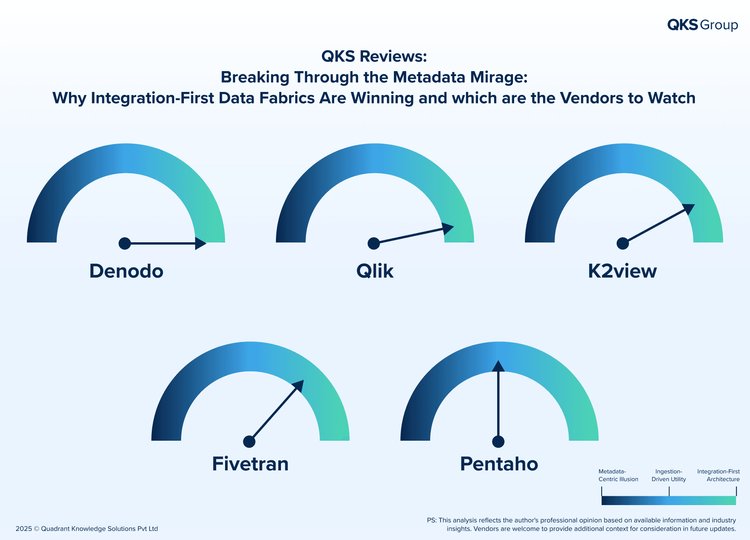
• Leading vendors (Denodo, Qlik) stand out with comprehensive, integration-first platforms that enable semantic interoperability and real-time performance.
• Capable vendors (K2view, Fivetran) show promise in enabling dynamic data integration and automation, but require broader ecosystem maturity.
• Lagging vendor (Pentaho) remain anchored in static metadata and struggle to support real-time, cross-silo data utilization.
Market Landscape
The enterprise data landscape is dotted with the wreckage of those revolutionary platforms that were supposed to get all our data problems solved. And here we are in 2025, still drowning in silos, still pursuing the ghost of an integrated data view, and still being sold the same re-packaged goods with glossier UIs and buzzword-laden marketing.
But something fundamental has shifted. The winners in today's data fabric wars aren't the ones with the prettiest dashboards or the most LinkedIn thought leadership posts. They're the vendors who understood a brutal truth: metadata without integration is just expensive documentation.
The Great Metadata Deception
For years, we've been sold the dream that if we just catalog our data better, tag it more comprehensively, and build more sophisticated lineage graphs, our data problems would magically disappear. Vendors spent fortunes building beautiful metadata stores that could tell you everything about your data except how to actually use it effectively.
The reality? Most organizations have become metadata rich and integration poor. They can tell you the schema of a table from 2019, but they can't tell you why their customer 360 view shows three different addresses for the same person.
The Integration-First Revolution
The vendors who are actually winning aren't playing the metadata theater game anymore. They're focusing on what matters: making data work together, not just look pretty in a catalog.
Denodo: The Virtualization Powerhouse
While others were busy building data lakes that turned into data swamps, Denodo doubled down on something radical: what if we didn't move the data at all? Their data virtualization platform has evolved into something that would make the early pioneers of federation weep with joy.
Denodo's latest architecture doesn't just create virtual views, it creates intelligent, adaptive data services that can optimize queries across heterogeneous sources in real-time. Their semantic layer isn't just a pretty abstraction; it's a performance-tuned engine that can make a complex join across Oracle, Snowflake, and MongoDB feel like a local table scan.
What distinguishes them is their appreciation that contemporary businesses don't require another duplicate of their data, they require their data to act like it is already consolidated. Denodo's smart caching and push-down optimization have evolved to such an extent that classical ETL methods appear to be stone tools.
Qlik: Beyond Pretty Pictures
Qlik executed a masterful pivot that most people didn't catch. While everybody was fixated on their visualization abilities, they quietly developed one of the strongest data integration platforms in the industry. Their buying spree was not accidental, it was strategic gearing up for integration-first future.
Qlik's Data platform, now enhanced with their expanded integration capabilities, creates something unique: a platform where data discovery and data preparation happen in the same cognitive space. Users aren't just exploring data they are actively participating in its integration and transformation.
Their cloud-native design scales in ways that make legacy BI platforms seem quaint. More significantly, Qlik has solved the problem of making data integration universally accessible to business users without dumbing it down for data engineers. It's sophisticated enough for sophisticated enterprise use cases but easy enough that domain experts can create their own data pipelines.
K2view: The Dark Horse
K2view is something truly unique in a market dominated with me-too offerings. Their data fabric approach based on entities is not another architecture pattern, but a complete rethink of how data should be structured and accessed.
Rather than a schema and tables mindset, K2view thinks in terms of business entities. Need to see all about customer ID 12345? K2view doesn't execute a sophisticated join of seventeen tables, it materializes that customer's full data picture as a coherent, performance-tuned entity.
Their micro-database strategy is genius: each business entity has its own tuned data store, real-time synchronized with source systems but queryable as a unified, denormalized view. It's like having a bespoke database for every significant entity in your business, automatically managed and constantly updated.
For companies with complex master data management issues, K2view provides something that classic MDM solutions never could: speed, scale, and simplicity in one solution.
The Middle Ground: FiveTran's Reliable Utility Play
Fivetran is to be commended for filling a pressing requirement in the contemporary data stack with great emphasis and accuracy. With a market that tends to try to do everything, Fivetran has had a consistent track record of excelling by streamlining data ingestion into something smooth, reliable, and wonderfully simple. With its comprehensive connector palette and high reliability rates, Fivetran stands as a preferred solution for companies looking for a reliable means to unify SaaS data into their warehouses.
Although Fivetran is strong in data movement with dependability, its founding philosophy has hitherto always been focused more on replication than real-time integration. As the data landscape more and more adopts integration-first strategies and demands wiser data unification, there is an expanding space for Fivetran to shift its positioning.
Recent moves in transformation capabilities suggest that Fivetran is carefully unfolding its value proposition outside of pipelines. Although this shift remains developing, it shows an evident intention to accommodate larger platform requirements a new direction that might redefine their place in the data landscape today.
The Evolution Challenge: Pentaho's Strategic Crossroads
Pentaho is a fascinating example of platform evolution. As one of the early movers in data integration, they've established an extensive suite that has benefited numerous organizations in the past. They've always been strong at offering an integrated platform that solves various data management requirements, ranging from ETL processing to reporting and analytics.
Yet the transition to integration-first architecture also opens opportunities and challenges for platforms with Pentaho's depth. The broad scope that used to make them appealing to provide ETL, reporting, data mining, and dashboard features in one platform now needs to navigate with caution in a market increasingly trending toward specialized, best-of-breed solutions.
The alignment with Hitachi Vantara's larger portfolio provides enterprise support and resources, but with competing priorities and strategic choices regarding where to allocate development resources. As Pentaho expands and enhances capabilities, the rate of innovation in cloud-native, real-time integration has been fast, and it has been difficult for any mature platform to keep pace on all fronts.
Pentaho's challenge is not unique to it numerous mature platforms are facing similar considerations regarding the value of broad capability coverage versus deeper specialization in particular spaces. Their large customer installed base and established reliability in legacy integration use cases are still valuable assets. The real question is how well they can recast their broad approach to accommodate the needs of modern, integration-first data architectures while preserving the stability and functionality existing customers rely on.
Conclusion: The Integration-First Future
The winners today see that the future of data isn't stored better, visualized nicer, or cataloged more comprehensively. It's that data acts like it never were in silos to begin with.
Real-time synchronization, caching that's clever, query optimization that adapts, and semantic layers that really deliver what they're supposed to. Integration as a first-class citizen and not an afterthought.
The metadata mirage is finally lifting. The question isn't whether your organization will adopt an integration-first approach it's whether you'll choose vendors who understand that the future of data is about making it work together, not just making it look good in a catalog.
The winners are already pulling ahead. The question is: are you betting on the right horses?
Disclaimer:
This blog is based on independent research and publicly available information. The insights presented reflect the views of QKS Group and are for informational purposes only. While we strive for accuracy, we do not guarantee completeness or absolute correctness. Vendors are welcome to provide clarifications or updates. If any vendor listed in this analysis wishes to provide additional context or clarification, we welcome a briefing call and will consider incorporating relevant updates. This analysis is not intended to disparage any vendor but to provide an informed, balanced perspective. We encourage open and constructive dialogue to foster transparency and a deeper understanding of the industry.
Authors: Arun U, Analyst - Data Architecture at QKS Group
Amandeep S. Khanuja, Associate Director & Principal Analyst at QKS Group
Vendors: