

30.07.2025
QKS Review
QKS Review: Beyond the Bid: Who's Delivering Real Value in eSourcing and RFx Management? – Part 2
Author:
Vishal Poduri


Executive Summary:
As the Strategic Sourcing Applications (SSA) market faces rising pressure from inflation‑driven cost volatility, supplier‑risk exposure, and AI‑fuelled expectations for speed and transparency, organizations are moving beyond traditional eRFx portals and spreadsheet‑driven sourcing tools.
This review blog by QKS Group assesses whether eSourcing & RFx Management vendors are truly innovating to meet these demands or merely making incremental updates.
What Modern eSourcing Platforms Should Deliver:
Today’s platforms must offer more than basic RFIs, RFQs, and reverse auctions. Critical next‑gen capabilities include:
• AI‑driven RFx creation and supplier recommendations
• Scenario‑based optimization & should‑cost analysis for award decisions
• Autonomous sourcing workflows with real‑time collaboration and analytics
Key Findings:
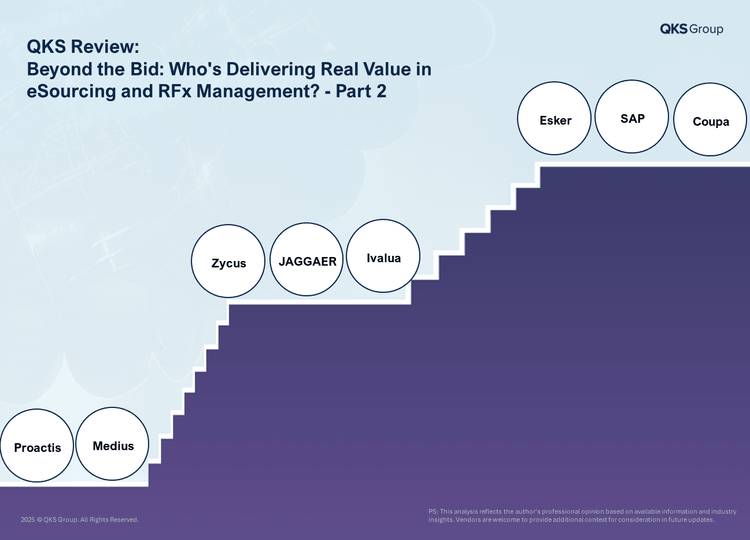
• Leading vendors (Coupa, SAP Business Network, Esker) stand out with comprehensive, enterprise‑grade platforms that blend rapid usability with deep optimization.
• Capable vendors (Ivalua, JAGGAER, Zycus) demonstrate strong innovation in AI guidance and scenario modeling, but still lack either consistent ease‑of‑use or global breadth across all modules.
• Lagging vendors (Medius, Proactis) remain anchored to fundamental RFx workflows and risk falling behind as enterprises demand data‑driven, autonomous sourcing experiences.
The Market Divide is Deepening
The baseline expectations for eSourcing have moved from simple RFI/RFQ creation to features like expressive bidding, “what-if” award simulations, GenAI-powered RFx creation, and deep supplier engagement. As capabilities mature, so does the divide between those enabling strategic outcomes and those offering tactical execution. In this blog, we dissect the strengths, trade-offs, and execution gaps across eight Strategic Sourcing Applications (SSA) vendors.
Setting the Pace for Strategic Execution
Coupa: Optimization Powerhouse, Not Always Plug-and-Play
Coupa remains one of the few vendors offering deterministic optimization via its sourcing optimizer, capable of evaluating expressive bids across multiple constraints. Its scenario “what-if” capabilities, AI-powered insights, and direct CLM integration create an efficient sourcing-to-contract flow. However, this power comes with complexity; users often require expert support to configure scoring models or handle non-price award factors. For procurement leaders with mature sourcing organizations and access to modeling expertise, Coupa is unmatched. But for those looking for agile, out-of-the-box flexibility, the steep learning curve may slow momentum.
SAP Business Network: Guided, Scalable, but Rigid in Flexibility
SAP delivers a robust, globally scalable platform with deep supplier network integration. Its guided sourcing feature with Smart Excel imports and structured bid evaluations supports consistent execution across business units. The multi-round RFx Management orchestration and unified sourcing workspace provide a holistic view for global procurement teams. However, SAP’s strength in control and governance often comes at the cost of flexibility. Customization is largely template-based, and power users requiring dynamic configuration or optimization logic may find the environment too restrictive. SAP is well-positioned for companies prioritizing compliance and repeatability, but less so for innovation-led sourcing strategies.
Esker: High Velocity Meets Guided Intelligence
Esker’s eSourcing platform impresses with its speed, accessibility, and focus on value realization. With event cloning, Excel compatibility, and multiscoring auction support baked into its DNA, Esker simplifies the sourcing lifecycle for lean teams. Its AI-powered questionnaire builder and guided workflows streamline bidder engagement and evaluation setup. Users report ROI within days of deployment, a rare feat in this space. But its strength is also its ceiling: Esker lacks the mathematical optimization and deep scenario modeling that strategic sourcing teams expect for high-stakes negotiations. For mid-market firms seeking rapid deployment and intelligent templates over complex models, Esker is an ideal fit.
Maturing Rapidly: Innovation on the Horizon
Ivalua: Deep Configurability, On the Cusp of Autonomous Sourcing
Ivalua offers a highly configurable sourcing suite with broad RFx Management support, scenario libraries, cost-breakdown templates, and guided workflows. The platform excels in category intelligence and modular rule application, which suits advanced sourcing teams. While some usability limitations remain, particularly for suppliers and non-technical users, the solution’s architecture supports complex workflows and granular control. Importantly, Ivalua’s roadmap points toward future-facing capabilities like should-cost analysis and autonomous sourcing, which could elevate its offering from tactical control to intelligent orchestration. For teams that want end-to-end configurability now, and emerging AI innovation tomorrow, Ivalua presents a compelling value proposition.
Zycus: GenAI-Led Efficiency, but Still Finding Its Optimization Groove
Zycus brings generative AI front-and-center with intelligent RFx creation, real-time bid interaction, and embedded intelligent questionnaires. The user interface is sleek and modern, making event design and supplier engagement intuitive. Zycus has opted for a guidance-heavy AI model rather than a mathematical one, favoring speed and ease of use. While it currently lacks deterministic optimization, i.e., the depth required for high-value multi-attribute negotiations, the vendor is clearly building toward stronger constraint modeling and analytics. For buyers focused on speed and automation, Zycus hits the mark, and its roadmap signals broader optimization depth on the horizon.
JAGGAER: Power and Precision, with a Steady Path to Simplification
With its Advanced Sourcing Optimizer (ASO), JAGGAER is technically one of the most complete platforms for complex sourcing. ASO supports multi-round, multi-attribute RFx Management events with constraint-based modeling, clause-level analysis, and AI-driven award navigation. Yet this sophistication often leads to adoption hurdles. Interfaces can still feel dense, and professional services are often needed for setup, but the company is actively investing in UX simplification and AI agents under its “JAI” strategy. The shift toward modularity and embedded guidance could reduce adoption friction over time. JAGGAER is a strong fit for global organizations prioritizing sourcing precision, especially as its roadmap promises greater usability without sacrificing depth.
Usable and Practical, But Not Strategy-Ready
Proactis: Straightforward, But Structurally Limited
Proactis offers a clean UI and ease of use for standard sourcing needs. RFx event creation is fast, supported by reusable templates and built-in auction formats. Features like supplier conduct capture and bid audit trails add governance for regulated sectors. However, the platform falls short on optimization depth, it lacks multi-attribute scoring, advanced analytics, and predictive AI. For basic RFQs or compliance-oriented workflows, Proactis delivers. But it’s not built to support the strategic sourcing ambitions of large enterprises.
Medius: Structured Workflow, But No Optimization Muscle
Medius provides solid sourcing execution with project-based RFx, configurable questionnaires, and multi-round event support. Dashboards are clean and demand capture is structured. Yet, Medius lacks any optimization engine or scenario modeling tools, making it ill-suited for complex award decisions. AI capabilities are minimal, and express bidding is basic. The platform serves well in environments where sourcing is recurring and operational but does not meet the bar for analytics-driven sourcing.
Conclusion: Capability Without Execution is Just a Checklist
In 2025, the eSourcing landscape is no longer defined by who can host a reverse auction or send out an RFP. It is defined by how platforms guide teams to better outcomes, through scenario analysis, AI-augmented decisions, configurability, and usability. Coupa, SAP, and Esker stand out for offering a mix of innovation, maturity, and execution. Ivalua, JAGGAER, and Zycus are in the race but face trade-offs in complexity, usability, or depth. Medius and Proactis may support transactional sourcing well but lack the capabilities needed to support strategic procurement transformation.
Disclaimer:
This blog is based on independent research and publicly available information. The insights presented reflect the views of QKS Group and are for informational purposes only. While we strive for accuracy, we do not guarantee completeness or absolute correctness. Vendors are welcome to provide clarifications or updates. If any vendor listed in this analysis wishes to provide additional context or clarification, we welcome a briefing call and will consider incorporating relevant updates. This analysis is not intended to disparage any vendor but to provide an informed, balanced perspective. We encourage open and constructive dialogue to foster transparency and a deeper understanding of the industry.
Author: Vishal Poduri, Analyst - Source-to-Pay at QKS Group
Vendors: