

19.06.2025
QKS Review
QKS Review: AI-Native Networking Platforms: Reality Check – Leaders, Hype, and the Overlooked
Author:
Aditya S


Executive Summary:
Executive Summary:
In today’s fast-evolving networking landscape, AI-native platforms are reshaping the way enterprises manage connectivity, security, and network automation. As networks grow more distributed, dynamic, and mission-critical, legacy approaches rooted in manual configuration and siloed operations are no longer sufficient. Enterprises now demand intelligent, adaptive solutions that deliver real-time insights, automated responses, and predictive capabilities.
AI-native networking platforms are ushering in a new era of self-optimizing, self-healing, and security-aware infrastructure, where AI and machine learning are embedded at the core of network operations. These platforms go beyond traditional automation by enabling closed-loop intelligence, continuous performance tuning, and proactive threat mitigation. As vendors race to integrate AI-driven insights into their offerings, the competitive landscape is rapidly evolving. The ability to deliver scalable, AI-native networking solutions that improve performance, resilience, and operational efficiency is fast becoming the defining factor between market leaders and followers in this new digital paradigm.
Why AI is Essential in Networking Solutions
AI has emerged as a pivotal force in the evolution of modern networking, fundamentally transforming how networks are managed and optimized. By enabling real-time decision-making, automated troubleshooting, and proactive performance enhancement, AI is reshaping network operations from reactive to predictive. As a result, enterprises are increasingly adopting AI-driven networking solutions to gain enhanced agility, streamline operational efficiency, minimize downtime, strengthen security posture, and deliver seamless user experiences across today’s complex and dynamic digital ecosystems.
- Network Optimization: AI continuously monitors real-time network traffic, identifying patterns, detecting congestion, and dynamically optimizing data flow. It intelligently reroutes traffic to avoid bottlenecks, reduces latency, and minimizes packet loss-delivering high-speed, reliable connectivity across distributed environments. This ensures seamless application performance and enhances the overall digital experience for end users.
- Predictive Maintenance: Leveraging machine learning, AI predicts potential network component failures, bandwidth saturation, or signal degradation well before they occur. It enables IT teams to take preemptive actions-such as reconfiguration, load balancing, or hardware replacement-drastically reducing unplanned downtime and increasing service continuity. This proactive approach ensures a more resilient and robust network infrastructure.
- Intelligent Traffic Management: AI dynamically classifies and prioritizes network traffic based on application criticality, user behavior, and business intent. It adapts routing decisions in real time to ensure low-latency performance for latency-sensitive services like video conferencing, VoIP, and mission-critical apps. This guarantees service-level consistency, even during peak loads or network disruptions.
- Automated Threat Detection:AI models are trained to recognize subtle anomalies and deviations in network behavior that might signal a security breach, malware activity, or insider threat. With real-time threat detection and automated response capabilities, the network can isolate affected nodes, block malicious traffic, and initiate self-healing protocols-minimizing the blast radius of attacks and ensuring compliance with security policies
- Operational Efficiency: By automating routine, error-prone tasks such as configuration, diagnostics, and performance tuning, AI significantly reduces manual workload and operational overhead. It empowers IT teams with actionable insights, accelerates root cause analysis, and enables faster resolution times. This not only boosts productivity but also helps enterprises scale operations efficiently while reducing OPEX.
With these advantages in mind, let’s explore how leading AI-native networking vendors are transforming enterprise networks.
In the race toward next-generation networks, AI is no longer a luxury - it's the engine driving agility, resilience, and innovation. While many vendors provide AI integration, the depth and impact of their implementations differ significantly. Some trailblazers have engineered AI-native architectures from the ground up, delivering truly autonomous, self-driving networks. Others have taken an evolutionary path, layering AI-driven analytics onto traditional frameworks -offering improvements, but falling short of full autonomy.
To help enterprises navigate this evolving landscape, we present a strategic breakdown of key players in AI-powered networking, highlighting their technological maturity, architectural depth, and vision for the future.
The AI-native networking Adoption Landscape
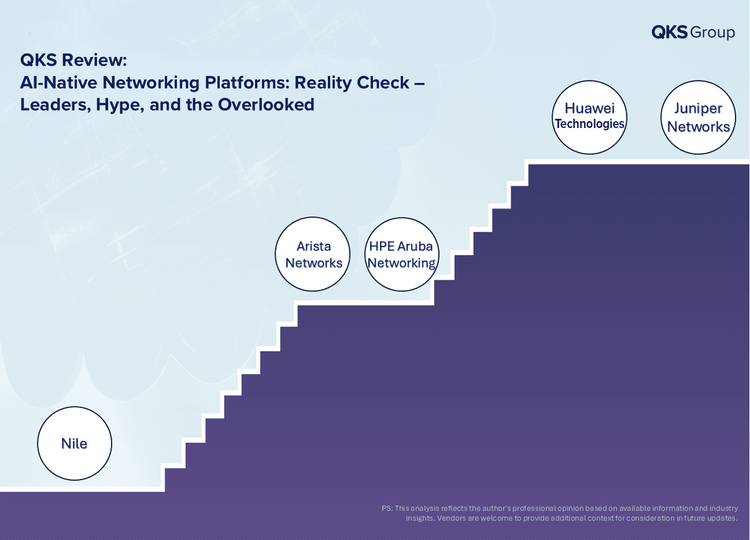
Market Leaders: Strong AI Integration Driving Innovation
Huawei: AI-Native, Self-Optimizing, and AI-Powered Network Slicing
Huawei has built a strong AI-native networking foundation with its Autonomous Driving Network (ADN) framework, enabling self-optimizing and self-healing networks. AI-powered fault detection proactively identifies network issues, allowing predictive maintenance that minimizes downtime and improves network stability.
The iMaster MAE-CN solution automates the lifecycle of 5G core network operations, ensuring seamless management and optimization. Additionally, Huawei’s AI-driven network energy efficiency models predict network load and dynamically adjust energy consumption for base stations and data centers, improving sustainability.
Huawei’s cloud-native microservices-based architecture supports 2G, 3G, 4G, and 5G infrastructures, offering flexible deployment models across centralized and edge networks. Its intent-based networking (IBN) translates high-level business goals into automated AI-driven network policies, reducing manual configuration and operational complexity.
One of Huawei’s standout AI capabilities is network slicing, allowing telecom operators to create multiple virtual networks on a shared physical infrastructure. AI ensures each slice is optimized for specific applications, such as IoT, AR/VR, and smart cities, providing guaranteed low latency and high reliability.
Additionally, Huawei’s Multi-access Edge Computing (MEC) enhances ultra-low latency applications, including industrial automation, smart grids, and autonomous vehicles, by processing data closer to the user at the edge. This AI-driven edge computing allows third-party applications to be deployed rapidly, expanding enterprise use cases.
With these innovations, Huawei joins as a leader in AI-native networking, bringing a self-optimizing, and AI-powered approach to telecom operators and enterprises worldwide.
Juniper Networks: AI-Native, Proactive Optimization, and Self-Healing
Juniper Networks has taken a different approach, positioning itself as a leader in AI-native networking. Unlike traditional solutions that simply use AI for analytics, Juniper’s AI strategy is deeply embedded into network operations, driving self-optimizing, self-healing, and self-learning capabilities.
The core of Juniper’s AI capabilities lies in Mist AI and the Marvis Virtual Network Assistant, which continuously analyze network conditions and automate traffic optimization, congestion management, and troubleshooting. This enables networks to adapt in real time, reducing manual intervention and operational complexity.
Furthermore, Juniper integrates AI with its Zero Trust security model, ensuring that AI is not just optimizing network performance but also dynamically detecting and responding to threats. By leveraging a cloud-native microservices architecture, Juniper ensures that AI-driven enhancements can be deployed without disrupting operations, making it a frontrunner in true AI-native networking.
Strong Performers: Advancing AI Capabilities but Not Fully Autonomous
HPE Aruba Networking: AI at the Edge for Intelligent Optimization
HPE Aruba has embraced AI-driven networking, particularly at the enterprise edge. Through Aruba Central and AIOps, it enables proactive network optimization, issue detection, and security enforcement. Aruba’s AI-powered analytics continuously monitor network behavior, providing real-time insights and predictive recommendations to reduce downtime and improve efficiency.
Aruba’s AI capabilities extend to SD-Branch and Edge Connect, where AI-driven automation optimizes multi-cloud connectivity, application performance, and security policies. Additionally, dynamic path selection and AI-driven failover mechanisms enhance SaaS and cloud application performance.
Despite these advancements, Aruba’s AI functionalities are focused on optimization rather than full automation. While predictive analytics and AIOps improve operational efficiency, its AI-driven capabilities still require some level of manual oversight, preventing it from being classified as a fully AI-native solution.
Arista Networks: AI for Observability, Efficiency, and Predictive Intelligence
Arista Networks delivers AI-driven networking with a focus on observability, efficiency, and predictive intelligence. Through its Etherlink platform, Arista integrates AI across four key components: AI Platforms with optimized hardware, an AI Suite powered by EOS, AI Agents that coordinate network and NIC performance, and AI Observability for deep insights into AI workload efficiency.
Arista’s CloudVision automation software, network data lake (NetDL), and Autonomous Virtual Assistant (AVA) provide real-time visibility into AI-driven workloads, enabling proactive monitoring, predictive maintenance, and optimized resource allocation. The platform’s open and interoperable architecture enhances automation, simplifies operations, and streamlines management workflows, reducing manual intervention and operational complexity.
To enhance energy efficiency, Arista leverages advanced silicon technology and optional Linear-drive Passive Optics, significantly reducing power consumption compared to traditional solutions. Additionally, its specialized telemetry features allow microsecond-level monitoring, ensuring precise performance optimization for AI applications.
While Arista offers industry leading predictive intelligence and enhanced observability, it is more data driven than fully autonomous. AI-powered analytics improve incident resolution and network efficiency, but real-time network adjustments and optimizations often require human intervention. This prevents Arista from reaching full AI-native automation but still makes it a compelling choice for enterprises prioritizing high-performance, scalable AI networking with deep visibility and operational efficiency.
Emerging Player: Fully Autonomous Networking with Zero-Touch Operations
Nile: AI-Native, Self-Optimizing, and Zero-Touch Networking
Nile represents a new generation of AI-native networking platforms, engineered from the ground up to deliver autonomous, high-performance campus networks through built-in AI automation, zero trust security, and a Network-as-a-Service (NaaS) model. Unlike traditional networks that require continuous manual oversight, Nile’s platform employs closed-loop automation and deterministic system design to eliminate 80% of network issues at the design stage and resolve 99.5% of incidents without human intervention.
By leveraging AI, Nile ensures that performance adjustments, security policies, and network configurations are handled autonomously, without the need for constant manual tuning. AI continuously monitors network behaviour, optimizes traffic patterns, and detects threats in real time, providing enterprises with a self-sustaining network.
As an emerging vendor in the networking space, Nile must continue proving its ability to scale reliably across complex enterprise environments. Its AI-native platform delivers clear operational, security, and cost-efficiency benefits-but in environments where legacy infrastructure remains, organizations may still need to maintain their existing management platforms alongside Nile’s service.
The Final Take
The AI-native networking platform landscape is rapidly maturing,with market leaders like Huawei and Juniper Networks offering deeply integrated AI capabilities that enable self-optimizing, self-healing, and intent-driven network operations. These platforms stand out for delivering real-time automation, predictive intelligence, and reduced manual intervention. Strong performers such as HPE Aruba Networking and Arista Networks bring powerful AI features focused on observability, optimization, and performance, though they still require some human oversight. Nile, an emerging player, is pioneering fully autonomous, zero-touch networking through a ground-up AI-native design that handles operations, security, and performance without manual tuning. As enterprises seek more agile, intelligent, and efficient network solutions, those embracing AI-native platforms are better positioned to lead in the digital era.
Disclaimer:
This blog is based on independent research and publicly available information. The insights presented reflect the views of QKS Group and are for informational purposes only. While we strive for accuracy, we do not guarantee completeness or absolute correctness. Vendors are welcome to provide clarifications or updates. If any vendor listed in this analysis wishes to provide additional context or clarification, we welcome a briefing call and will consider incorporating relevant updates. This analysis is not intended to disparage any vendor but to provide an informed, balanced perspective. We encourage open and constructive dialogue to foster transparency and a deeper understanding of the industry.
Author: Aditya S, Analyst - IT/Network Operations Management at QKS Group
Vendors: