

24.06.2025
QKS Review
QKS Review: AI Maturity in FP&A: Who’s Leading the Intelligence leveraging GenAI and Who’s Still Stuck in Spreadsheets?
Author:
VVVD Akhilesh


Executive Summary:
Executive Summary
The FP&A landscape is undergoing a major transformation from backward-looking reporting to forward-looking, AI-powered decision intelligence. While nearly every vendor claims to be “AI-driven,” QKS' analysis reveals a fragmented reality: some platforms are building truly autonomous financial systems, others are merely automating yesterday’s workflows with GenAI wrappers.
This review benchmarks leading FP&A vendors based on the maturity, depth, and strategic direction of their AI capabilities:
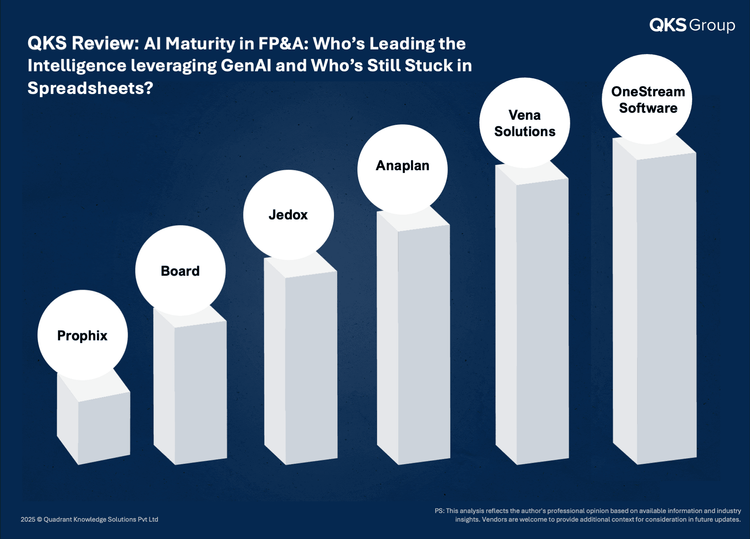
- Leaders like OneStream and Vena have embedded AI into the core of planning workflows. Their platforms enable continuous learning, real-time scenario modeling, and agentic copilots that actively guide financial decisions. They aren’t layering GenAI; they’re operationalizing it.
- Mid-tier players like Anaplan, Jedox, and Board offer solid technical foundations including no-code ML, Python integration, and basic forecasting, but fall short in real-time adaptability, orchestration, and autonomous intelligence. Their GenAI initiatives remain disconnected from core FP&A logic.
- Laggards like Prophix still focus on surface-level automation and productivity features. Their AI assistants offer convenience but lack contextual awareness, self-healing models, or autonomous planning capabilities.
In an era where speed, precision, and adaptability define competitive advantage, FP&A vendors must evolve from simply enabling tasks to driving decisions. GenAI is no longer a differentiator and the real differentiator is how intelligently and deeply it’s embedded.
Financial Planning & Analysis (FP&A) is no longer just about reporting numbers; it’s about enabling faster, smarter decisions in a world that won’t wait. AI, and more specifically Generative AI, is now at the heart of this transformation. The promise? Forecasts that adapt in real time, copilots that guide strategy, and systems that don’t just report outcomes rather they shape them.
But reality is fragmented. While nearly every vendor claims to be “AI-powered,” yet few go beyond automating yesterday’s tasks. Some platforms have embedded intelligence deeply into the planning fabric. Others are dressing up legacy interfaces with chatbots and calling it innovation.
At QKS, we cut through the noise. This review evaluates the AI maturity of key FP&A platforms. Not who markets it best, but who’s actually building systems that learn continuously, adapt to change, and drive proactive financial decisions. Some vendors are clearly paving the way for autonomous finance. Others are piecing together capabilities with no clear direction. And a few are simply dressing legacy tools in AI buzzwords.
Leading the AI-First FP&A Transformation
OneStream has emerged as a front-runner in AI-powered Financial Planning & Analysis (FP&A) by deeply embedding machine learning into the financial planning lifecycle. Its flagship solution, SensibleAI™ Forecast, delivers a fully integrated AutoML pipeline that automates nearly 90% of the model development process from feature engineering and model tuning to validation and deployment. Unlike isolated AI modules, SensibleAI Forecast operates natively within the platform, enabling continuous learning loops and real-time retraining for demand planning, P&L forecasting, and working capital forecasting. Complementing this is SensibleAI Studio, a powerful solution offering a broad range of embedded AI capabilities to end users and power users throughout the platform. AI routines such as time-series anomaly detection, regression, and cold-start modeling accelerate time-to-value for data integration, data quality, and FP&A processes. Further strengthening its AI arsenal is the Task Manager, which orchestrates planning tasks and automates workflow dependencies. OneStream’s differentiators lie in its broad portfolio of SensibleAI solutions and forward-looking roadmap focused on agentic AI, with recently announced generative AI-based planning assistants, and autonomous FP&A operations. By offering AI that is contextual, explainable, and embedded across the financial decision-making process, OneStream sets a high bar for what intelligent FP&A should look like.
Vena Solutions is rapidly transforming into a next-gen AI-powered FP&A platform, moving beyond its Excel-native roots. Central to this evolution is Vena Copilot, an agentic-first AI solution purpose-built for FP&A. Unlike traditional bots that simply respond to commands, Vena Copilot introduces AI agents like the Analytics Agent (for trend detection, contextual insights, and natural language queries) and the Reporting Agent (for instant, ad-hoc report generation across business functions). Integrated directly into Microsoft Teams, Copilot enables finance professionals to interact with data and perform FP&A tasks within their collaboration environment. Vena Copilot leverages Microsoft Azure AI for best-in-class AI capabilities with enterprise-grade security and compliance. With a clear trajectory toward autonomous finance, Vena stands out not for the complexity of its algorithms, but for how effectively it translates AI into tangible outcomes for finance teams. It's a platform designed not just to automate, but to intelligently empower and eventually guide financial decision-making in real time.
The Middle Tier: Technically Solid, Strategically Uncertain
Anaplan sits in the mid-tier of the Financial Planning & Analysis (FP&A) AI maturity curve not because it lacks capability, but because its AI vision hasn’t fully caught up with its technical potential. Its core AI tool, PlanIQ, is a no-code forecasting engine that integrates in-house models and third-party tools like Amazon Forecast and Meta’s Prophet, supporting advanced time-series techniques such as DeepAR+ and CNN-QR. This allows for accurate forecasting across use cases like demand planning and sales projections, without requiring deep data science skills. Anaplan also supports Bring Your Own Model (BYOM), enabling integration of custom ML models built in Python or other frameworks. However, Anaplan’s AI journey begins to stall beyond forecasting. While PlanIQ is relatively mature and effective for time-series predictions. Its generative AI assistant, CoPlanner, is still early-stage and underdeveloped. CoPlanner is designed to assist users in navigating planning tasks and offering AI-generated insights, but currently, it behaves more like a contextual chatbot than a true decision-making partner. It lacks the agentic intelligence seen in more advanced platforms. While the platform has solid technical components, it has yet to unify them into a truly intelligent, end-to-end planning ecosystem.
Jedox positions itself as a practical, accessible AI enabler within FP&A, focusing on usability over complexity. Its flagship capability, AIssisted Planning, offers built-in machine learning and customizable predictive models for use-cases like demand forecasting, revenue prediction, and churn analysis. With the Prediction Wizard, finance users can deploy time-series models without coding or statistical knowledge. For advanced teams, Jedox supports Python and R integrations, allowing custom model development and integration with external ML libraries. This flexibility helps organizations scale AI from simple forecasting to more advanced simulations. However, Jedox’s AI maturity is limited by its lack of AutoML orchestration, real-time model retraining, and self-healing capabilities. Forecasts remain static unless manually refreshed, reducing agility. Additionally, Jedox shows minimal focus on emerging technologies like LLMs, agentic planning, or context-aware decision-making. While user-friendly and effective for foundational AI use cases, the platform trails more advanced competitors in autonomous, scalable, and generative AI-driven FP&A innovation.
Board presents itself as an all-in-one decision-making platform, integrating business intelligence, analytics, and planning in a unified environment. Its AI capabilities have recently evolved with the launch of Board.ai, an integrated generative AI layer built on Microsoft AzureML and OpenAI. At its core, Board still leverages the BEAM (Board Enterprise Analytics Modeling) module for time-series forecasting, clustering, and regression-based modeling, accessible via a no-code interface. The platform also supports Bring Your Own Model (BYOM), enabling integration of custom ML models built in Python or R. However, Board’s AI maturity remains incremental rather than advanced. While Board.ai brings conversational and generative features to the forefront, it still trails leaders in deploying mature LLM-based assistants, autonomous decision-making, self-healing models, or real-time retraining loops. For now, Board is advancing steadily but still falling short of enabling truly autonomous financial planning.
Falling Behind: Still Automating the Past
Prophix finds itself in the “falling behind” category of AI maturity in Financial Planning & Analysis (FP&A) not because it lacks vision, but because its execution has not yet caught up with industry expectations. Prophix is making progress in AI-led FP&A with its Prophix One Intelligence engine and Prophix Copilot, offering features like natural language interaction, predictive forecasting, anomaly detection, and task automation. These tools enhance user productivity by simplifying financial reporting, accelerating close cycles, and providing accessible insights without requiring technical expertise. However, despite this AI-forward positioning, Prophix’s capabilities remain largely task-focused rather than strategically transformative. The Virtual Financial Analyst (VFA), now part of Copilot, supports basic queries and insights but lacks deeper intelligence such as contextual modeling, self-healing forecasts, or agentic planning workflows. There’s no real-time retraining or autonomous scenario simulation. While Prophix offers a user-friendly AI layer, it falls short of enabling autonomous FP&A. In its current form, Prophix’s AI offering is more about task automation and user convenience than truly elevating FP&A into a strategic, intelligent function.
Final Word
AI is no longer optional in FP&A; it’s the new baseline. FP&A is undergoing a seismic shift. What once revolved around monthly closes and backward-looking reports is now being redefined by Generative AI, pushing the boundaries from automation to autonomous decision-making. The real question is: Who’s moving toward autonomous finance, and who’s still stuck in rule-based automation?
The true leaders are OneStream and Vena who aren’t just adding GenAI as a layer; they’re embedding it at the core of financial operations, enabling agentic systems that learn, adapt, and guide in real time. Their platforms are not just forecasting; they're contextualizing insights, orchestrating scenarios, and executing decisions autonomously. In contrast, Anaplan, Jedox, Board, and Prophix have introduced GenAI capabilities, but the impact remains shallow limited to task assistance or conversational interfaces.
In today's business environment, generative AI is essential for the transition from operational finance to intelligent finance. FP&A platforms that do not incorporate generative intelligence may fall behind and risk becoming obsolete.
Disclaimer:
This blog is based on independent research and publicly available information. The insights presented reflect the views of QKS Group and are for informational purposes only. While we strive for accuracy, we do not guarantee completeness or absolute correctness. Vendors are welcome to provide clarifications or updates. If any vendor listed in this analysis wishes to provide additional context or clarification, we welcome a briefing call and will consider incorporating relevant updates. This analysis is not intended to disparage any vendor but to provide an informed, balanced perspective. We encourage open and constructive dialogue to foster transparency and a deeper understanding of the industry.
Author: VVVD Akhilesh, Senior Analyst at QKS group
Vendors: