

31.07.2025
QKS Review
QKS Review: AI in ITSM: Revolutionizing Service Management with Intelligent Automation
Author:
Karun E S


Executive Summary:
As the IT Service Management (ITSM) market faces rising pressure from increasing service complexity, heightened user expectations, and the demand for proactive support, organizations are moving beyond traditional ticketing and workflow automation tools.
This review blog by QKS Group assesses whether AI-powered ITSM vendors are truly innovating to meet these demands or merely making incremental updates.
What Modern AI-Enabled ITSM Platforms Should Deliver:
Today’s platforms must offer more than core features. Critical next-gen capabilities include:
- Agentic AI and Intelligent Automation for real-time triage, resolution, and self-service support.
- Predictive and Proactive Analytics that reduce downtime and enhance operational foresight.
- Enterprise-Wide AI Integration, extending IT capabilities across domains like HR, Facilities, and Compliance.
Key Findings:
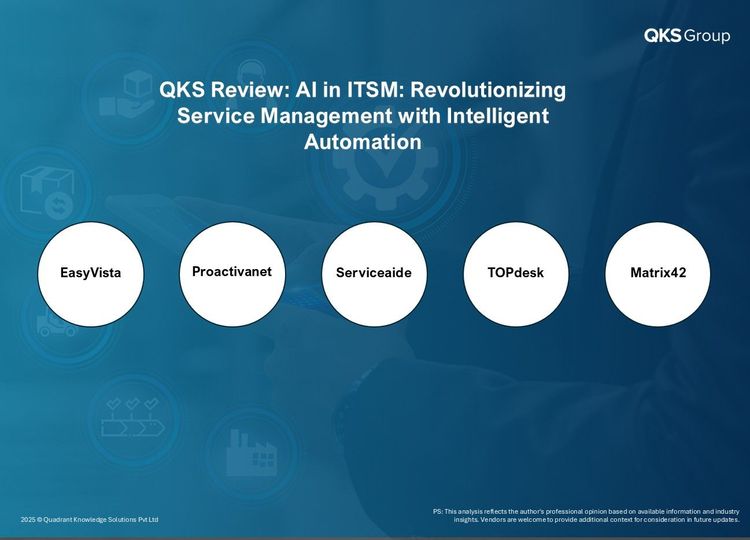
- Leading vendors EasyVista and Serviceaide stand out with comprehensive, enterprise-grade AI implementations, offering capabilities such as generative AI for ticketing and knowledge management, predictive analytics, and agentic automation frameworks.
- Capable vendors Proactivanet, TOPdesk, and Matrix42 demonstrate targeted innovation, especially in areas like cybersecurity integration, asset risk analytics, ESM extensibility, and AI-supported agent workflows. However, some lack broad scalability or full enterprise-grade orchestration.
- No vendor in this analysis can be considered lagging; rather, the ecosystem is evolving at varied paces. Vendors must now prioritize context-aware automation, responsible AI governance, and flexible LLM integration to remain competitive and relevant in a rapidly maturing AI-ITSM market.
The Evolving Role of AI in ITSM
IT Service Management (ITSM) tools have traditionally focused on processes such as incident management, change management, and knowledge sharing. AI elevates this by infusing intelligence, natural language processing (NLP), machine learning (ML), and generative AI to make systems more intuitive and responsive. Key trends include:
- Agentic AI and Automation: Systems that act autonomously, such as chatbots handling Tier-1 queries or AI suggesting resolutions.
- Predictive Analytics: Forecasting issues before they escalate, reducing downtime.
- Personalized Experiences: Tailoring interactions based on user sentiment and history.
- Integration with ESM: Extending AI beyond IT to enterprise-wide services like HR or facilities.
Vendors are responding with innovative features, often certified under frameworks like ITIL v4, ensuring compliance and reliability.
AI Capabilities Across Major Vendors
EasyVista: Unified AI for Proactive Operations
EasyVista stands out with its EV Pulse AI layer, embedded across its unified ITSM platform. It’s a core component that automates tasks and delivers real-time insights. For instance, EV Pulse AI Suggestions provide agents with ticket triage recommendations, while Automations use large language models (LLMs) for features like ticket summarization and multilingual translation.
In 2024-2025 updates, EasyVista introduced generative AI for content generation, such as reformulating memos or summarizing notes, enhancing communication efficiency. Their roadmap emphasizes AI-driven orchestration, with plans for EV Pulse AI Conversations and Operations, enabling predictive issue resolution. A key USP is the choice of LLMs (e.g., OpenAI, Azure, or EasyVista's in-house model), ensuring flexibility for regulated industries like healthcare. EasyVista's approach bridges IT support and operations, reducing silos and improving digital employee experience (DEX) through tools like real-user monitoring integrated with AI insights.
Proactivanet: AI-Powered Risk Management and Self-Service
Proactivanet, a unified ITSM and IT Asset Management (ITAM) platform, integrates AI to enhance both operational efficiency and cybersecurity. Their chatbot uses NLP and NLU for multichannel engagement, but 2025 plans focus on generative AI for advanced features like automatic ticket categorization and knowledge article generation from incident data.
A standout innovation is CyberITAM, which employs AI for vulnerability detection and risk analysis. This ties into IT Service Management (ITSM) by alerting on asset risks and automating remediation. Proactivanet's roadmap includes over 80 AI use cases, such as predicting technology obsolescence and proactive cost-saving suggestions for FinOps. Their no-code workflows, combined with AI, make it ideal for enterprise service management (ESM), extending to non-IT areas like HR. With certifications like ISO 27001, Proactivanet emphasizes secure, compliant AI deployment.
Serviceaide: Agentic AI for Enterprise-Scale Efficiency
Serviceaide excels in agentic AI through its Luma suite, which powers end-user experiences with generative AI for knowledge management (KCS) and automated troubleshooting. Some features are AI-based ticket summarization, field recommenders, and virtual agents that deflect inbound requests.
Their 2025 roadmap is ambitious, introducing agentic frameworks for unified employee portals, zero-shot agents, and locally trained models for accuracy. Serviceaide's strength lies in responsible AI, protecting data in regulated sectors like utilities and healthcare (e.g., HIPAA, NERC CIP compliance). Integration with BPMN for business process automation extends AI to ESM, allowing custom modules without coding.
TOPdesk: AI-Assisted Simplicity for Agent Empowerment
TOPdesk focuses on AI that empowers agents rather than replacing them, aligning with their "best-value-for-money" ethos. Their AI-assisted service management includes features like intelligent triage, knowledge suggestions, and conversational AI via partnerships (e.g., Ebbot for GenAI chatbots). In 2024, they enhanced knowledge management with AI-driven FAQs and self-service portals, emphasizing ease of use without extensive training.
Looking ahead, TOPdesk's roadmap prioritizes AI for asset management and predictive analytics, with UI renewals to integrate AI seamlessly. Their omnichannel support (e.g., self-service portals, mobile apps) uses AI for personalized experiences. TOPdesk's strategy is to make AI accessible for midsize enterprises across industries like education, government, and so on.
Matrix42: AI for Secure, Integrated Workspaces
Matrix42 is leveraging AI not only in ITSM but across its Unified Endpoint Management (UEM) and compliance domains. Their AI capabilities include predictive maintenance, anomaly detection, and chatbots for self-service, often powered by ML for tasks like license optimization and compliance checks.
Their 2025 plans involve deeper AI for endpoint security and workflow automation, with features like AI-based change impact analysis. This makes it strong for industries like finance and manufacturing, where data governance is critical. Additionally, this makes Matrix42 well-positioned for enterprises seeking to combine AI-driven operational intelligence with service management and endpoint governance.
Conclusion: The Path Forward
AI in IT Service Management (ITSM) is no longer a luxury; it is becoming the core enabler for scalable, efficient, and user-centric service delivery. Whether through conversational agents, predictive insights, or automated workflows, each vendor in this analysis presents a distinct path to AI adoption.
Organizations must align their AI strategy with internal IT maturity, process complexity, and long-term automation goals. The choice is not about who offers the most AI features, but who fits best with the enterprise’s current and future state of IT operations.
Disclaimer:
This blog is based on independent research and publicly available information. The insights presented reflect the views of QKS Group and are for informational purposes only. While we strive for accuracy, we do not guarantee completeness or absolute correctness. Vendors are welcome to provide clarifications or updates. If any vendor listed in this analysis wishes to provide additional context or clarification, we welcome a briefing call and will consider incorporating relevant updates. This analysis is not intended to disparage any vendor but to provide an informed, balanced perspective. We encourage open and constructive dialogue to foster transparency and a deeper understanding of the industry.
Author: Karun E S, Senior Analyst - IT/Network Operations Management at QKS Group
Vendors: