

18.09.2025
QKS Insight
Pentaho’s Data Intelligence Evolution: From ETL to Catalog of Catalogs
Author:
Arun U
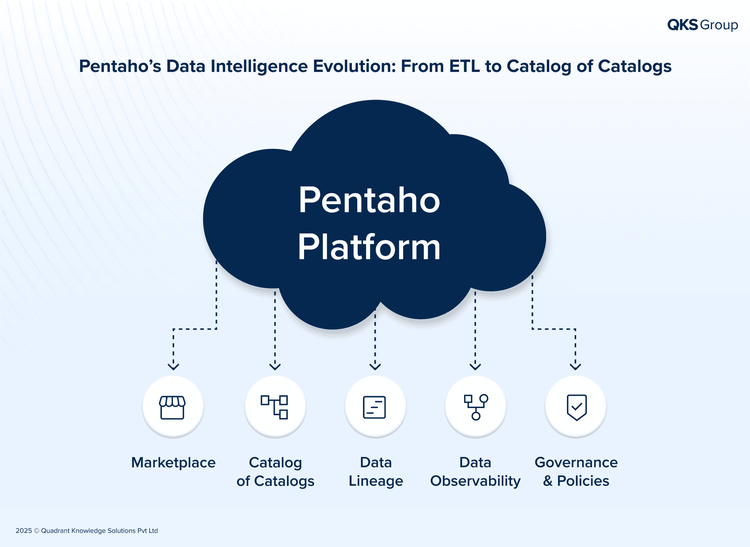


Pentaho’s data catalog and intelligence platform has evolved considerably over the past two decades, moving from its ETL origins to a modular, open platform encompassing catalog, governance, quality, optimization, and data movement. This review summarizes its architecture, notable differentiators, integration strategy, and roadmap based on a recent vendor briefing and live demo.
Platform Evolution & Architecture
Pentaho is structured as a modular platform: organizations can license only specific components, catalog, data mastering, PDI (data integration), or full end-to-end functionality. The catalog supports both structured and unstructured data and aims to meet hybrid enterprise needs with deployment flexibility (cloud, on-prem, hybrid). Recent developments include integration of data quality and catalog features, aligning with Hitachi’s broader data IP.
Core Capabilities
- Granular Lineage: Pentaho captures lineage at table, column, and transformation levels. OpenLineage support has recently been introduced, allowing ingestion of lineage from other ETL/ELT tools (Airflow, DBT).
- Flexible Catalog Licensing: Pricing tiers allow for a departmental approach; customers pay only for the number of sources/DBs connected in a given year, making entry-level adoption incremental rather than all-or-nothing.
- Governance: The catalog supports both business and governance vocabularies, empowering users to map custom rules and policies. Policies can be applied to data, reports, models, and applications. However, applied model governance is limited: cataloging of models and usage tracking are available, but formal bias and drift monitoring are on the roadmap.
- Data Marketplace & Delivery: Unlike most catalogs that focus only on discovery, Pentaho’s marketplace allows actual delivery of datasets (e.g., via direct movement to S3 or other endpoints), not just retrieval of metadata. Access and data movement are monitored with built-in trust scores and dynamic policy enforcement.
- Quality and Observability: Quality assessment applies to both structured and unstructured assets, integrating profiling and computing “freshness,” staleness, and duplication. Data observability is live for data at rest and partially for data in flight (integrated with the ETL layer).
Integration and Ecosystem
Pentaho has consciously positioned itself as a "catalog of catalogs", the platform does not require rip-and-replace adoption and instead connects with existing catalogs, integrating lineage and metadata flows. APIs and out-of-the-box connectors support common tech stacks, with current work ongoing for Iceberg, Databricks, and Power BI metadata. The strategy acknowledges the fragmentation typical in mid-to-large-size organizations, rather than proposing a single-vendor answer.
Practical User Experience
- Glossary and Governance: The platform features customizable glossaries and a relationship builder (shown as a “galaxy view”). Business and governance taxonomies can be extended, and rules for classification, masking, and policy enforcement are created through a UI-driven, rule-based engine.
- Data Identification & Masking: Automated scans apply 150+ patterns out-of-the-box but allow for custom dictionaries. Masking and encryption can be configured directly in ETL/data movement pipelines, particularly benefitting use cases involving regulated and PII/PHI datasets.
- Data Products: Users can define data products as logical collections of assets. Publishing a data product is subject to built-in checks, e.g., sensitivity and quality must be assessed prior to publishing for external or internal use.
Final Notes
Pentaho’s platform is architected for hybrid real-world adoption, hybrid deployment, and incremental enterprise buy-in. The “catalog of catalogs” vision realistically fits fragmented enterprise data landscapes. The main technical strengths are on flexible governance, end-to-end lineage, actionable data marketplace features, and operational blending of data integration and cataloging.
Potential buyers should be aware of the current scope of AI/ML governance and the OEM nature of integrated data quality but will find an open, API-friendly approach with real multi-cloud and hybrid support.
Author: Arun U, Principal Analyst at QKS Group