

01.07.2025
QKS Insight
Next-Gen AML Trends That Matter: Strategic Shifts, AI Agents, and Intelligence-Led Compliance
Author:
Siddharth Arya
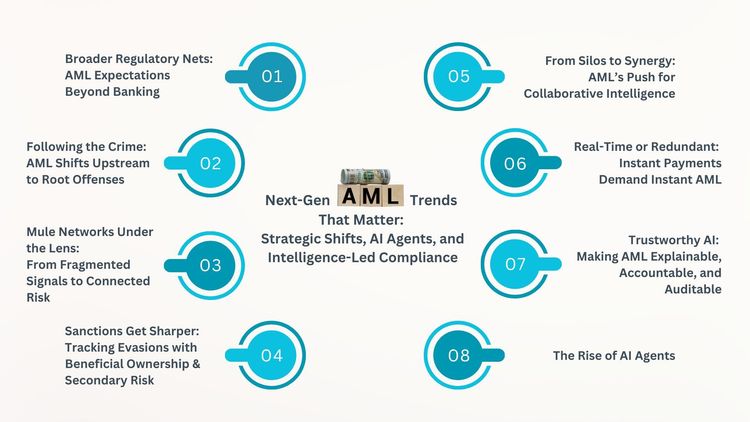


As financial institutions recalibrate their defences, several trends are shaping how AML compliance is approached, deployed, and enforced in 2025 and beyond:
- Broader Regulatory Nets: AML Expectations Beyond Banking
The Anti-Money Laundering (AML) compliance landscape is undergoing a structural transformation. Regulatory focus now extends beyond traditional banks to include a broader spectrum of sectors and risk typologies. Designated Non-Financial Businesses and Professions (DNFBPs), including real estate firms, online gaming platforms, luxury goods dealers, and legal/accounting service providers, are increasingly subject to AML requirements due to their exposure to illicit fund flows. Concurrently, Virtual Asset Service Providers (VASPs), including cryptocurrency exchanges and wallet providers, are being brought into scope by regulations such as the EU’s AMLD5/6, and FATF recommendations.
- Following the Crime: AML Shifts Upstream to Root Offenses
AML efforts are shifting upstream, with increasing focus on detecting predicate offenses, like human and drug trafficking, and environmental crime. Regulatory developments like the U.S. AML Act of 2020 and EU AMLD6 are broadening the scope of recognized predicate offenses, prompting financial institutions to integrate crime-specific typologies, enhanced due diligence, and targeted monitoring protocols into their AML frameworks.
- Mule Networks Under the Lens: From Fragmented Signals to Connected Risk
Mule accounts have emerged as a critical challenge, increasingly used to facilitate fraud, scams, and money laundering. Acting as transit points, they enable rapid cross-border fund movements, complicating beneficiary tracing and making real-time detection essential. Institutions are now leveraging behavioral analytics, device intelligence, and graph analytics, while regulators push for mandatory reporting and cross-bank collaboration.
- Sanctions Get Sharper: Tracking Evasion with Beneficial Ownership & Secondary Risk
Sanctions enforcement is intensifying, with greater scrutiny on evasion, secondary sanctions, and beneficial ownership transparency. OFAC, OFSI, and EU regulators are increasingly focused on sanctions circumvention, shell structures, and ultimate beneficial ownership (UBO) transparency. New sanctions targets now include human smugglers and enablers of sanctioned entities, with jurisdictions like the UK expanding scope to non-traditional sectors such as gold trading. Modernized screening and due diligence systems are now essential.
- From Silos to Synergy: AML’s Push for Collaborative Intelligence
Information sharing is becoming central to Anti-Money Laundering (AML) strategy. Jurisdictions like Canada, Singapore, the UK, and the EU are enacting real-time collaboration frameworks such as Singapore’s COSMIC or the UK’s MITT, while Privacy-Enhancing Technologies (PETs) and Federated Learning are enabling safe, compliant intelligence exchange. These efforts are enhancing detection of complex, cross-institutional threats like mule networks and trade-based money laundering.
- Real-Time or Redundant: Instant Payments Demand Instant AML
With the rise of instant payment infrastructures, SEPA Instant, UPI, FedNow, AML systems must now operate with millisecond-level latency to flag and act on threats before funds move. Real-time analytics, dynamic scoring, and instant alerting are becoming foundational to respond to high-velocity risks, marking a clear shift from reactive monitoring to proactive defence.
- Trustworthy AI: Making AML Explainable, Accountable, and Auditable
Regulatory developments such as the EU AI Act, which classifies AML use cases as high-risk, are accelerating the shift toward ethical, explainable, and compliant AI. Financial institutions are now required to deploy AI systems that are interpretable, auditable, and aligned with robust governance frameworks. Financial institutions must now reconcile the demand for advanced detection capabilities with the imperative for regulatory transparency and governance. As a result, there is a clear move away from opaque, black-box models toward interpretable and auditable solutions. Institutions are no longer passive consumers, they are emerging as strategic partners in AI development to ensure alignment with compliance expectations, operational integrity, and risk accountability.
- The Rise of AI Agents
Agentic AI is redefining Anti-Money Laundering (AML) by introducing autonomous decision-making across alert triage, case generation, and risk escalation. AI copilots are now capable of initiating risk actions, not just recommending them. These AI copilots act with contextual awareness, interpreting patterns, prioritizing threats, and recommending and even executing actions with minimal human input. This marks a shift from AI as a support tool to AI as a decisioning agent, enhancing speed, consistency, and scale in investigations while ensuring auditability and regulatory oversight remain intact.
Closing Thoughts:
As Anti-Money Laundering (AML) becomes increasingly strategic, its future will be defined not just by technology, but by how effectively institutions, regulators, and vendors co-create a transparent, real-time, and collaborative defence layer.
Financial crime is evolving, AML must evolve faster.
Which other trends do you think are shaping the future of financial crime detection?
Drop your thoughts in the comments - we’d love to hear from you.
Author : Siddharth Arya, Senior Analyst at QKS Group