

21.07.2026
QKS Insight
LTTS Engineering Intelligence Live 2026: An Analyst's Perspective on an Engineering-First AI Strategy
Author:
Narayan Gokhale



Technology events over the past two years have largely revolved around AI capabilities, with vendors often positioning AI as the starting point for digital transformation. LTTS adopted a different narrative at Engineering Intelligence Live in Bengaluru. LTTS also organized its Engineering Intelligence strategy around four pillars: Engineering AI, Agentic AI, Physical AI, and Industrial AI. Rather than presenting these as isolated product categories, the company positioned them as complementary capability areas supporting different engineering use cases. The framework provides a structured way to communicate the company's AI strategy, although its effectiveness will ultimately depend on how consistently these capabilities mature across customer deployments.
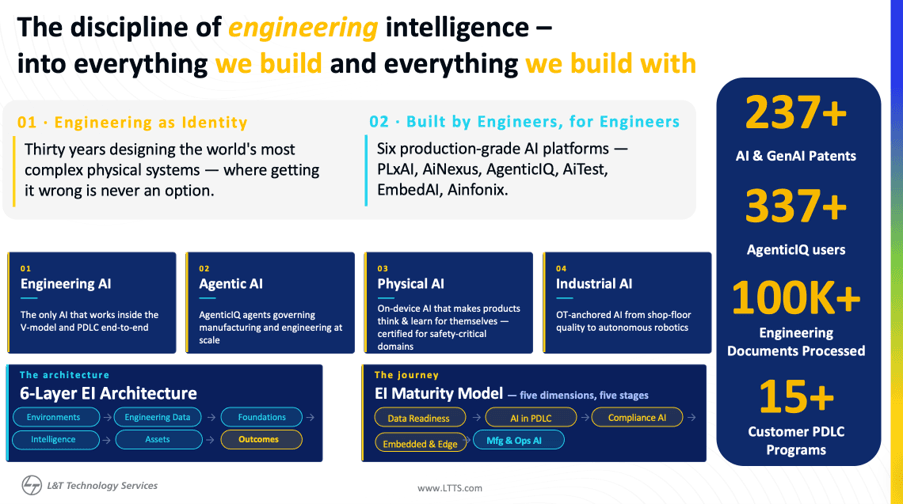
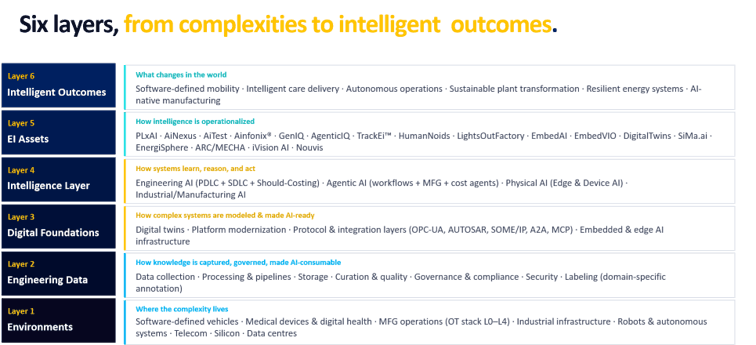
Throughout the event, the company consistently argued that engineering workflows and domain expertise should define how AI is applied, rather than allowing AI capabilities to dictate engineering processes. That theme remained consistent across executive presentations, customer discussions, and platform demonstrations, making it one of the more notable takeaways from the event. Binding them together are the EI Architecture (6-layer architecture including Environment, Engineering Data, Foundations, Intelligence, assets, and outcome) and the Maturity model.
Instead of presenting AI as a standalone technology layer, LTTS demonstrated how it has embedded AI into engineering-specific platforms. Ainfonix 4.0 focused on operational intelligence for process industries, SDV.ai addressed software-defined vehicle development, while QAssur.ai targeted quality assurance and compliance in regulated environments. Although these platforms address different markets, they share a common design philosophy. Each begins with an engineering problem and incorporates AI within an established engineering workflow rather than positioning AI as the primary solution.
The performance metrics presented during the demonstrations also reflected this approach. LTTS reported that SDV.ai can accelerate validation activities by up to twelve times, reduce dependence on real-world data by 90%, and shorten product development timelines by approximately two times. The company also highlighted a reported 60% reduction in false positives for its Asset Health Monitoring solution. These figures, while based on company presentations, emphasize engineering outcomes such as validation speed, operational efficiency, and product development rather than AI model performance. As with any vendor-presented metrics, broader customer adoption and independent validation will ultimately determine how consistently these outcomes translate across production environments.
One of the more interesting architectural concepts introduced during the event was Assurance Gate. Rather than focusing on generating AI outputs, LTTS described this capability as a validation layer that performs engineering rule checks, safety validation, confidence assessment, and pre-execution verification before AI-generated recommendations influence engineering workflows. The concept reflects a practical challenge facing industrial AI deployments. Large language models generate probabilistic outputs, whereas engineering environments often require deterministic and verifiable decisions.
From an industry perspective, the emphasis on validation deserves attention because governance remains one of the largest barriers to deploying AI in engineering operations. Whether Assurance Gate represents a meaningful competitive differentiator will depend on how effectively it performs across real-world deployments and whether competing engineering service providers introduce similar validation frameworks over time. The event demonstrated the architectural direction, although its long-term market impact remains to be seen.
The event also provided additional clarity around LTTS' broader business strategy. CEO Amit Chadha described the company's direction as moving beyond a traditional engineering services model by combining engineering expertise with reusable platforms, engineering intellectual property, and AI-enabled accelerators. This reflects an ongoing shift that several engineering and R&D service providers have been pursuing as they look to reduce dependence on purely people-led delivery models and increase the contribution of software, platforms, and proprietary assets.
One announcement that stood out was LTTS' decision to track revenue generated through AI-enabled delivery. The company framed this metric around engineering productivity, faster development cycles, and accelerated product launches instead of workforce reduction. While it is too early to determine whether this becomes a broader industry benchmark, it represents an interesting metric to monitor as engineering service providers increasingly integrate AI into delivery models.
Overall, Engineering Intelligence Live focused less on demonstrating AI for its own sake and more on explaining how AI can operate within engineering environments that demand reliability, safety, and domain expertise. That positioning differentiates the event from many AI-focused conferences where technology often takes precedence over operational context. At the same time, many of the capabilities showcased remain at a stage where long-term customer adoption, measurable business outcomes, and execution at scale will determine their significance.
From an analyst's perspective, the event highlighted an engineering-first view of AI that aligns with the requirements of industrial organizations. Whether this approach becomes a lasting competitive advantage for LTTS will depend less on the messaging itself and more on the company's ability to expand proprietary engineering IP, demonstrate repeatable customer outcomes, and sustain platform adoption as the market continues to mature.
Author: Narayan Gokhale, Vice President & Principal Advisor, at QKS Group
Anoch Mane, Principal Analyst, at QKS Group
Ignatius Daniel, Principal Analyst at QKS Group
Vendors: