

08.07.2022
QKS Insight
Immersive Experience for Improving Digital Healthcare
Author:
Nikhilesh Naik



With prevalent lifestyle choices and eating habits, an increase in chronic & neurobehavioral diseases among general population, and a noticeable deprivation of nutrition from the food chain, people are increasingly focused on investing in healthy habits and outcomes. The ever-increasing demand for nutrition-focused food coupled with shortage of supply has increased the risk of adulteration, which in turn has contributed to health concerns by millennials and GenZ. An Increase in the preference for sedentary jobs and their ill effects on the body- has resulted in a rising demand for digital healthcare products and solutions.
People are looking forward to a digital experience that will help them monitor their health; they are willing to invest in technologies that will provide them with an interactive & engaging experience. Immersive technologies deliver realistic simulations that offer psychological & physical experiences which hold tremendous potential in healthcare, from developing a drug to monitoring a patient recovering from injury.
Immersive experience technologies such as AR, VR, and MR hold the key to enhance the experience delivered during end-to-end patient journey, from diagnosis of a disease to the post-treatment therapy. Let us understand each.
Augmented Reality (AR): Augmented reality or AR is the real time integration of digital information with a user environment. AR can be applied in healthcare in several verticals, including augmented surgery, locating emergency services & equipment, and medical education & anatomical study.
Virtual Reality (VR): Virtual reality or VR is a computer-generated environment, scenes, or objects that facilitate users to experience and interact with them. VR in the field of healthcare offers streamlining of live operations, real conferencing, experiencing pain & relief, and rehabilitation.
Mixed Reality (MR): Mixed reality or MR is an amalgamation of AR & VR and superimposes digitally created objects in real environments to produce new environments and visualization effects. MR in healthcare enables acceleration of diagnostic procedures, virtual knowledge transfer in medical practices, and determination of applications in the field of medicine.
The above technologies hold tremendous potential in the field of medicine, and they not only improve patient experience of those suffering from physical conditions but they are also seen as effective solutions for psychological issues. Few applications of digitally immersive technologies are:
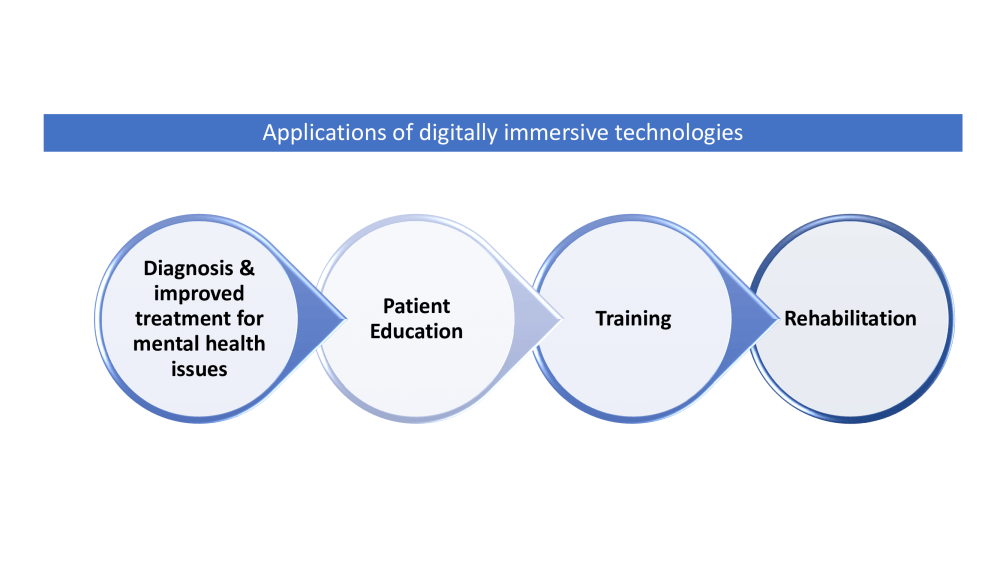
- Diagnosis & improved treatment for mental health issues: Virtual Immersive experience technology facilitates sense of presence in a virtually created environment through a head mounted display and specialized interface device. These devices offer image changes as per head movements to provide a sense of immersion to its user. The immersive technology, thus, provides a controlled virtual environment where people suffering from mental issues can enter, face their troubles, implement their therapies, and spend time for distancing themselves from their real-life troubles. Immersive technology also provides an artificial environment for treating critical issues such as phobias, anxiety, depression, PTSD, and fatigue.
- Patient Education: The understanding of human anatomy is a complex subject. Even after studying for a long time for critical or newly discovered health issues, medical experts are unable to provide accurate diagnosis and treatment. Immersive experience technology, thus, helps a patient understand in a simple way about the actual issues he is suffering from, their effects on his health, prolonged effects on body with & without treatment, and treatment plans for dealing with these issues. Immersive technology can also be used to educate children about human body and solutions they should follow for living a healthy life.
- Training: Immersive technology can be used for training medical practitioners about the use of new technology. It is impossible to get a live patient for a teaching medical professional to perform medical procedures ranging from simple tasks such as taking blood sample to complex surgeries. Immersive technologies, thus, provide an advanced solution as an efficient alternative for medical practitioner trial & error training and enable them with realistic trainings to implement their theoretical knowledge. Immersive technology, therefore, provides cost-efficient and effective training procedures for the healthcare personal.
- Rehabilitation: Be it a physical injury or mental trauma, rehabilitation of the patient plays a crucial role in bringing that individuals life back to normal. Immersive technology facilitates virtual programs that help people recovering from injuries to face their traumas and engage them in a controlled environment. This technology also offers a program for addicts that shows the virtual impact of drugs on health and the type of damages, both physical & mental, these drugs can create on human health. The technology can also be used for treating people recovering from physical injury by providing them a medium where they can perform physical activities through sensory feelings.
The impact of rich visuals on human psychology has forced the medical fraternity to search for capable alternative treatment solutions with efficiency to create immersive experience. Since the first use of VR in the mid-90s to train mobility-impaired children, immersive experience solutions have seen a rapid growth in their use by the healthcare ecosystem. A range of factors such as easy access through mobile devices, ease in the handling of devices used for immersive reality, and the research that proves that immersive reality offers a crucial solution for psychological issues have resulted in a rise in expenditure from leading healthcare market vendors to research and facilitate virtually immersive technologies on a commercial scale. The need for human touch during treatment, data compliance & privacy issues, and lack of technological infrastructure for implementing immersive technology on a large scale is limiting its growth in the global healthcare sector.
Author
Nikhilesh Naik is an analyst at Quadrant Knowledge Solutions tracking global markets in the Enterprise Software domain.