

10.09.2026
QKS Insight
How to Prioritize Enterprise Process Transformation in an Age of Disruption
Author:
Kunal Pakhale



- Prioritize by business value and implementation feasibility first, treat technology as the enabler, not the starting point.
- Use risk, autonomy potential and complexity as modifiers that can override a simple two-axis score.
- Run it as a portfolio: quick wins now, foundation-building for high-value/low-feasibility, selective automation for the rest.
- Optimize for the end-to-end value chain and long-term adaptability, not the efficiency of any single function.
Enterprises today are under pressure to transform at scale. Generative AI, intelligent automation, process intelligence, real-time data and autonomous agents are reshaping what is possible across the end-to-end value chain. The opportunity is significant, but so is the complexity. Every function has a long list of processes that could be improved, automated, or reimagined. Technology vendors, internal stakeholders and industry use cases often create a sense of urgency to act everywhere at once.
Successful transformation is not about doing more; it is about doing what matters most.
Prioritization provides the discipline to separate noise from true opportunity. It helps enterprises focus scarce resources on processes that can deliver meaningful business impact, are feasible to implement, align with strategic objectives and have an acceptable risk profile. The matrix below, developed as part of the broader QKS Group research on enterprise process transformation, provides a practical way to evaluate and sequence transformation opportunities.
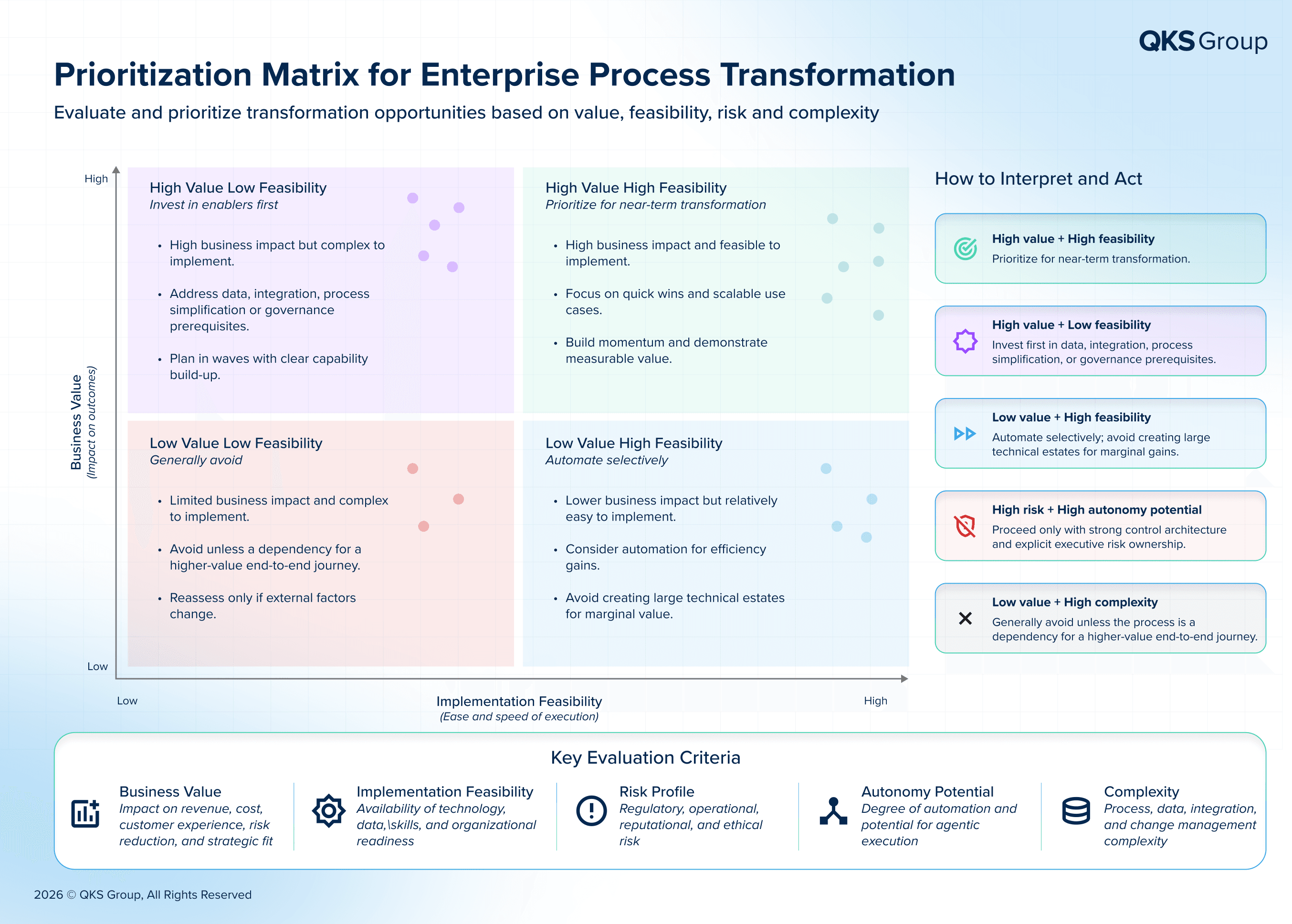
Figure 1. Prioritization Matrix for Enterprise Process Transformation.
Why prioritization matters more than technology selection
Enterprise process transformation is often framed as a technology adoption exercise. That framing is too narrow. The central transformation problem is deciding which parts of the enterprise value chain should operate differently and why. Technology becomes an enabler after the process opportunity, business outcome, decision structure and operating constraints have been established. This distinction is increasingly important as enterprises evaluate generative AI, agentic AI, process mining, intelligent document processing, decision intelligence, optimization, autonomous operations and other emerging capabilities. Each technology can produce value, but not every process is an appropriate candidate for the same intervention.
Reading the matrix
The matrix evaluates transformation opportunities across two primary dimensions — business value and implementation feasibility.
Business value - the potential impact of a process on:
- Revenue and cost
- Customer experience
- Risk reduction
- Operational performance and resilience
- Strategic differentiation
Implementation feasibility - the ease and speed of transformation, given:
- Technology availability
- Data quality
- Integration readiness
- Process standardization
- Skills and organizational readiness
The intersection creates the primary prioritization logic, while risk, autonomy potential and complexity act as critical modifiers.
High value and high feasibility: the near-term transformation zone
Processes in the high-value, high-feasibility quadrant should normally receive the strongest near-term attention. These opportunities offer a favorable relationship between expected business impact and execution effort. They can produce measurable outcomes relatively quickly, create organizational confidence and generate reusable capabilities for subsequent transformation waves. Customer onboarding, selected service operations, standardized claims or case processes, and high-volume knowledge workflows can fall into this category when data, rules and system interfaces are sufficiently mature. Feasibility must nevertheless be assessed at the end-to-end process level; a task may be easy to automate while the complete process remains constrained by upstream data defects, downstream approvals or fragmented system ownership.
KEY POINTER: Assess feasibility end-to-end, not task-by-task; an easily automated step can still sit inside a process blocked upstream or downstream.
High value and low feasibility: build the foundation before scaling
High-value but low-feasibility processes should not be discarded because they are difficult. They often contain the most strategically important transformation opportunities, but their complexity means immediate automation can create more problems than it solves. Supply chain planning, cross-functional financial and operational planning, complex product development, enterprise risk processes and multi-party fulfilment can require substantial data, integration, process simplification and governance work before advanced automation or AI can operate reliably. The correct response is capability building, establish the enablers first:
- Common data models
- Event visibility
- Integration layers
- Standardized process variants
- Explicit decision rights
- Governance mechanisms
…then proceed in controlled waves.
Low value and high feasibility: automate selectively, not indiscriminately
Low-value, high-feasibility processes are tempting because they are easy to automate. That does not make them strategically important. Enterprises should capture efficiency where the economics justify it, but avoid creating fragmented automation estates that increase technical debt, maintenance requirements and governance overhead. The relevant question is whether the process contributes materially to an important end-to-end journey or creates a reusable automation capability. If it does not, a simple intervention may be appropriate, but a major platform or AI investment is difficult to justify.
Risk and autonomy change the prioritization decision
The matrix cannot be treated as a simple two-dimensional scoring exercise when autonomous or agentic execution is involved. A process may have high value and high feasibility while still being unsuitable for high levels of autonomy because errors could create material financial, regulatory, customer, safety or reputational consequences. Conversely, a relatively low-risk process may be an excellent candidate for agentic execution if actions can be tightly bounded, observed and reversed. Enterprises therefore need to evaluate the following before increasing autonomy:
- Decision criticality
- Authority boundaries
- Data sensitivity
- Explainability requirements
- Human escalation paths
- Failure consequences
KEY POINTER: High value and high feasibility do not justify high autonomy on their own; bound, observe and reverse before you delegate.
Low value and high complexity: avoid unless strategically dependent
Processes with low business value and high implementation complexity should generally remain outside the active transformation portfolio. The exception is dependency. A process that appears low value in isolation may be a necessary component of a high-value end-to-end journey. A shared data or integration capability, for example, may not have an obvious standalone business case but may be essential to transforming fulfilment, planning or service. This prevents enterprises from optimizing individual activities while overlooking capabilities required to transform the larger value stream.
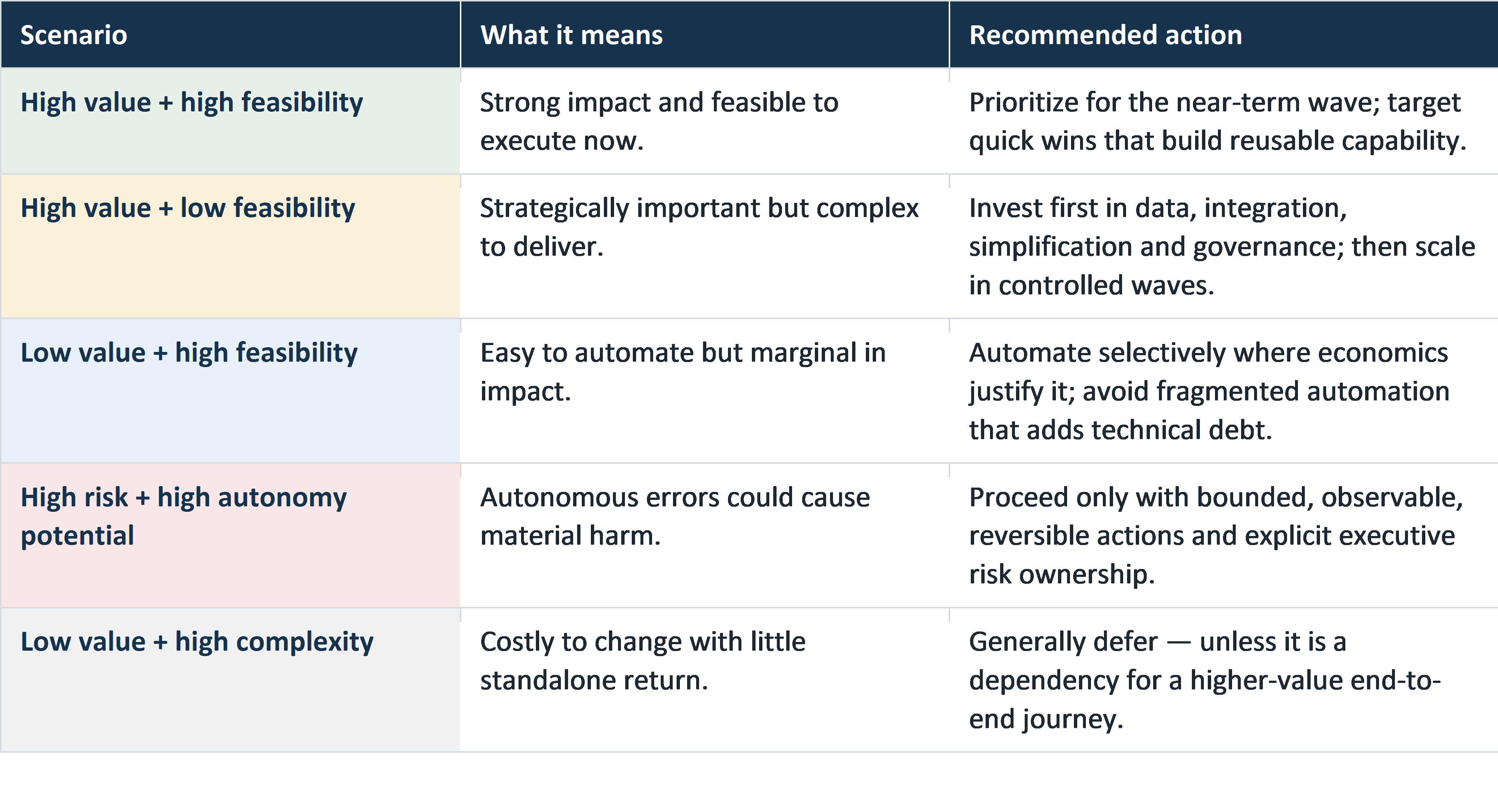
Quick reference: from quadrant to action
The five scenarios below summarize how each position on the matrix, and its risk and complexity modifiers, should translate into a decision.
How the matrix connects to the enterprise value chain
The prioritization model becomes more powerful when applied to the enterprise value chain rather than individual functional backlogs. The broader QKS Group enterprise process transformation framework connects strategy and governance with the core value-creation chain: Understand and Engage; Innovate and Design; Plan and Align; Source and Procure; Operate and Execute; Deliver and Fulfil; and Serve and Retain. Finance, people, technology, data, legal, risk and compliance, corporate services, facilities and sustainability operate as enabling capabilities across these domains. A transformation opportunity should therefore be evaluated according to its effect on the end-to-end outcome, not only the efficiency of the local function.
From process automation to adaptive process architecture
AI changes the nature of the prioritization question. Traditional automation is primarily concerned with deterministic execution: if a defined condition occurs, a defined action follows. Generative and agentic systems introduce a model in which systems can interpret context, generate alternatives, reason over enterprise knowledge and execute multi-step actions within defined boundaries. This does not mean every process should become autonomous. It means enterprises can choose deliberately among human execution, AI assistance, deterministic automation, agentic execution and adaptive orchestration.
The technical prerequisites behind feasibility
Implementation feasibility should be treated as a technical assessment rather than an executive perception. A process is more feasible when:
- Its inputs are available and reliable
- Process states are observable
- Business entities are consistently identified
- System interfaces are accessible
- Rules and policies can be represented
- Exceptions are understood
- The organization can govern the resulting automation
Fragmented applications, poor master data, undocumented workarounds, excessive process variants, opaque decisions and weak integration architecture reduce feasibility. This is why process simplification and instrumentation frequently produce more transformation value than immediately deploying another AI capability.
Using process intelligence to improve prioritization
Process intelligence provides a feedback mechanism because it replaces assumptions about process performance with evidence from actual execution. Event data can reveal cycle-time variation, rework, bottlenecks, conformance issues, handoff delays and recurring exceptions. Combined with task-level analysis and business outcome data, this evidence can materially improve both value and feasibility assessment. A process that appears attractive in workshops may prove to have low transaction volume or highly variable execution, while a less visible process may contain a large concentration of avoidable work and therefore offer a stronger transformation case.
KEY POINTER: Let evidence from actual execution, not workshop enthusiasm, decide what enters the portfolio.
Building the transformation portfolio
The matrix should ultimately become a portfolio-management mechanism:
- High-value, high-feasibility opportunities form the initial transformation wave.
- High-value, low-feasibility opportunities become foundation programs with explicit capability milestones.
- Low-value, high-feasibility opportunities are handled selectively where automation economics are compelling.
- High-risk processes with significant autonomy potential receive additional governance and executive oversight.
- Low-value, high-complexity opportunities are generally deferred unless they are dependencies for a higher-value journey.
This sequencing balances near-term value realization with the longer-term architecture required for enterprise adaptability.
The strategic objective is adaptability
The purpose of prioritization is not simply to create a better automation backlog. It is to help the enterprise develop an operating architecture that can absorb continuous disruption. The strongest transformations create reusable orchestration, data, integration, decision, governance and AI capabilities that can be applied across multiple value-chain domains. They also establish feedback loops through which process performance, customer outcomes, exceptions and external signals continuously inform redesign. In that model, transformation becomes an ongoing management capability rather than a finite technology program.
Conclusion
Enterprise process transformation is becoming less about identifying where technology can be inserted and more about determining where the enterprise should change the way work is designed, decided and executed. The prioritization matrix provides a disciplined mechanism for making that decision. By evaluating business value and implementation feasibility, and then applying risk, autonomy potential and complexity as critical modifiers, enterprises can distinguish quick wins from foundational investments, selective automations from strategic transformations, and attractive opportunities from expensive distractions. In an environment shaped by generative AI, agentic systems, real-time planning, process intelligence and increasingly autonomous operations, that discipline is essential.
The organizations that transform effectively will not be those that automate the most processes. They will be those that understand their value chain deeply enough to know which processes should be simplified, which should be augmented, which should be automated, which can safely become autonomous, and which should be left alone.
Author: Kunal Pakhale, Principal Analyst at QKS Group