

06.10.2026
QKS Insight
From Transformation Vision to Business Value: A CXO Playbook for Manufacturing Transformation
Author:
Narayan Gokhale



Knowing that manufacturing needs to transform is relatively easy.
Knowing where to start, what to prioritize, how to scale and how to measure value is considerably harder.
Most manufacturing organizations don't suffer from a shortage of transformation ideas.
They suffer from too many competing initiatives: AI, MES modernization, Digital Twins, Industrial IoT, Predictive Maintenance, Connected Worker, Smart Quality, Robotics, Industrial Data Platforms, Automation
The challenge is not identifying technologies.
The challenge is deciding: Which capabilities should we build, in what sequence, to create the greatest business impact?
QKS POV
Manufacturing Transformation should be managed as a business transformation portfolio, not as a collection of technology projects.
A CXO needs a structured approach. Example: A five-step QKS Manufacturing Transformation approach.
Step 1 - Define the Business Outcomes
Start with the enterprise's strategic priorities.
For example:
- Reduce manufacturing cost
- Improve throughput
- Improve FPY / quality
- Increase asset utilization
- Reduce downtime
- Improve production flexibility
- Reduce time-to-market
- Improve resilience
- Reduce energy consumption
- Improve workforce productivity
The important principle:
Don't begin with the technology. Begin with the outcome.
Step 2 - Assess the Current Transformation Maturity
Assess the organization across the six dimensions:
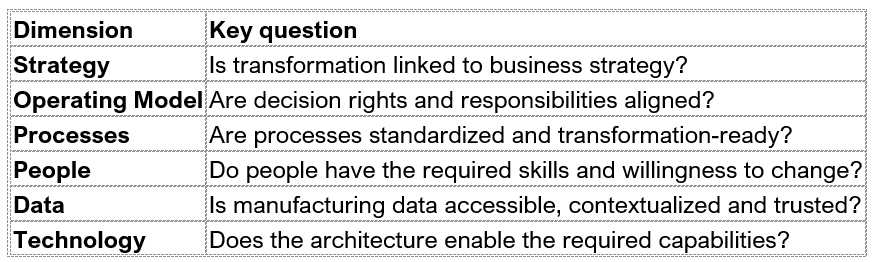
This prevents a common mistake:
Assuming that technology maturity equals transformation maturity.
It doesn't.
Step 3 - Identify Capability Gaps
Now ask: What does the organization need to be capable of doing that it cannot do effectively today?
Examples:
Current àRequired capability:
Reactive qualityà Predictive / preventive quality
Static production planningà Dynamic production optimization
Plant-level visibility à Enterprise-wide manufacturing intelligence
Manual decision-making à AI-assisted decision-making
This is where transformation becomes concrete.
Step 4 - Prioritize Transformation Initiatives
The organization will usually identify dozens of potential initiatives.
They cannot all be done simultaneously.
A practical prioritization model should consider:
- Business Impact: How much value can this create?
- Feasibility: How difficult is it to implement?
- Time-to-Value: How quickly can value be realized?
- Scalability: Can the capability be replicated across plants?
- Strategic Importance: Does it create a foundation for future transformation?
This moves the organization from:
"What can we do?" to: "What should we do first?"
Step 5 - Build the Transformation Roadmap
The roadmap should not simply be: 2027: AI, 2028: Digital Twin, 2029: Autonomous Operations
That is a technology roadmap.
A transformation roadmap should show:
Business Outcome à Capability à Process Transformation à Data Foundation à Technology Enablement à People / Change à KPI / Value
This creates a much stronger connection between transformation investment and business value.
From Pilot to Enterprise Scale
One of the biggest obstacles to Manufacturing Transformation is the:
Pilot-to-Scale Gap
A successful pilot demonstrates: "It works."
Scaling requires proving: "It can work repeatedly, across plants, processes and organizational boundaries."
Scaling therefore requires:
- Common architecture
- Data standards
- Integration
- Governance
- Cybersecurity
- Workforce readiness
- Change management
- Business ownership
- Repeatable implementation methodology
QKS POV
Pilot success is a technology achievement. Scaling is an organizational capability.
Measuring Transformation
Ultimately, transformation must be measured through business outcomes.
Operational: HIGHER OEE, Throughput, FPY, and LOWER Downtime, Scrap / Rework Financial: LOWER Cost per unit, Working capital, and HIGHER ROI
Strategic: LOWER Time-to-market, and HIGHER Manufacturing agility, Resilience
Sustainability: LOWER Energy / unit, Waste, Emissions
The exact KPIs will vary by industry and manufacturing environment.
But the principle remains:
If transformation cannot be connected to measurable business outcomes, it is difficult to distinguish transformation from technology deployment.
The Transformation Maturity Journey
I would introduce the following QKS conceptual maturity model:
1. Digitized: Manual information becomes digital.
2. Connected: Assets, systems and people become connected.
3. Visible: The organization gains real-time operational visibility.
4. Predictive: Problems and outcomes can increasingly be anticipated.
5. Adaptive: Operations can dynamically respond to changing conditions.
6. Autonomous: Systems increasingly make and execute decisions, with humans managing exceptions and strategic decisions.
The objective isn't to rush to autonomy.
The objective is to build the capabilities required to move to the next appropriate maturity stage while continuously creating business value.
Where Manufacturing CXOs Should Be Careful.
Five Transformation Traps
1. Technology-first transformation: Buying technology before defining the business problem.
2. Pilot proliferation: Creating dozens of successful pilots without an enterprise scaling strategy.
3. Plant-by-plant optimization: Optimizing individual plants while losing sight of the manufacturing network.
4. Data without context: Collecting massive amounts of data without creating actionable manufacturing intelligence.
5. Measuring activity rather than value
Counting (Projects → Users → Devices → Models) instead of: Productivity → Quality → Cost → Agility → Resilience
The QKS CXO Message
The objective of Manufacturing Transformation is not to build the most technologically advanced factory.
It is to build a manufacturing enterprise that can continuously improve, respond faster, make better decisions and adapt to change—while creating measurable business value.
The most important question for a Manufacturing CXO is therefore not: "What technologies should we deploy?"
It is: "What capabilities must our manufacturing enterprise develop to achieve our strategic business objectives - and what is the right sequence to build them?"
That is the conversation QKS Manufacturing Transformation Advisory should help CXOs lead.
Author: Narayan Gokhale, Vice President & Principal Advisor at QKS Group