

01.10.2025
QKS Insight
Flexibility vs. Governance: The Central Dilemma in Collaborative Work Management
Author:
Ashray Gadekar
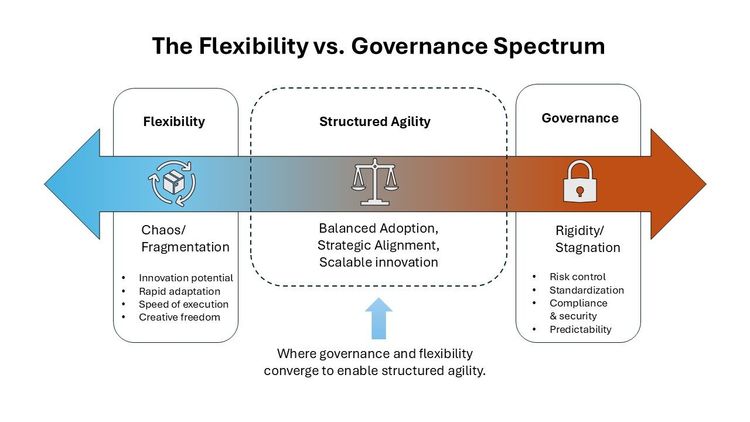


The Work Management Dilemma
Collaborative Work Management (CWM) platforms have become the backbone of modern organizations, offering a unified space for planning, tracking, and delivering work. Yet, as adoption scales, enterprises face a paradox: how to give teams the flexibility to innovate while enforcing the governance necessary to maintain consistency, compliance, and visibility. Striking this balance is not just a technical challenge, it is a cultural and strategic one. Too much flexibility, and organizations risk fragmentation; too much governance, and they risk suffocating agility. The balance is critical because it determines whether CWM platforms truly enable organizational transformation or merely add another layer of complexity. Flexibility empowers teams to adapt workflows, experiment with new approaches, and respond quickly to shifting priorities that are essential for innovation and speed. Governance, on the other hand, provides the structural backbone that ensures work remains aligned with enterprise objectives, data is reliable, and compliance requirements are met.
If flexibility dominates without guardrails, organizations end up with siloed practices, inconsistent data, and dashboards that provide little enterprise-wide visibility. Conversely, when governance is overemphasized, platforms become rigid, discouraging adoption and driving teams back to shadow systems. The right equilibrium ensures that local creativity scales into enterprise value: teams maintain autonomy in how they deliver, while leadership gains trustworthy insights for strategic decision-making.
The Promise of Flexibility in CWM
Flexibility is one of the strongest selling points of Collaborative Work Management (CWM) platforms. Teams thrive when they can configure workflows, experiment with automation, and adopt views such as boards, timelines, Gantt charts that match their working style. Low-code customization and modular templates empower users to bypass rigid IT structures and accelerate execution. However, this flexibility comes with hidden costs. Different departments often evolve their own “mini-systems,” creating silos that undermine cross-functional collaboration. Without oversight, decentralized freedom can quickly become a breeding ground for shadow IT, where processes are effective in isolation but misaligned at the enterprise level.
The Case for Governance
Governance ensures that work scales without losing structure. Standardized processes, compliance controls, and consistent reporting are essential for organizations that operate across multiple business units, geographies, or regulatory environments. With governance, executives gain the visibility needed for informed decision-making, risk management, and portfolio alignment. Yet, governance has its pitfalls. When rules are too rigid, platforms become bureaucratic, deterring adoption and pushing users back into spreadsheets or external tools. Governance that is perceived as “control for the sake of control” creates resistance, making the system less effective over time.
The Tension in Practice
This friction is visible in daily operations. A product team may want to experiment with flexible workflows, while leadership demands standardized reporting across the portfolio. Project managers might adopt unique metrics to track progress, only to find they cannot be rolled up into enterprise dashboards. Similarly, end-users expect intuitive, dynamic tools, but IT teams prioritize auditability and compliance.
The result is a persistent tension: flexibility without governance risks chaos and inconsistent outcomes, while governance without flexibility leads to stagnation and disengagement.
Pathways to Balance
Organizations are experimenting with models to bridge the gap:
- Tiered Governance Models: Teams are given autonomy at the local level but operate within enterprise-wide guardrails. Governance becomes proportional, not absolute. This proportional approach to governance ensures that teams retain the freedom to adapt workflows while enterprise leaders maintain consistency of data and processes. For users, the result is reduced friction and a sense of empowerment, while for vendors, it allows them to appeal to both agile teams and centralized PMOs, strengthening their positioning as scalable, enterprise-ready solutions.
- Guardrails, Not Roadblocks: Instead of restricting workflows, governance can take the form of pre-approved templates, policy-driven automation, or mandatory data fields that preserve consistency while leaving room for creativity. Here, governance does not manifest as restrictive workflows but as enablers such as pre-approved templates, policy-driven automation, or mandatory data fields. For users, this model saves time, reduces errors, and still leaves room for creativity in execution. For vendors, offering configurable guardrails provides a competitive edge by showing they can balance usability with enterprise needs, appealing simultaneously to smaller teams looking for simplicity and to large organizations demanding structure.
- Embedded Intelligence: Advanced analytics and AI-driven features enable governance in the background, flagging compliance gaps, suggesting corrective actions, or automating routine governance checks. The use of embedded intelligence is gaining traction, where advanced analytics and AI features provide governance in the background. Instead of manual checks, the system flags compliance gaps, suggests corrective measures, or automates routine governance tasks. This creates tangible value for users by reducing the burden of governance and enabling compliance without slowing down operations. For vendors, embedding intelligence elevates their platforms beyond workflow management to decision-support systems, increasing customer stickiness and long-term platform dependency.
- Change Management & Culture: Governance must be positioned as a form of enablement rather than restriction. Clear communication, user training, and ongoing engagement help employees understand governance to scale their efforts safely rather than as an obstacle. For users, this fosters smoother adoption, reduces resistance, and ensures sustained use of the platform. For vendors, incorporating change management support and training modules directly into their offerings strengthens customer relationships and improves renewal prospects, creating a more resilient business model.
Suggestion for Vendors
- Lightweight, Extensible Governance: Design governance models that are minimal at the start but scale with organizational maturity. A schema-first architecture with configurable “non-negotiables” ensures baseline consistency while giving teams freedom to innovate.
- Transparency and Predictive Intelligence: Embed auditability features such as version history, activity logs, and traceability, while leveraging AI and analytics to proactively detect policy drift, automate corrective actions, and surface compliance insights in real time.
- Iterative, Feedback-Driven Frameworks: Treat governance as a living system refined through user feedback, adoption metrics, and real-world dashboards. Iterative updates prevent rigidity and help governance evolve with changing organizational needs.
- Scalable, Future-Ready Design: Build platforms that can transition from manual oversight to automated policy engines, while supporting integrations with AI agents, cross-system workflows, and custom extensions. This ensures long-term adaptability in dynamic work environments.
- Enablement Over Enforcement: Position governance as an enabler rather than a barrier. Providing training, adoption toolkits, and embedded change management resources strengthens customer relationships and elevates vendors from tool providers to strategic partners.
Conclusion: Finding the Elusive Balane
The debate over flexibility versus governance in Collaborative Work Management is not a zero-sum game but a design challenge that vendors and enterprises must solve together. The future of CWM will not be defined by platforms that simply offer more features or new visualizations; it will be shaped by how effectively they embed governance without eroding the autonomy that drives adoption. The most successful platforms will be those that treat governance as a fluid, adaptive layer, lightweight enough to foster creativity yet robust enough to provide trusted enterprise-wide visibility. Striking the right balance ensures that localized innovation scales into organizational value, rather than fragmenting into disconnected silos. It gives leaders the confidence that decisions are based on reliable data while keeping teams engaged through tools that feel enabling rather than restrictive. For vendors, the balance becomes a market differentiator: those who master embedded intelligence, scalable governance frameworks, and change management support will not just provide tools, but shape the cultural and operational fabric of how work gets done.
Author: Ashray Gadekar, Analyst - Strategic Portfolio Management at QKS Group