

14.09.2026
QKS Insight
Consecutive Year: SPARK Matrix Digital Banking Platform Leadership Report 2023-2026
Author:
Divya Baranawal



Executive Summary
FIS has strengthened its position in the digital banking platforms market by evolving from a broad banking technology provider into a more focused, open and globally scalable platform business. Its sustained SPARK Leader positioning across the 2024, 2025 and 2026 assessments reflect continued advancement in platform architecture, ecosystem connectivity, digital engagement and commercial banking.
The company’s strategic realignment began with the majority-stake sale of Worldpay, which sharpened its focus on Banking and Capital Markets. This direction reinforced FIS® Digital One™ as a strategic engagement layer connecting customer-facing experiences with core banking and transaction-processing environments.
Across the assessment period, FIS expanded the platform beyond traditional online and mobile banking. Investments in open APIs, digital origination, AI-assisted engagement and commercial banking progressively extended its coverage across customer acquisition, servicing, payments and treasury workflows. Strategic acquisitions added complementary capabilities, while the global rollout of FIS® Digital One™ Commercial increased its relevance to regional and multinational banks.
FIS’s principal differentiation lies in combining digital engagement with established banking infrastructure and broad transaction-processing capabilities. This provides institutions with a flexible path to modernization without making every digital initiative dependent on immediate core replacement.
The next stage of FIS’s development will be defined by execution rather than portfolio expansion alone. Sustained leadership will depend on simplifying adoption, integrating acquired and existing capabilities, and delivering a consistent platform experience across customer segments, deployment environments and regions.
FIS at a Glance and Market Position
FIS is a global financial technology provider with capabilities spanning core banking, digital engagement, lending, payments, fraud management, customer servicing and treasury operations. Its position in the digital banking platforms market is underpinned by a combination of established financial-institution relationships, extensive processing infrastructure and broad coverage across the banking lifecycle.
FIS capabilities span more than 75 countries, with its platforms processing over 40 billion transactions annually. These company-level metrics demonstrate the operational scale, processing experience and institutional reach underpinning its digital banking proposition.
Digital One Ecosystem
FIS Digital One serves as the digital engagement layer within the company’s banking environment. It connects customer and employee experiences across consumer, small-business and commercial banking through a modular ecosystem of interconnected capabilities.
The platform supports digital account opening, online and mobile banking, business banking, personalized engagement, banker-assisted sales and servicing, branch origination and teller operations. FIS Digital One Commercial extends this coverage into payments, cash management, liquidity, trade finance, foreign exchange and corporate treasury.
Digital One portfolio is integrated with multiple FIS core platforms and can also be deployed by institutions operating non-FIS cores. Digital One Flex, however, is designed for institutions operating FIS core banking environments. This allows FIS to address both tightly integrated FIS-core deployments and broader digital modernization requirements across heterogeneous banking environments.
Market and Customer Positioning
FIS addresses distinct institutional requirements through a combination of packaged functionality and architectural flexibility. Community and regional banks can adopt pre-integrated capabilities with standardized deployment options, while larger institutions can use configurable components and APIs to retain greater control over customer experience, integration and technology architecture.
The expansion into commercial banking further strengthens FIS’s relevance across small businesses, mid-market organizations and large enterprises. A common platform across these segments provides banks with an opportunity to reduce fragmented customer experiences and rationalize separate digital environments.
Sustained SPARK Leader Positioning
FIS retained its SPARK Leader position across the 2024, 2025 and 2026 assessments, reflecting continued strength in Technology Excellence and Customer Impact. Its positioning is supported by functional breadth, core connectivity, omnichannel delivery, platform openness and enterprise-scale execution.
FIS’s principal market advantage is its ability to connect digital engagement with the infrastructure used to manage accounts, process transactions and deliver banking services. Sustaining this position will depend on translating that breadth into a consistently integrated and easily adoptable platform experience.
FIS’s Digital Banking Journey (2023–2026) from a SPARK Matrix™ Perspective
FIS’s journey from 2023 to 2026 reflects a structured progression from strategic refocusing to a more open, intelligent and globally scalable digital banking proposition. Across this period, the company strengthened its technology foundation, expanded into adjacent banking workflows and demonstrated increasing deployment scale. The journey can be viewed across four stages: Focused and Integrated, Modern and Open, Intelligent and Connected, and Global and Composable.
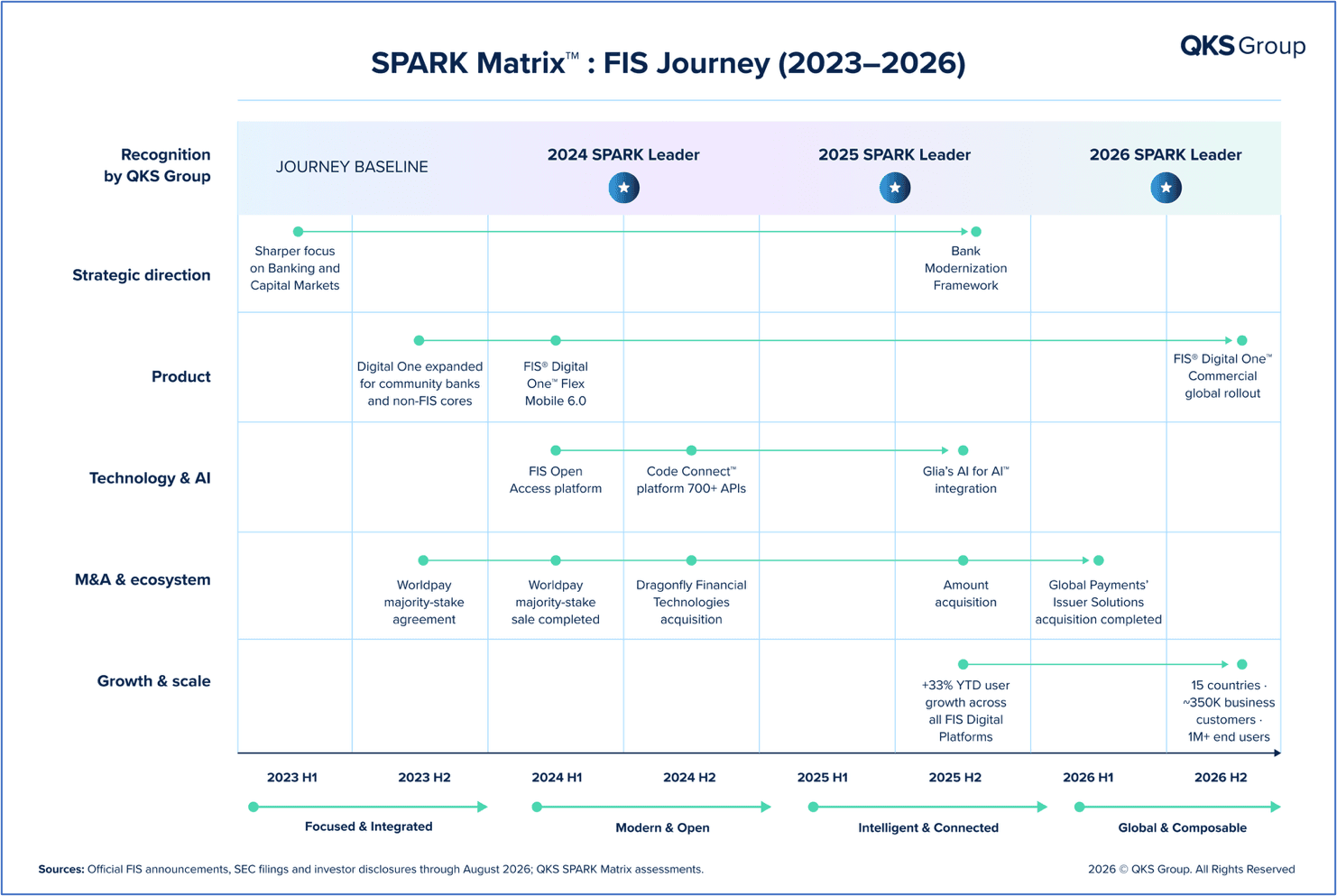
Focused and Integrated: 2023
- FIS entered 2023 with a sharper focus on Banking and Capital Markets following the agreement to sell a majority stake in Worldpay. The transaction marked an important change in strategic direction, concentrating management attention and investment on the company’s core banking and capital markets businesses.
- Within digital banking, FIS continued expanding Digital One across community banks and institutions operating non-FIS cores. While Digital One Flex remains aligned with FIS core banking environments, other parts of the portfolio provide greater flexibility for institutions seeking to modernize customer and employee experiences without replacing their underlying core
- The importance of 2023 therefore lies in the foundation it established. FIS combined a more focused corporate strategy with a digital banking platform capable of supporting modernization across different core environments and institutional segments.
Modern and Open: 2024
- FIS translated this strategic focus into visible product and architectural advancement during 2024. The completion of the Worldpay majority-stake sale reinforced its banking-led direction, while FIS Digital One Flex Mobile 6.0 modernized the primary mobile interaction channel.
- Digital One Flex Mobile 6.0 introduced an updated user experience, stronger authentication, enhanced money movement and improved account and transaction management. Its common foundation across mobile and online banking also supported greater consistency in channel management and customer servicing.
- Platform openness advanced through FIS Open Access and Code Connect™. Open Access supported consent-based financial data sharing, while Code Connect provided access to more than 700 APIs. These capabilities improved connectivity with third-party providers and allowed banks to introduce services without tightly coupling every enhancement to the core.
- The acquisition of Dragonfly Financial Technologies extended FIS into cloud-based commercial banking and cash management, creating the foundation for a broader commercial banking proposition.
Intelligent and Connected: 2025
- FIS’s development in 2025 centred on connecting digital engagement, origination and modernization more cohesively. The FIS Banking Modernization Framework brought together core banking, digital capabilities, APIs, data and AI within a flexible transformation model. Institutions could enhance existing environments, introduce cloud-native components or pursue broader platform modernization according to their operational priorities.
- The acquisition of Amount added digital origination and decisioning capabilities across deposits, lending and cards. This extended FIS beyond ongoing account servicing into customer acquisition and onboarding.
- FIS also integrated Glia’s AI for All™ into Digital One, combining AI-assisted responses with contextual transfer to human agents. The development strengthened continuity between digital self-service and assisted support. Together, these developments strengthened the connection between customer acquisition, digital servicing and assisted customer support.
Global and Composable: 2026
- FIS expanded its banking and payments footprint in 2026 through the acquisition of Global Payments’ Issuer Solutions business, subsequently positioned as FIS Total Issuing™ Solutions. The transaction added scaled credit processing, fraud management, loyalty and value-added services.
- The global rollout of Digital One Commercial marked the most significant expansion of the Digital One proposition during the period. Its core-agnostic, API-first architecture supports payments, cash management, liquidity, trade finance, foreign exchange and treasury services across the United States, EMEA and APAC.
- A scaled APAC deployment further demonstrated the platform’s ability to support complex, multi-country commercial banking requirements through a single environment.
- From a SPARK Matrix™ perspective, FIS progressed from strengthening its digital banking foundation to orchestrating a broader set of banking capabilities across products, customer segments and geographies.
Technology and Product Capability Evolution
FIS’s technology evolution reflects a shift from digital channel enablement toward a broader platform architecture connecting customer experience, data, intelligence and banking operations.
Unified Experience Architecture: Digital One provides a common foundation across online, mobile, self-service and employee-assisted channels. This supports consistent customer journeys while reducing duplicated channel logic and fragmented servicing processes.
Open Integration and Core Abstraction: Consent-based data sharing, standardized APIs and core-agnostic deployment options allow institutions to introduce new capabilities without making digital modernization dependent on immediate core replacement. Effective adoption nevertheless requires consistent data definitions, security controls, API versioning and event management across internal and third-party systems.
Embedded Intelligence: FIS has expanded intelligence across customer acquisition, origination, decisioning and servicing. AI-assisted engagement combines automated handling of routine interactions with contextual escalation to human agents. Its effectiveness will depend on data quality, explainability, human oversight and measurable improvements in conversion, service resolution and productivity.
Commercial Banking Orchestration: FIS Digital One Commercial extends the platform into payments, cash management, liquidity, trade finance, foreign exchange and treasury. Its composable architecture enables banks to support different business segments and regional requirements through a common environment.
Platform Maturity: The next stage of maturity will depend on consistency across identity, entitlements, APIs, data models and operational tooling. These elements will determine whether customers experience FIS capabilities as a unified platform or continue managing them as separate product implementations.
Customer Impact and Market Validation
FIS’s customer impact is reflected in portfolio-wide adoption, institutional reach and the operation of Digital One Commercial across a complex international banking environment.
Adoption and Institutional Reach
- Users across all FIS digital platforms increased by 33% year to date in 2025, indicating strengthening adoption across the broader digital portfolio. FIS Digital One also supports financial institutions representing more than $1 trillion in combined assets, demonstrating relevance across community, regional and larger banking organizations.
Enterprise-Scale Deployment
- FIS Digital One Commercial provides a strong demonstration of international deployment scale. A leading APAC bank operates the platform across 15 countries through a single instance, supporting approximately 350,000 business customers and more than one million end users.
- The deployment accommodates multiple languages, currencies, time zones and regional payment schemes while supporting small businesses, mid-market organizations and large enterprises. This validates the platform’s ability to consolidate commercial banking operations across customer segments and geographic markets.
Market Validation
- FIS’s customer traction across community, regional and global institutions reinforces its position in the digital banking platforms market. Its compatibility with different core environments broadens its relevance, while portfolio-wide user growth and a scaled multi-country commercial banking deployment demonstrate its ability to support diverse customer segments and regional requirements. These strengths contribute to FIS’s continued performance in Customer Impact and sustained market leadership.
Strategic Implications for FIS Customers
FIS’s platform direction provides institutions with a flexible modernization path while creating opportunities to consolidate digital banking capabilities across a broader operating environment.
- Customers can adopt capabilities in phases, aligning investment with specific priorities rather than undertaking a single large-scale transformation.
- Existing FIS core customers can benefit from closer connectivity with established processing and servicing workflows.
- Institutions using non-FIS cores gain greater platform choice but should assess integration effort, data synchronization and release dependencies.
- The breadth of the FIS portfolio creates opportunities to reduce vendor fragmentation across origination, servicing, payments, issuing and treasury operations.
- Commercial banks can consolidate separate customer-segment or country platforms while retaining support for localized currencies, languages, payments and regulatory requirements.
- AI-assisted engagement can improve service availability and employee productivity, provided institutions establish appropriate governance, performance measurement and human oversight.
- Customers should distinguish between capabilities that are natively integrated and those requiring additional implementation, configuration or third-party support.
- Identity and entitlement consistency, API lifecycle management, data residency, implementation capacity and roadmap alignment should form part of platform evaluation and contracting.
- Consecutive SPARK Leader positioning across 2024, 2025 and 2026 provides independent validation of FIS’s technology capabilities, customer impact and continued market development.
Realizing these benefits will depend on disciplined integration across acquired and existing capabilities, consistent identity and data models, effective API governance, and a phased roadmap linked to measurable business outcomes.
Strategic Outlook and Conclusion
FIS is positioned to benefit from the banking industry’s shift toward modular modernization. Financial institutions increasingly require technology that can improve customer experience, connectivity and operational efficiency without forcing immediate replacement of established processing environments.
The company’s next phase will be defined by portfolio coherence rather than capability expansion alone. Clear adoption pathways, consistent implementation models and stronger continuity across banking workflows will be essential as customers evaluate whether broader platform consolidation can meaningfully reduce technology and operating complexity.
FIS also has an opportunity to strengthen its role as the orchestration layer between digital engagement and underlying banking operations. This will require consistent identity and entitlement frameworks, governed data exchange, reliable API management and standardized operational tooling across products and regions.
AI will become an increasingly important part of this operating model. Its value will depend on integration within defined banking workflows, appropriate human oversight and measurable improvements in service quality, decision-making and productivity.
FIS has the scale, institutional reach and technology breadth to remain a leading digital banking platform provider. Sustaining that position will depend on converting portfolio breadth into a simpler customer experience, predictable implementation and demonstrable business outcomes.
Author: Divya Baranawal, Vice President & Principal Analyst at QKS Group
Vvvd Akhilesh, Principal Analyst at QKS Group