

05.02.2025
QKS Insight
Connected Worker Platforms (CWP) for Manufacturing – Are Industrial Metaverse and Spatial Computing the Next Frontiers?
Author:
Narayan Gokhale
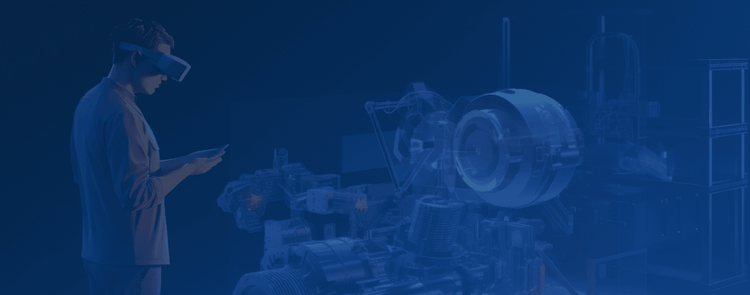


The manufacturing landscape is rapidly evolving, driven by a convergence of revolutionary technologies. As discussed in our previous report, "The Growing Importance of Connected Worker in Manufacturing for Digital Transformation Success" connected worker platforms (CWP) for manufacturing are becoming mainstream, empowering frontline workers with digital tools and addressing key challenges like quality assurance, training, and operational efficiency. This digital transformation, as highlighted in the report, is deeply intertwined with people, processes, and products, making technologies like connected worker platforms "must-have" solutions. But the journey doesn't stop there. The next frontier promises to be even more transformative: the Industrial Metaverse, powered by AI, spatial computing, and digital twins. Just as the consumer metaverse is reshaping customer experience, the Industrial Metaverse has the potential to revolutionize operational excellence in manufacturing.
Connected workers, equipped with handheld and wearable devices, are at the heart of this transformation. They represent the "people" perspective in the digital transformation of manufacturing, connecting them seamlessly to processes and products. Connected Worker Platforms (CWP) for Manufacturing, as detailed in our earlier report, facilitate the digitization of work instructions and inspections, boosting efficiency and compliance. But the future holds even greater possibilities.
Over the next 5-10 years, manufacturing will be defined by several key characteristics, each amplified by deeper AI/ML integration. These include additive manufacturing, automation and robotics, the circular economy, cybersecurity, human-machine collaboration, personalized production, skills transformation, smart factories, supply chain resilience, and sustainable practices. AI is already streamlining form creation, automating work instructions, accelerating training content creation, enabling adaptive learning, improving UI/UX, enhancing AR, driving predictive analytics, and bolstering safety and quality control.
The Industrial Metaverse is emerging as a game-changer. Within this virtual realm, workers interact with digital twins of machines, products, and entire factory layouts. This enables virtual prototyping, remote collaboration, immersive training, and predictive maintenance, leading to faster problem-solving and real-world impact. Imagine a remote expert guiding a technician through a complex repair using a virtual pointer within a 3D scan of a machine – this is the power of the Industrial Metaverse. Or consider a global apparel manufacturer simulating factory shutdowns or new equipment introductions within a virtual environment, minimizing disruption and optimizing investments.
Digital twins are fundamental to the Industrial Metaverse. They exist across product, production, and performance domains. Product digital twins enable virtual design, production twins verify manufacturing processes, and performance twins provide real-time monitoring and analysis, driving efficiency improvements. Digital twins bring realism to the virtual world, mirroring real-world objects and their behaviors.
Spatial computing, driven by advancements in AR/VR/MR, adds another layer of depth. It allows computers to interact with 3D data in a natural way, mirroring human perception. Consider motion analytics: cameras capture manufacturing processes, and the data is mapped into a 3D space, allowing experts to analyze and optimize workflows.
Wearable technology completes the connected worker ecosystem. Smart PPE, sensors, and wearables enhance worker safety and productivity in challenging environments. Smart clothing and exoskeletons further augment worker capabilities, comfort, and safety.
The consumer metaverse has demonstrated the power of deep engagement, fostering creativity and innovation. Manufacturing is now poised to follow suit. The Industrial Metaverse offers a profound opportunity to enhance operational, manufacturing, and supply chain processes throughout a product’s lifecycle. It's a strategic shift that will crack new business potential across sectors.
Working within the Industrial Metaverse means recreating the feeling of being on-site, enabling next-level design, simulation, testing, training, and even remote operations. It fosters richer collaboration and empowers interaction with machinery, assets, and environments, regardless of location. The Industrial Metaverse isn't just a technological advancement; it's a new way of working, a new way of thinking, and a new way of achieving operational excellence. CWP for Manufacturing and Connected Worker Platforms are key to explore the full potential of this transformation. The future of manufacturing is connected, it's intelligent, and it's immersive. It's time to embrace the Industrial Metaverse and unravel its transformative potential.
Author: Narayan Gokhale , Vice President & Principal Analyst - Research & User Consulting at QKS Group