

11.09.2026
QKS Insight
Beyond Industry 4.0: What Does Manufacturing Transformation Really Mean?
Author:
Narayan Gokhale


The Manufacturing Transformation Paradox
Manufacturers have spent more than a decade investing in technologies associated with Industry 4.0: Industrial IoT, Automation and robotics, MES and MOM, Cloud, Analytics, Digital Twins, AI, Connected workers, Industrial data platforms
These investments have undoubtedly changed manufacturing.
Machines are more connected.
Operations are increasingly visible.
Data is more accessible.
Decisions are becoming increasingly intelligent.
Yet a fundamental question remains: Has manufacturing actually transformed or have manufacturers simply become better at using technology?
This distinction is becoming increasingly important.
A manufacturer can have a highly automated factory and still struggle with productivity.
It can have enormous amounts of industrial data and still struggle to make timely decisions.
It can have successful AI pilots and still struggle to scale them across plants.
And it can have a sophisticated digital architecture while its underlying processes and operating model remain largely unchanged.
This is the Manufacturing Transformation paradox.
From Digitalization to Transformation
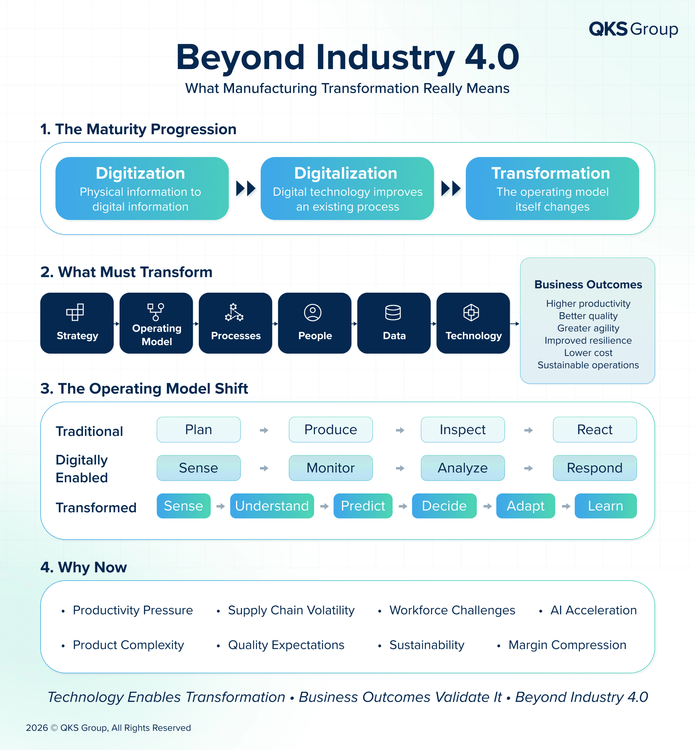
There is an important progression:
- Digitization: Converting physical information into digital information.
(Paper work instruction → Digital work instruction)
- Digitalization: Using digital technologies to improve an existing process. (Manual production monitoring → Real-time digital monitoring)
- Transformation: Fundamentally changing how the organization operates and creates value (Reactive production management → Predictive and adaptive operations)
The first two can improve efficiency.
The third changes the operating model itself.
That is where QKS believes the next phase of Manufacturing Transformation needs to focus.
QKS POV: What is Manufacturing Transformation?
QKS defines Manufacturing Transformation as the fundamental evolution of a manufacturing enterprise's strategy, operating model, processes, people, data and technology to create measurable improvements in business performance and its ability to continuously adapt.
What Does the Manufacturing Enterprise Need to Transform?
1. Strategy: What does manufacturing need to achieve for the business? (Examples: Cost leadership, Faster time-to-market, Greater flexibility, Resilience, Sustainability)
2. Operating Model: How should manufacturing be organized to achieve those objectives?
3. Processes: How should production, quality, maintenance, planning, inventory and other operations work?
4. People: What roles, skills, decision rights and ways of working are required?
5. Data: What information is required to make manufacturing visible, intelligent and increasingly predictive?
6. Technology: What technologies enable the required capabilities?
7. Business Outcomes: Ultimately: HIGHER Productivity , Throughput, Quality / FPY (First Pass Yield), Agility, Resilience, LOWER Cost, Waste / Energy
This is the important distinction: Technology enables transformation. Business outcomes validate transformation.
Smart Factory ≠ Manufacturing Transformation
The term Smart Factory is often used almost synonymously with Manufacturing Transformation.
QKS believes they should be distinguished.
A Smart Factory typically emphasizes: Connected assets, Automation, Real-time monitoring, Data, Analytics, AI, Intelligent equipment
Manufacturing Transformation is broader.
It asks: How should the entire manufacturing enterprise operate differently because these capabilities now exist?
For example:
Traditional: Plan → Produce → Inspect → React
Digitally enabled: Sense → Monitor → Analyze → Respond
Transformed: Sense → Understand → Predict → Decide → Adapt → Learn
The last stage represents a fundamentally different operating model.
Why Manufacturing Transformation Matters Now
Manufacturing leaders are facing several simultaneous pressures:
1. Productivity pressure: Higher costs and margin pressure require continuous productivity improvement.
2. Product and demand complexity: More products, variants, customization and shorter product cycles increase manufacturing complexity.
3. Supply-chain volatility: Manufacturing needs to respond more rapidly to supply disruption and changing availability.
4. Quality expectations: The cost of defects, recalls, warranty and rework continues to increase.
5. Workforce challenges: Manufacturers need to address skills shortages, knowledge transfer and changing workforce expectations.
6. Sustainability: Energy, waste, emissions and resource efficiency are increasingly business priorities.
7. AI acceleration: AI creates an opportunity to fundamentally change how manufacturing decisions are made—but also creates the risk of another wave of disconnected pilots.
The Technology Trap
One of the biggest risks is approaching transformation through technology.
The conversation often starts with: "Where can we use AI?" or "Do we need an industrial data platform?" or "Should we modernize our MES?"
QKS believes the better sequence is:
Business Outcome à Capability Gap à Process Change à Data Requirement à Technology à Measurable Value
For example:
Reduce unplanned downtime: Need predictive maintenance capability à Change maintenance decision process à Integrate asset, maintenance and production data à AI / analytics / IIoT / APM technologies. This leads to higher availability and lower maintenance cost
The technology is important. But it comes after understanding the business problem.
The New Manufacturing Transformation Agenda
The first generation of Industry 4.0 largely focused on: Connect → Automate → Monitor
The next phase should increasingly focus on: Understand → Predict → Optimize → Adapt
And eventually: Autonomous decision-making with human oversight
This means the manufacturing enterprise gradually moves from: Reactive ("What happened?") à Predictive ("What is likely to happen?") à Prescriptive ("What should we do?")à Adaptive ("How should the operation change?")à Increasinglyautonomous ("Can the system execute the appropriate response?")
The QKS Manufacturing Transformation Principle
Manufacturing Transformation should not be measured by how much technology a manufacturer deploys, but by how fundamentally and measurably the enterprise improves the way it operates.
The real question for the Manufacturing CXO is therefore not: "What technology should we implement next?" but: "What should our manufacturing enterprise be capable of doing tomorrow that it cannot do today?"
That is where Manufacturing Transformation begins.
Author: Narayan Gokhale, Vice President & Principal Advisor at QKS Group