

18.07.2025
QKS Insight
Benchmarking Intelligence: Introducing the QKS AI Maturity Matrix for PPM Vendors
Author:
Ashray Gadekar
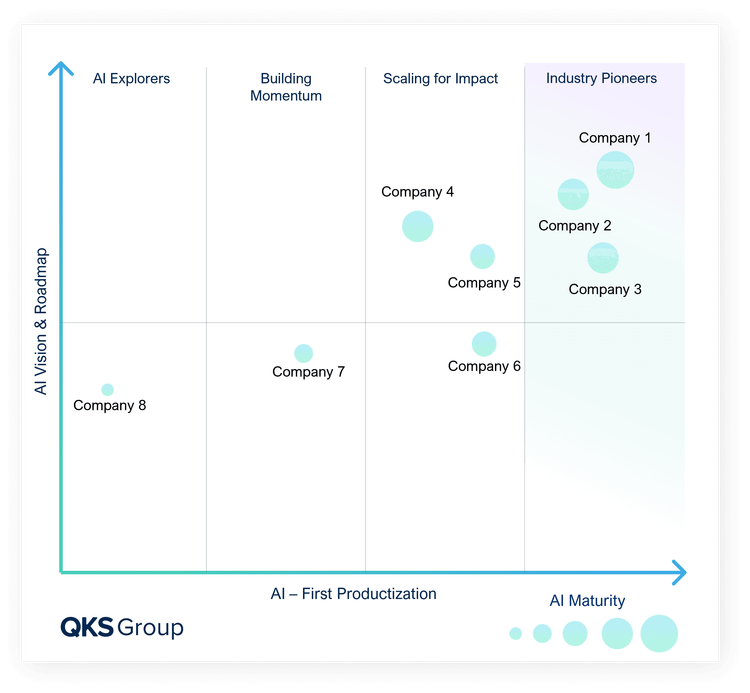


In the evolving narrative of enterprise agility, Project Portfolio Management (PPM) is undergoing a profound transformation. Once a discipline rooted in status tracking and budget control, PPM is fast becoming the central nervous system of strategic execution. Yet this shift isn’t being powered by dashboards or workflows alone, it’s being driven by intelligence.
At QKS Group, we are observing a growing recognition among enterprise leaders that AI is no longer a futuristic add-on in PPM platforms. It is the defining layer that enables real-time sense-making, decision augmentation, and intelligent orchestration across the project portfolio. But awareness alone is not enough. The market now requires a structured understanding of what constitutes true AI maturity and how vendors stack up in this new landscape. To address this, we’ve developed the QKS AI Maturity Matrix for PPM, a benchmark that reflects where vendors truly stand in enabling the future of project and portfolio execution.
Understanding the Foundation: What PPM Platforms Really Do
At their essence, Project Portfolio Management (PPM) platforms provide a centralized environment where organizations can assess, plan, and govern their project portfolios in alignment with strategic priorities. These systems consolidate information from across the enterprise throughout the projects, programs, financials, and resources, allowing decision-makers to manage capacity, track performance, and measure value delivery.
In the traditional model, PPM platforms acted as control towers, monitoring initiatives and surfacing key metrics to PMOs and leadership. The focus was on enabling standardized reporting, ensuring compliance with governance frameworks, and optimizing for on-time and on-budget delivery. However, as enterprise ecosystems have become more distributed, and the pace of change more accelerated, this retrospective, status-driven approach is falling short of business needs.
Why PPM Now Needs Intelligence at Its Core
The limitations of conventional Project Portfolio Management (PPM) models are increasingly apparent. Decision-making based on past performance no longer ensures future readiness. Enterprises today are grappling with overlapping dependencies, dynamic resourcing constraints, shifting strategic objectives, and external market volatility.
AI offers a paradigm shift by enabling PPM platforms to move from static oversight to cognitive orchestration. Instead of merely visualizing project health, AI allows platforms to interpret data in context, predict outcomes, simulate scenarios, and recommend decisions.
AI transforms PPM into a responsive, forward-looking layer by integrating machine learning models, generative simulation engines, and contextual data pipelines. It allows organizations to ask higher-order questions: What initiatives should we fund to maximize impact? Where are our resource bottlenecks likely to emerge next quarter? What strategic trade-offs can deliver the most enterprise value?
The Strategic Implications of AI-Driven PPM Platforms
The infusion of AI into PPM is redefining how enterprises execute strategy. No longer limited to Gantt charts and milestone tracking, modern platforms are emerging as cognitive partners to business leaders.
As project delivery becomes increasingly cross-functional and multi-dimensional, AI enhances the precision and velocity of decision-making. For instance, a financial controller can assess capital efficiency of ongoing initiatives in real-time. A PMO leader can model the impact of shifting a critical resource. A portfolio executive can run simulations to evaluate different investment prioritization strategies under constrained budgets.
The shift from systems of record to systems of recommendation indicates that PPM is no longer just operational infrastructure. It is becoming a strategic instrument, capable of guiding the enterprise through complexity and enabling more adaptive, value-centric decision frameworks.
Organizations that embed AI into their portfolio management workflows are realizing significant advantages. These include improved time-to-decision, better resource utilization, more resilient planning cycles, and higher portfolio throughput. In regulated industries such as healthcare or energy, where compliance and traceability are paramount, AI also brings the added dimension of contextual intelligence, ensuring not just speed, but correctness in strategic response.
Why the QKS AI Maturity Matrix Is Critical for the PPM Market
While the demand for AI in Project Portfolio Management (PPM) is clear, the supply side remains fragmented. Most vendors are now marketing “AI features”, yet few have operationalized AI at the architectural level. Many implementations remain limited to natural language chat interfaces or isolated forecasting models that lack enterprise integration.
At QKS Group, we believe that AI maturity cannot be assessed by feature count or marketing claims. It must be measured by how deeply AI is woven into a platform’s data fabric, decision engines, and orchestration layers. The QKS AI Maturity Matrix for PPM addresses this gap.
This framework segments vendors into four levels of AI maturity, ranging from initial experimentation to enterprise-wide intelligence enablement. It evaluates how platforms support predictive modeling, simulation, intelligent resourcing, and decision automation across diverse project portfolios. Importantly, it links technical sophistication with user outcomes assessing not just what AI is embedded, but what it enables.
For technology buyers, this matrix offers clarity. It becomes a tool to identify platforms that align with current needs while offering a roadmap to future intelligence. A mid-market organization, for example, may benefit from a Stage 2 platform with foundational predictive features. Meanwhile, a transformation-intensive enterprise may require a Stage 4 system that supports real-time portfolio steering and strategic foresight.
For vendors, the matrix provides a strategic blueprint. It helps product leaders benchmark themselves against peers, identify architectural gaps, and evolve toward an AI-native operating model. More importantly, it allows them to shift the conversation from capabilities to outcomes, from “What does your platform track?” to “What decisions can it empower?”
Looking Forward: AI as the Decision Layer of Enterprise Execution
As organizations continue to evolve toward more adaptive, outcome-driven operating models, the role of Project Portfolio Management (PPM) will become even more central. Without intelligence, even the most integrated platform becomes a bottleneck.
The next wave of innovation in PPM will not be defined by UI enhancements or feature expansion, it will be defined by the ability to simulate, optimize, and orchestrate at scale.
The QKS AI Maturity Matrix for PPM is designed to reflect this reality. It provides a rigorous, transparent, and actionable framework for evaluating the real intelligence of portfolio platforms. In a market crowded with claims, it helps both buyers and vendors anchor their strategies in credibility, capability, and clarity.
To explore the QKS AI Maturity Matrix for PPM or inquire about your platform’s evaluation, contact nikhileshn@qksgroup.com or ashrayg@qksgroup.com . If your platform aspires to be more than a dashboard, if it aims to be a decision engine, this is your benchmark to lead with purpose.
Author: Ashray Gadekar, Analyst at QKS Group