

24.10.2025
QKS Insight
AI-First Product Management: The Shift Toward Autonomous Decision Systems
Author:
Ashray Gadekar
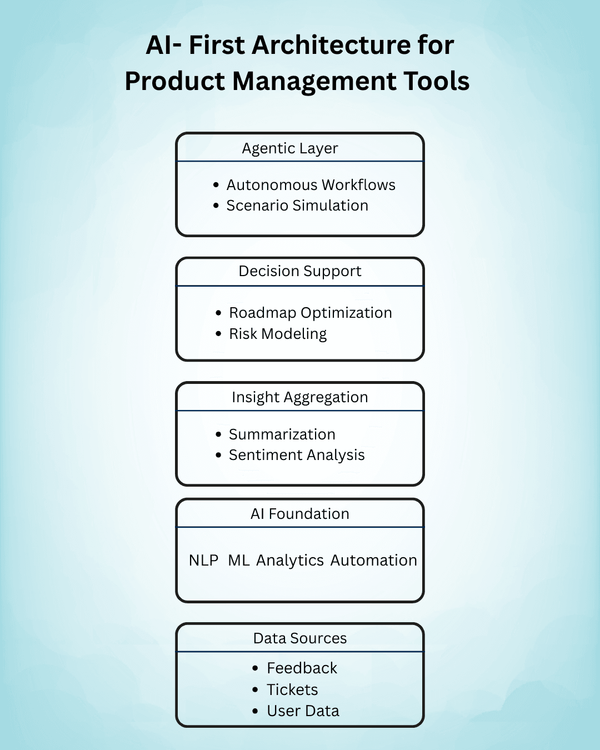


Introduction: The Role of Product Management and AI Impact
Product management has always been about bridging strategy with execution ensuring that customer needs, market signals, and organizational goals align in a roadmap that drives measurable outcomes. Traditionally, this required product managers (PMs) to operate as information integrators: aggregating feedback from customers, analyzing competitive landscapes, drafting requirement documents, and aligning stakeholders. While this work is critical, much of it is labour-intensive, repetitive, and prone to bias or human delay.
Artificial Intelligence is redefining this paradigm by introducing automation, augmentation, and intelligence layers across the product lifecycle. AI-driven clustering, summarization, and sentiment analysis tools now process massive volumes of customer feedback and generate prioritized insights within hours. Natural Language Processing (NLP) models can draft structured epics, acceptance criteria, and even release notes, while predictive models support scenario planning and roadmap optimization. More advanced systems embed agentic capabilities such as autonomous workflows that can triage tickets, suggest backlog prioritization, or simulate business outcomes with minimal human intervention.
AI in Product Management: Before vs After
1. Customer Discovery & Feedback Analysis
Before AI: Product managers relied on manual methods such as surveys, one-on-one interviews, and quarterly reports from support teams or sales. The data was silo ed across CRM, helpdesk, and spreadsheets, requiring days or weeks of manual collation. Insights were often reactive, delayed, and biased toward the loudest customers or largest accounts. Pattern recognition across geographies or segments was limited, and weak signals (e.g., emerging issues in smaller regions) were often overlooked.
After AI: AI-powered discovery engines ingest feedback streams in real time support tickets, chat logs, call transcripts, NPS surveys, and even public reviews. Natural Language Processing (NLP) clusters similar feedback into themes, applies sentiment analysis, and highlights trending pain points across cohorts. Machine learning models detect weak but rising signals (e.g., early adoption blockers in a niche market) that humans might miss. The result is faster and more balanced discovery that reduces bias and enhances strategic responsiveness.
2. Backlog Grooming & Hygiene
Before AI: Grooming was highly manual as PMs had to read through each ticket, resolve duplicates, and create consistent tagging. Ambiguous user inputs (“it’s slow” or “login doesn’t work sometimes”) remained unstructured, requiring multiple clarification rounds with engineering. The backlog often grew cluttered, slowing prioritization and creating noise for developers. Grooming meetings could consume several hours weekly.
After AI: AI systems now deduplicate issues automatically, detect semantic similarity, and consolidate them into unified backlog items. NLP rewrites vague feedback into structured user stories with acceptance criteria, while maintaining original context for traceability. Classification algorithms auto-tag items into consistent taxonomies (e.g., feature requests vs. defects, performance vs. UX). This results in cleaner, structured backlogs that improve downstream planning and execution velocity.
3. Prioritization & Roadmapping
Before AI: Prioritization frameworks were built on static models like RICE or weighted scoring, maintained in spreadsheets or standalone tools. These models required manual updates and often relied heavily on subjective stakeholder inputs. Scenario testing (e.g., shifting features between quarters) was cumbersome, and dependencies were manually tracked across complex Excel sheets or Gantt charts.
After AI: AI-driven prioritization engines calculate impact/effort scores dynamically by integrating multiple datasets (usage analytics, customer ARR impact, technical complexity). Predictive models simulate roadmap scenarios instantly, showing trade-offs such as revenue impact or delivery risk when shifting priorities. Dependency graphs are auto generated, and probabilistic models assess delivery feasibility. PMs spend less time calculating and more time validating scenarios, leading to more evidence-based roadmap planning.
4. Documentation & Communication
Before AI: Drafting PRDs, epics, and release notes was labour-intensive. PMs spent hours structuring documents, refining narratives, and tailoring updates for stakeholders. Release communication required manual drafting across different formats such as emails for customers, wiki updates for internal teams, and decks for executives. This repetitive writing slowed cycle time and diluted focus on strategy.
After AI: Generative AI tools create first drafts of PRDs, epics, and acceptance criteria in seconds, trained on organizational templates and tone. AI generates multiple communication formats from the same content: a customer-facing changelog, an internal executive summary, and a developer-focused Jira ticket description. Summarization engines also generate meeting notes and status updates automatically, ensuring consistency and reducing manual overhead. PMs shift from “document creators” to “document reviewers and strategists.”
5. Product Analytics & Experimentation
Before AI: PMs depended on data analysts for insights. Requests involved writing SQL queries, exporting dashboards, and waiting for interpretation. Anomalies (e.g., sudden churn in a specific segment) often went unnoticed until scheduled reviews. Hypothesis generation for A/B testing required brainstorming and lengthy validation cycles. Decision-making was reactive and lagged customer behavior.
After AI: AI-enhanced analytics platforms proactively monitor product metrics and flag anomalies in real time (e.g., increased drop-offs at a checkout step). Models automatically segment users (by geography, device type, customer tier) and highlight statistically significant differences. AI agents transform analytics into actionable recommendations, enabling faster iteration and data-driven experimentation.
6. Strategy & Long-Term Planning
Before AI: Scenario planning and forecasting were manual exercises in Excel or specialized tools, with limited agility. Roadmaps were updated quarterly or annually, reflecting static assumptions. Aligning strategy with execution often lagged due to slow data refresh cycles, human error, and complexity in modeling large portfolios.
After AI: AI enables dynamic strategy modeling. Predictive engines simulate multiple roadmap futures. Machine learning optimizes resource allocation across portfolios, balancing capacity, cost, and revenue projections. AI agents provide real-time recommendations to adjust roadmaps based on emerging signals from customer behavior, competitor moves, or internal resourcing. The strategic layer becomes adaptive rather than static, shifting product management toward continuous portfolio orchestration.
Current Functionalities in the Market
Current AI-powered product management platforms emphasize three broad categories of capability:
- Insight Aggregation & Discovery: Automated clustering of multi-channel feedback, real-time trend surfacing, and context-driven sentiment analysis.
- Execution Enablement: Automated ticket grooming, backlog deduplication, acceptance criteria generation, and story rewriting into structured formats.
- Decision Support & Forecasting: AI-driven prioritization engines that simulate multiple roadmap outcomes, predict delivery risks, and quantify potential business impact.
- Communication & Narrative Acceleration: Automated drafting of PRDs, release notes, stakeholder updates, and even executive-level summaries tailored to audience context.
- Proactive Analytics: Early-warning anomaly detection, automated hypothesis generation for experimentation, and segmentation insights without reliance on static dashboards.
- Agentic Extensions (Emerging): Early prototypes where AI autonomously updates boards, nudges stakeholders, and rebalances priorities as inputs shift.
Conclusion & Outlook
AI has moved product management from an era of manual information wrangling to one of automated intelligence orchestration. The shift is not about replacing PMs but elevating their role: from backlog administrators and document authors to strategic decision-makers and market shapers. The immediate value lies in productivity gains and faster insight-to-decision cycles. The medium-term outlook is more transformative: AI agents capable of real-time roadmap adjustment, automated risk modeling, and continuous feedback integration could make product management a continuously adaptive function rather than a periodic planning discipline.
Over the next 24–36 months, we are expecting the market to converge on embedded AI-first product management platforms where AI is not an add-on but a native core capability. The PM function will increasingly rely on AI not just for speed, but for scope expansion: managing larger data sets, simulating complex multi-scenario outcomes, and enabling organizations to move from reactive roadmapping to proactive product orchestration.
Author: Ashray Gadekar, Analyst at QKS Group